Last updated 2026-08-21
TL;DR
Bounce house rental is a local service that delivers, sets up, and takes down an inflatable for a paid event. There is no national bounce house license. You form a business, get an EIN if needed, buy insurance venues accept, meet state amusement-ride or city rules, and keep ops and weather notes. Confirm every fee and form with the board that issues the permit.
What is bounce house rental?
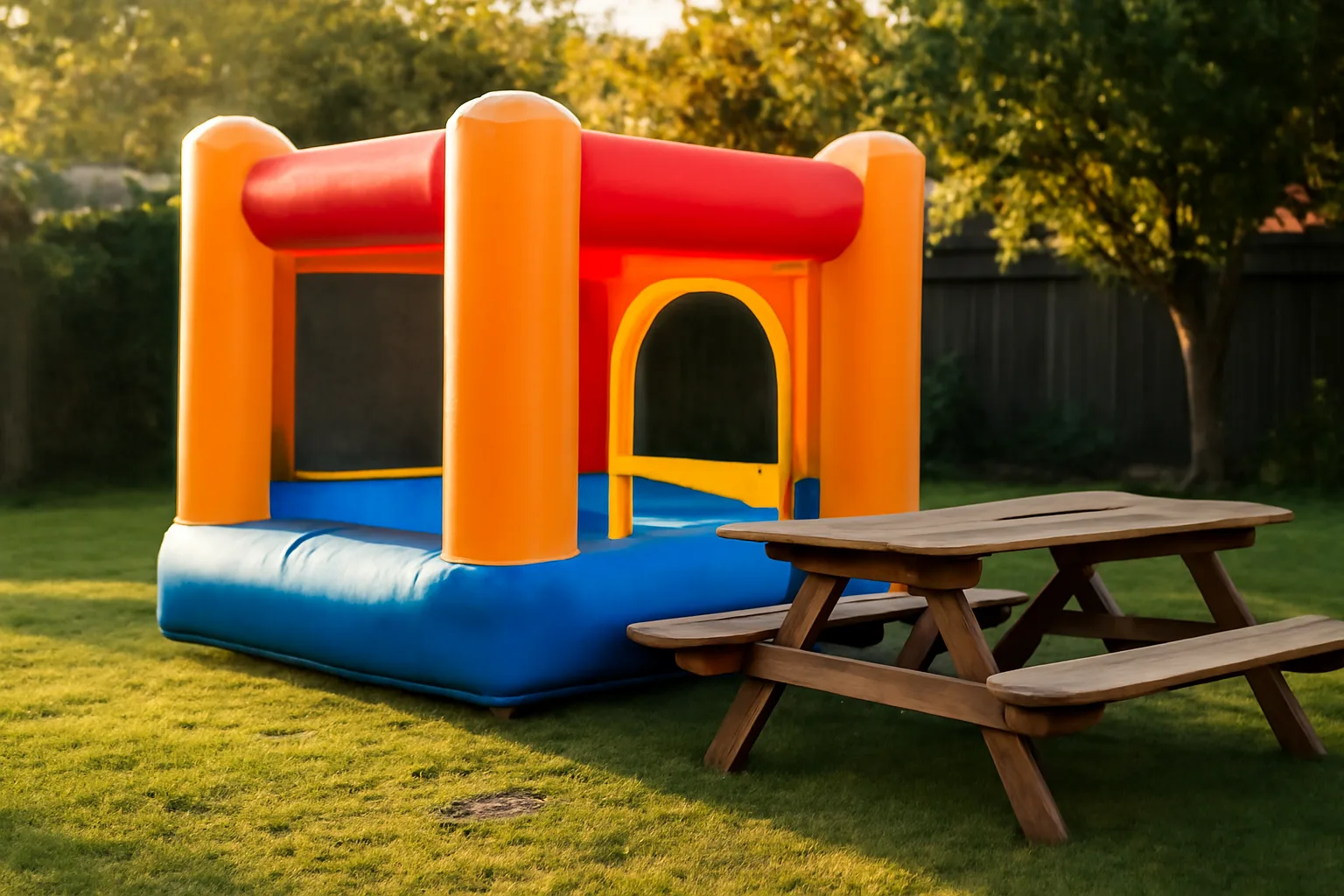
Bounce house rental is a paid local service. You own or lease inflatable amusement devices, haul them to a yard or venue, stake or weight them, run a blower, then take the unit down when the clock stops. The customer pays for the unit, the delivery window, and the fact that you carry the insurance and the setup duty.
It is not a franchise kit. It is not a federal license trade. Most jobs are birthdays, school carnivals, church picnics, and corporate family days. Some operators stay with the unit the whole time. Some drop it and leave if the contract and the insurer allow that. Parks and schools usually do not allow an unattended unit. Ask before you quote a drop-off price.
The product is an inflatable amusement device, not a toy you found in an aisle. ASTM International publishes F2374 as the practice covering design, manufacture, operation, and maintenance of those devices [10]. Manufacturers and many underwriters point at that standard. A city party ordinance is a different piece of paper.
People mix this up with general party rental. Tables and chairs sit still. A bounce house moves, holds children, and fails in wind. Billock and colleagues estimated 64,657 U.S. pediatric emergency visits for inflatable bouncer injuries from 1990 to 2010 (Pediatrics, 2012) [9]. That figure is why a parks department wants a certificate of insurance before they hand you a gate code.
You can stage this from a garage if zoning and your HOA allow it. You still need a way to dry wet vinyl, keep it clean, and stop blowers and stakes from walking off. A $200 backyard inflatable is not a rental fleet. Many insurers will not schedule that class of product. I would not put one on a paying job.
How do you start bounce house rental?
You start bounce house rental on paper, then you buy vinyl. Form a business your state recognizes, get an Employer Identification Number if you need one, open a bank account in that name, and buy liability insurance a venue will accept. Then you ask your state ride board or city clerk whether the inflatable needs a permit. Only after that do you take a deposit.
Skip the vinyl first. The order saves you from owning a unit you cannot legally set on a school lawn.
"Applying for an EIN is a free service offered by the Internal Revenue Service. Beware of websites on the Internet that charge for this free service." That sentence is on the IRS EIN application page [1]. File on IRS.gov. Do not pay a random site for a number the Service issues at no charge.
Pick a structure with the tax and liability tradeoff in mind. The U.S. Small Business Administration walks through sole proprietorships, partnerships, LLCs, and corporations on its structure guide [3]. I would not stay a bare sole proprietor once kids are jumping on something I own. That is a judgment, not a statute.
If you pay weekend help, read who counts as an employee. Department of Labor Wage and Hour Division Fact Sheet 13 explains the employment relationship under the Fair Labor Standards Act [11]. Paying a cousin in cash and calling it a favor can still be wage-hour work. Keep that clean from day one.
The injury load is why this sequence matters. Pediatrics published the 64,657 estimate for 1990 to 2010, with a 95 percent confidence interval from 32,420 to 96,893 [9]. You do not need a national myth to take that seriously. You need a policy, a contract, and a setup you can defend if someone asks what you did on site.
Is there a national bounce house rental license?
There is no national bounce house rental license in the United States. The IRS can issue an EIN [2]. Your state can register an entity and a sales-tax account. A city can require a business license or a home-occupation permit. A ride board can require an amusement permit. None of those is a federal bounce house card.
People still talk like there is one number you call in Washington and then you are "licensed." That story wastes a month. What exists is a stack of ordinary business paper plus, in some states, amusement-ride rules that were written for carnivals and now get applied to inflatables.
Federal paper is thin on purpose. You may need an EIN to open a bank account or hire staff [12]. You file income tax. If you have employees, OSHA's general duty clause still applies. Section 5 of the OSH Act says each employer shall furnish employment "which are free from recognized hazards that are causing or are likely to cause death or serious physical harm to his employees" [5]. That is about your crew, not a bounce house license.
State and city paper is where operators actually get stuck. One county wants a vendor permit for a festival. The next town wants proof of workers' comp even if you work alone. A school district wants additional-insured wording your policy does not have yet. Confirm each of those with the office that issues the slip. Nobody can honestly publish a single national fee or wait time that stays true next month.
What business paper do you file first?
File the identity paper before you print yard signs. That means an entity your state recognizes, an EIN if you need one, a business bank account, and a sales-tax account if your state taxes rental of tangible personal property. Then buy insurance. Then ask the city clerk about a local license. The vinyl comes after the account can accept a deposit without mixing it into grocery money.
The SBA tax-ID guide is a plain map of federal versus state numbers [12]. The IRS EIN page is the actual filing door, and it is free on IRS.gov [1]. State entity fees change. I will not invent yours. Confirm the current amount with the secretary of state or business filing office.
IRS Publication 334 is the small-business tax guide most sole proprietors and single-member LLCs actually use for deductions and records [13]. Truck mileage, advertising, policy premiums, and repairs live there. Keep receipts as you go. Do not wait until April to reconstruct a season of blower fuel.
A simple stack looks like this. Adjust it to the offices that actually touch your address.
| Layer | What you usually handle | Who confirms it |
|---|---|---|
| Federal | EIN, income tax, employment taxes if you have staff | IRS [1][13] |
| State | Entity, sales or rental tax, amusement-ride permit if the statute reaches inflatables | Secretary of state, revenue department, ride board |
| City or county | Business license, home-occupation, festival vendor slip | City clerk or county licensing |
| Job site | Certificate of insurance, park or school permit, additional insured | Venue, parks department, district risk office |
I would not spend money on a trademark search or a fancy operating agreement in month one unless a partner is putting in cash. Get bankable and insurable. The rest can wait until you have a calendar that needs it.
What insurance do venues actually ask for?
Venues ask for a certificate of insurance that names them as additional insured, states general liability limits they already wrote into a facility packet, and matches the date and address of the event. Many school and park packets ask for $1 million per occurrence. Some ask for $2 million. That is a venue rule, not a federal bounce house law. Confirm the wording with the risk office that will reject you at the gate.
The SBA insurance guide lists general liability as a common policy type and tells you to match coverage to how you actually operate [4]. A policy that excludes amusement devices is waste paper. Read the exclusions. If the form will not schedule an inflatable, keep shopping.
If your state treats the unit as an amusement ride, the statute may set a floor. Texas Occupations Code Chapter 2151 is the amusement-ride chapter. It requires inspection and liability insurance, and the dollar floors differ by ride class [6]. Read the current class definitions against your units. Do not assume a number you heard in a Facebook group is the statutory amount.
I would not take a paying job on a personal homeowner policy. Those forms usually exclude business use. I also would not buy the cheapest binder that cannot issue additional-insured certificates in 24 hours. Parks do not wait on your agent to "see what they can do."
For the certificate details venues keep rejecting, read what a COI has to show and how additional insured wording fails. If you add employees or subcontractors later, the gaps change. That is a separate insurance problem, not something you fix with a Facebook post.
Which states treat bounce houses as amusement rides?
Some states put inflatables under amusement-ride statutes. Some leave them to cities. A few sit in a gray zone until an inspector decides your unit counts. There is no trustworthy public matrix that stays current for all 50 states. Confirm with the agriculture department, labor department, or ride board that actually writes the permit in your state.
Florida Statute 616.242 is the safety-standards statute for amusement rides [7]. If you operate in Florida, read whether your inflatable is in scope and what annual permit and inspection language applies. I will not invent the current fee. Confirm it with the Florida Department of Agriculture and Consumer Services program that administers that statute.
Ohio Revised Code 1711.53 is the permit section a lot of ride operators hit first [8]. Read the definitions in that chapter against the units you own. If you are in scope, you do not get to skip the permit because the job is "just a backyard birthday."
Texas Occupations Code Chapter 2151 is the parallel chapter in Texas, with inspection and insurance duties tied to ride class [6]. Again, class is a statutory definition. It is not your marketing name for the unit.
Other states may use labor departments, fire marshals, or nothing at the state level. City special-event rules can still stop you even when the state is quiet. Call the board. Get the form name. Write down the date you called. That note is worth more than a blog that pretends the country has one rule.
What equipment and ASTM rules apply?
Buy commercial inflatable amusement devices built to be rented, not backyard toys. Pair each unit with the blower the manufacturer specifies, ground stakes or water barrels that match the manual, a GFCI on the cord, and a way to measure wind on site. ASTM F2374 is the named practice for design, manufacture, operation, and maintenance [10]. Buy the current standard from ASTM. Do not run on a photocopy of an old excerpt.
I would start with one or two mid-size units you can dry, patch, and load alone. A 15-unit fleet in month one is how people end up with moldy vinyl and a policy they cannot pay. Used commercial units can be fine if you can inspect seams, step-pads, and anchor points, and if the insurer will schedule them. Used big-box toys are a waste.
Keep the manufacturer manual in the truck. If the manual says no shoes, no flips, and a maximum occupancy, that language should also sit in your contract. When a claim comes, people ask what rule you posted and whether you followed your own paper.
I keep an ASTM-style pre-use check and a weather log with the stakes. You can build that packet from F2374 and a notebook. InflatablePath also publishes a $149 one-time ASTM + Weather Kit if you want the forms already assembled. Either path is fine. The standard is the source. The kit is just paper.
Trailers are optional on day one if the unit fits in a van and you can keep it clean. A cheap open trailer that grinds vinyl on rusted rails will cost more than it saves. No CDL is required for most single-axle setups under ordinary state GVWR rules, but you confirm that on the trailer plate and with your DMV. Do not guess from a forum.
How much money do you need to start?
Nobody publishes a solid national average for bounce house rental startup cost that I would trust. The pile is one or two commercial units, blowers, stakes or weights, a way to haul them, entity and license fees, and the insurance down payment. Those lines move by manufacturer, state, and whether you already own a truck.
I will not invent a starter budget and pretend it is research. Entity filing fees are set by each secretary of state and change. Insurance deposits depend on claims history, limits, and whether the form treats you as an amusement risk. Confirm both. A used commercial unit can cut the vinyl line. It does not cut the insurance line.
What I would not fund: six cheap consumer inflatables, a vinyl banner, and no policy. Parks will not book you. A claim on a backyard toy can follow you. Spend first on a unit an underwriter will schedule and on a policy that can issue certificates.
Cash flow is lumpy. Spring weekends pay. January does not. Keep a reserve for patches, a second blower, and the week a tropical storm cancels the calendar. Pub 334 is how you treat those costs at tax time [13]. It is not a loan.
If a lender or a partner wants a number, build a quote sheet from real invoices: unit, blower, trailer, policy binder, filing fee from the state site. That ugly spreadsheet beats a blog range that was made up to look confident.
What do you put in a rental contract?
A bounce house rental contract should state the unit, the address, the start and end time, the surface you will accept, who supervises, whether you stay on site, the weather cancel rule, the deposit, the damage rule, and the adult who signs. Short is fine. Vague is not.
Write the wind and rain rule in the contract so the argument happens before Saturday, not on the lawn. Name the instrument you will trust (a handheld anemometer you carry) and what happens to the deposit if you shut the job down. If you leave that blank, you will eat the fuel and the customer will still be angry.
Occupancy, age mix, shoes, flips, and water belong in writing because they belong in the manual. If you allow a slip-and-slide against a dry unit, you own that choice. I would not.
Parks and schools will add their own facility agreement on top of yours. Their additional-insured demand has to match what your agent can actually issue. If you need help reading those packets, start with venue insurance requirements and why school riders get rejected.
Do not take a booking on a text thread with no signature. A deposit without a contract is a gift. Venmo notes are not terms.
How do weather shutdowns work on a paid job?
You shut the job down when wind, lightning, rain, or ground conditions make the unit unsafe, using a written number and a tool you carry, not a vibe. Read the current wind language in ASTM F2374 and the manufacturer manual [10]. Put your shutdown trigger in the contract. Then use it.
I will not invent a single national miles-per-hour figure and pretend every standard and every manual agree. They do not always. That is why you read the documents you will be asked to produce later.
Carry a handheld anemometer. Take a reading at the site, not from a downtown airport app while you sit in the truck. Soft ground that will not hold stakes is a shutdown even if the air is calm. So is lightning. So is a blower that will sit in standing water.
Tell the customer early when a forecast is ugly. Early cancels keep the relationship. Curb-side fights do not. If you fold because you are tired, that is on you. If you fold because the reading crossed the number in the contract, that is the job.
Photos of stakes, weights, and the anemometer reading belong in the job file. They take 30 seconds. They are the difference between "we were careful" and proof you were careful.
What records should you keep in year one?
Keep a job file that can survive a claim and a tax season. That means the signed contract, the certificate you sent, photos of the setup and anchors, a weather note, a pre-use check, invoices, and repair logs. If you have employees, keep time records that match what the Wage and Hour Division expects [11].
Pub 334 is the IRS small-business guide for how those costs land on a return [13]. You do not need fancy software in year one. You need dates, amounts, and a bank account that is not your personal checking.
If you have staff, OSHA's general duty clause is still in play [5]. Training notes on lifting, electrical cords, and stake-out are dull. Write them anyway. A recognized hazard with no note is a bad fact pattern.
I would photograph every unit after every job for the first season. Tears show up late. So does mold if you rolled a damp bed. A photo timestamp is cheaper than arguing with yourself in November.
For how long to keep claim-related files, follow your insurer and your state. When in doubt, keep the season longer than you want to. Storage is cheap compared with a missing COI. More on that paper trail sits in claim-file habits and what underwriters ask after a loss.
What should you confirm with your board before you advertise?
Confirm the entity name, the local business license, sales-tax collection, amusement-ride scope, and the insurance limits venues in your area actually require. Then advertise. A pretty feed that books a school you cannot legally serve is a mess you made yourself.
Call the ride board or agriculture department and ask whether inflatable amusement devices need a permit at your size and use. Call the city clerk about home-occupation and truck parking. Call the state revenue department about tax on rentals. Write the names of the people you spoke with. Confirm every fee with that office. Fees change. I will not invent yours, and I will not guess a processing time.
No article can promise you will be approved. Boards apply their own statutes. Your job is to read the section that applies and file the form it names. Florida operators start with 616.242 [7]. Ohio operators start with 1711.53 [8]. Texas operators start with Chapter 2151 [6]. Everyone else starts by asking which chapter is theirs.
If you want the ASTM and weather forms in one packet, the kit is on /start. Build the same packet yourself if you prefer. Either way, the board that issues the permit is the source for fees and scope. We publish independent reference material. We are not a law firm and we do not file for you.
Frequently asked questions
What is bounce house rental?
Bounce house rental is a local paid service. You deliver, stake or weight, inflate, and later take down an inflatable amusement device for an event. Customers pay for the unit, the time window, and the insurance and setup duty you carry. It is ordinary party hire plus amusement-device risk, not a federal licensed trade.
How do you start bounce house rental?
Start on paper. Form a state-recognized business, get a free EIN on IRS.gov if you need one, open a business bank account, and buy liability insurance venues will accept. Then ask your ride board or city clerk whether a permit applies. Buy commercial units after that. Taking deposits before you can issue a certificate is how first jobs die.
Do I need an EIN to rent bounce houses?
Many banks and insurers want an EIN even for a single-member shop. The IRS issues EINs at no charge on IRS.gov and warns that other sites charge for that free service. You may also need the number if you hire staff. Confirm with your bank and tax preparer whether your setup needs one before you advertise.
Does every state inspect inflatables?
No. Some states put inflatables under amusement-ride statutes such as Florida 616.242, Ohio 1711.53, or Texas Occupations Code Chapter 2151. Other states leave the work to cities or do not issue a state permit at all. Confirm scope with the board that actually writes permits where you operate. Do not trust a national rumor.
What insurance limit do bounce house rental companies carry?
There is no single federal limit. Many parks and schools ask for $1 million per occurrence, and some ask for $2 million. If a state amusement-ride statute applies, it may set its own floor by ride class. Read the venue packet and the statute. Buy a form that will schedule inflatables and issue additional-insured certificates fast.
Can I start bounce house rental with one unit?
Yes, and I would. One or two commercial units you can dry, patch, and insure beat a pile of consumer toys you cannot put on a policy. Used commercial vinyl is fine if seams and anchors pass inspection and the insurer will schedule it. Add units when weekends are actually full, not when a sales page tells you to.
Do I need a CDL to haul a bounce house?
Most operators hauling one unit on a light single-axle trailer do not need a CDL. The trigger is usually combined weight ratings on the truck and trailer plates, plus your state DMV rules. Read the GVWR sticker. Confirm with the DMV. Do not take a forum's word for a weight class.
What wind speed shuts down a bounce house rental?
Use the figure in the current ASTM F2374 language and in your manufacturer manual, then write your trigger in the contract. Manuals do not all match, so a single national number is a myth. Carry an anemometer and measure at the site. Soft ground that will not hold stakes is also a shutdown.
Are used bounce houses a bad idea?
Used commercial units can be a good buy if you inspect seams, step-pads, blowers, and anchors, and if an insurer will schedule them. Used big-box backyard toys are a bad idea for paid rental. Many policies will not cover that class, and parks will not take the risk. Cheap vinyl is expensive when a claim arrives.
Do I charge sales tax on bounce house rental?
Many states tax the rental of tangible personal property, which can include inflatables. Some exempt certain nonprofit or school jobs. Some cities add their own tax. Confirm with your state revenue department before you print a rate card. If you should collect and you do not, the back tax is yours.
Can I run bounce house rental from my house?
Sometimes. Zoning, home-occupation rules, truck parking, and HOA covenants decide it, not a national small-business slogan. Ask the city clerk before you store vinyl in the garage and park a trailer on the street. A neighbor complaint is a real first-year problem. Get the rule in writing.
What is ASTM F2374?
ASTM F2374 is ASTM International's standard practice for the design, manufacture, operation, and maintenance of inflatable amusement devices. Insurers and manufacturers point at it. Buy the current version from ASTM and keep a pre-use check that matches it. It is not a government license, and owning a copy does not replace a state permit.
Sources
- IRS, Apply for an Employer Identification Number (EIN) Online: The IRS provides EIN application as a free service on IRS.gov and warns that other websites charge for that free service.
- IRS, Employer ID Numbers: An EIN is the IRS nine-digit number used to identify employer and certain other tax accounts.
- U.S. Small Business Administration, Choose a business structure: SBA outlines sole proprietorship, partnership, LLC, and corporation as the common legal structures for a new U.S. business.
- U.S. Small Business Administration, Get business insurance: SBA lists general liability as a common policy type and advises matching coverage to actual operations.
- OSHA, OSH Act Section 5 Duties: Section 5 requires each employer to furnish employment free from recognized hazards likely to cause death or serious physical harm.
- Texas Occupations Code Chapter 2151, Regulation of Amusement Rides: Texas Chapter 2151 regulates amusement-ride operation and ties inspection and liability insurance duties to statutory ride classes.
- Florida Senate, Florida Statute 616.242 (2023): Florida Statute 616.242 sets safety standards, permit, and inspection rules for amusement rides.
- Ohio Revised Code 1711.53: Ohio Revised Code 1711.53 is the amusement-ride permit section administered through the director of agriculture.
- Billock, Chounthirath, Smith, Pediatrics (2012), Pediatric Inflatable Bouncer-Related Injuries in the United States, 1990-2010: An estimated 64,657 children younger than 18 (95% CI 32,420-96,893) were treated in U.S. emergency departments for inflatable bouncer-related injuries from 1990 to 2010.
- ASTM International, F2374 Standard Practice for Inflatable Amusement Devices: ASTM F2374 is the standard practice for design, manufacture, operation, and maintenance of inflatable amusement devices.
- U.S. Department of Labor WHD, Fact Sheet 13: Employment Relationship Under the FLSA: Fact Sheet 13 explains when a worker is an employee under the Fair Labor Standards Act rather than a non-employee helper.
- IRS, Publication 334 Tax Guide for Small Business: Publication 334 is the IRS tax guide covering records and deductible expenses for small businesses.