Last updated 2026-08-21
TL;DR
Bounce house rental is a party and event business that delivers, sets up, then tears down commercial inflatables. You start it like any other firm (entity, EIN, tax accounts) and, in many states, add amusement-ride permits, amusement-limit liability insurance, and written inspection and wind logs. Fees and forms sit with the state or county board. Confirm them before you buy a unit.
What is bounce house rental?
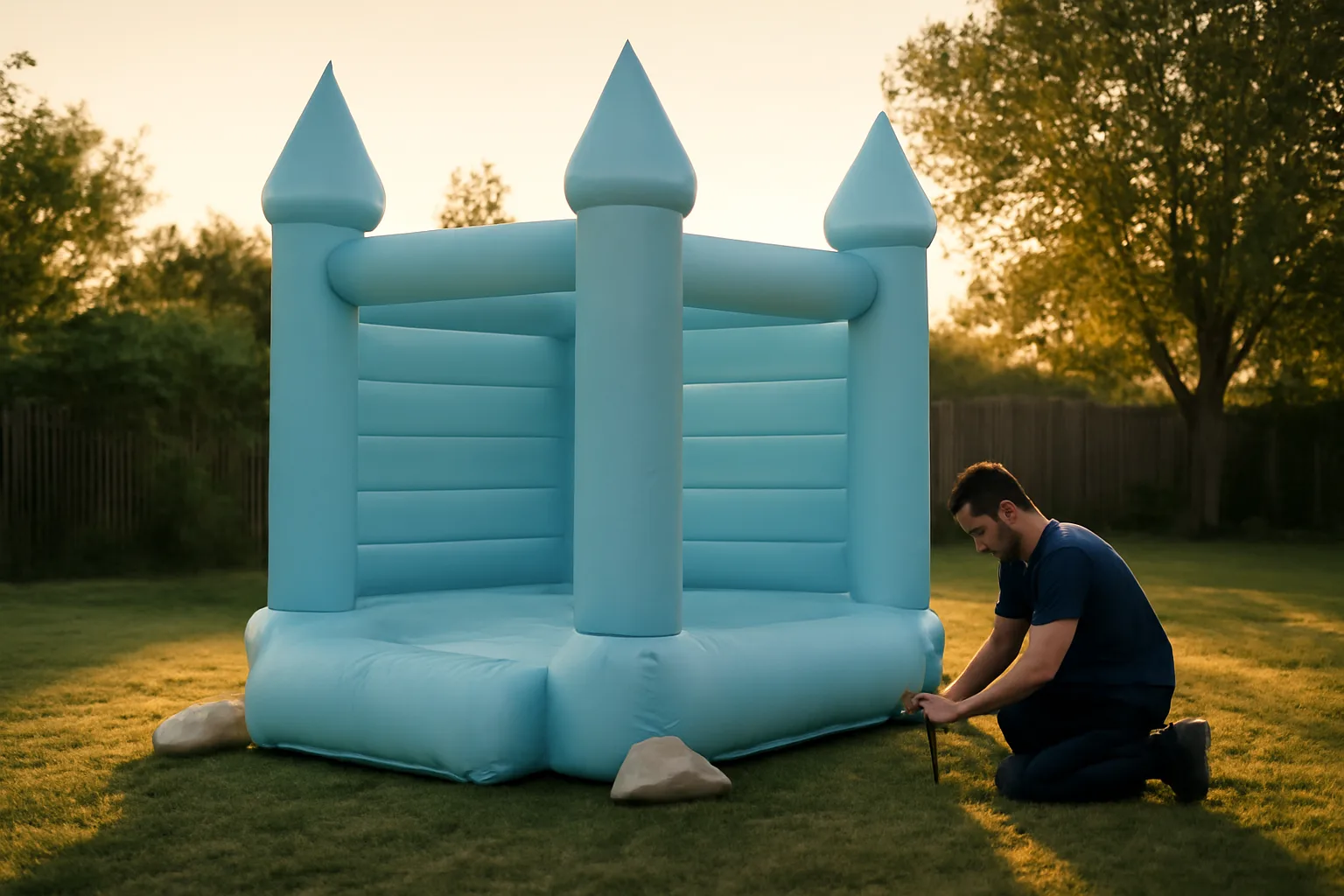
Bounce house rental is a delivery business. You own commercial inflatables, haul them to a yard or hall, anchor them, run a blower, then pack them wet or dry and leave. Most paid work is birthday parties, school field days, church picnics, and corporate family events. Some operators stay on site. Many drop the unit and come back at pickup time.
It is not a toy closet. Once money changes hands and the public jumps, a lot of states treat that castle as an amusement ride or amusement device. Weekend ads skip that part. Texas puts amusement rides under Occupations Code chapter 2151. Florida writes amusement ride safety, including inflatables used as rides, into section 616.242. Ohio requires a permit from the director of agriculture before you operate an amusement ride. [4][5][10]
The Census Bureau files most of this work under NAICS 532289, All Other Consumer Goods Rental, the same bucket used for party and event rental goods. [12] You are closer to a truck shop than to a playground factory.
Gear is simple and heavy. A commercial vinyl unit. One electric blower per air cell. Stakes or water barrels. Outdoor-rated cords. A vehicle that can haul a wet slide home without cooking the transmission. Wet vinyl lies about its weight until you lift it.
I would not call this passive income. You work weekends. You cancel for wind. You pick grass out of hook-and-loop tape. If that still sounds like your kind of work, the rest of this guide is the paper path, not a national myth.
How do you start bounce house rental?
You start bounce house rental by forming a business, getting a free EIN, opening state tax accounts, checking whether your ride board regulates inflatables, binding amusement-grade liability insurance, then buying commercial units you can actually inspect and log. Fees are local. Confirm them with the board that issues the permit before you spend on vinyl.
I would form an LLC in my home state. A sole proprietorship is cheaper on day one and mixes your house with a blown-over slide. The U.S. Small Business Administration puts it plainly: "The business structure you choose influences everything from day-to-day operations, to taxes, to how much of your personal assets are at risk." [8]
Get the EIN from IRS, online, at no charge. An Employer Identification Number is the federal tax id for a business entity. Anyone who bills you for that number is running a sideline. [7] Register the entity and any trade name with your state, then ask the city or county about a basic business license and a sales tax permit. SBA lays that sequence out in its register-your-business guide. [13]
Then ask the carnival-and-ride agency one sentence. Do you regulate commercial inflatable amusement devices? Ask for the answer in writing. Texas Occupations Code chapter 2151 requires amusement-ride operators to carry liability insurance of at least $1 million per occurrence. [4] Florida runs inflatable amusement rides through section 616.242. [5] Ohio Revised Code 1711.53 is the permit gate at the Department of Agriculture. [10] Other states stay quiet. Quiet is not a blessing. It is a different statute.
Buy the unit after you know the inspection path. A pretty castle that cannot pass the person with the clipboard is a garage ornament. Bind insurance next, not last. Schools and parks will ask for a certificate naming them additional insured. A waiver PDF does not replace that.
Keep IRS records from the first dollar. Publication 583 is the starter manual for books, income, and expenses. IRS also lets many new firms deduct some startup costs in year one, with a dollar cap you should read in the current publication, not on a forum. [6]
Last mechanical step: a wind meter, stakes that match the manufacturer sheet, a written pre-op checklist, and a cancel clause you will actually use on a gusty Saturday.
Do you need a license to rent bounce houses?
Sometimes you need a ride permit. Almost always you need ordinary business paper. The mix depends on the state, and sometimes on the county, and nobody publishes a clean national roster of inflatable permits.
Start with the boring licenses. Entity registration. A local business license if the city sells one. A sales tax or seller permit if your state taxes rental of tangible personal property (many do). Those sit with the secretary of state and the department of revenue, not with a Facebook group.
Then the ride license. If your inflatable is an "amusement ride" or "amusement device" under state law, you may need an annual permit, an inspector, and a decal on the blower box. Ohio is blunt. The statute bars operation of an amusement ride without a permit issued by the director of agriculture. [10] Florida writes the safety program into s. 616.242. [5] New York runs a state amusement device program under Labor Law Article 27. Ask the Department of Labor whether your unit is in scope before you assume you are out. [11]
Some states never swept backyard-style inflatables into the carnival code. Some did, then carved out size or use exceptions. Read the definition section. Do not trust a map you found on a vendor blog.
I would call the ride board before I ordered a unit. If they send you a form, fill that form. If they say they do not regulate inflatables, save the email. Renewals are their own chore once you are in the system. Operators already permitted in Florida or California should treat the renewal packet as a calendar item, not a surprise.
Never invent a processing time. Boards change queues. Confirm current fees and filing windows with the office that cashes the check.
What insurance do bounce house rental companies need?
You need a commercial general liability policy written for amusement or inflatable operations, plus coverage on the units and the truck. Personal homeowner or auto policies will not like a paying bounce house in the driveway. Tell the agent the truth on day one.
Limits are not a national number. Texas Occupations Code chapter 2151 requires amusement-ride operators to carry liability insurance of at least $1 million per occurrence. [4] Other states set their own floors, or they set none and then a school district sets one for you. I would not shop a $300,000 general liability quote and hope a park accepts it. Ask three venues what they print on the facility packet. Buy to that number or higher.
Expect the venue to want additional insured language, a waiver of subrogation, and a certificate that names the job site. Build time for that email chain. Friday at 4 p.m. is how people lose Saturday.
Inland marine or floater coverage on the vinyl is a separate decision. CGL pays other people's injuries. It does not automatically replace a slashed castle. Auto coverage has to match commercial use. A personal policy after a claim on a paid delivery is a bad surprise.
Waivers help on some claims in some courts. They do not bind a child the way operators wish they did, and they do not satisfy a statute that already named a dollar figure. Get the policy. Then get the waiver. In that order.
What safety standard covers commercial bounce houses?
The standard operators actually name is ASTM F2374, Standard Practice for Design, Manufacture, Operation, and Maintenance of Inflatable Amusement Devices. CPSC staff worked with industry on that practice, and the Commission publicly pointed people to it when the document matured. [2][3]
F2374 is a practice, not a federal license. It talks about design, anchoring, wind, operations, and upkeep. Your manufacturer should say how the unit was built. Your job is the operations and maintenance half: setup, anchors, blowers, deflation, repairs, and the decision to stay closed.
I would not buy a "commercial" unit from a general marketplace seller that cannot point to F2374 design practice. Cheap vinyl fails at the seam on a hot July Saturday. That is not a vibe. That is a claim file.
CPSC still treats inflatable amusement devices as a consumer safety problem. The injury record is not theoretical. Pediatrics estimated 64,657 children ages 17 and under were treated in US emergency departments for inflatable-related injuries from 1990 to 2010. The injury rate rose 15 times over that window. [1] That paper is old. It is still the cleanest national ED series most people can cite.
If you want ASTM operating items and a wind protocol in one packet, InflatablePath sells a $149 one-time ASTM + Weather Kit. Read the statute and the manufacturer sheet first. The kit does not replace either one.
What paper should you keep in year one?
Keep the paper a board, an insurer, or an IRS examiner could ask for without warning. That is the whole test.
Entity documents and the EIN letter. The state ride permit if you have one, plus any inspector report. The insurance policy and every certificate you issued. Manufacturer manuals and the spec sheet that lists anchor counts and maximum wind. A pre-operation checklist for every setup. A wind log with time, reading, and who took it. A repair log. An incident form, even if you hope to never use it.
IRS wants income and expense records that tie to bank deposits. Publication 583 is the plain-language starting point. Mileage to jobs is real money if you track it as you drive, and a mess if you invent it in April. [6]
I would keep a job jacket, paper or digital, for each rental: contract, site address, named additional insured, photos of stakes and the blower, wind readings, and the pickup condition. Photos settle arguments about mud and tears.
Staff paper matters if anyone helps you. W-2 versus 1099 is a classification question, not a feeling. Misclassifying a Saturday helper is how a cheap crew becomes an expensive letter.
Do not build a shrine of unused binders. Build one folder you will actually fill on site. Empty logs are worse than no logs, because they show you knew the rule and skipped it.
How does weather shut down a bounce house job?
Wind shuts it down. Rain often shuts it down. Lightning always shuts it down. Your manufacturer sheet names a maximum wind speed. That number wins over the parent who already paid a deposit.
National Weather Service wind pages exist so you can read watches and warnings in plain language, not so you can argue with a gust front. [14] I carry a handheld anemometer and I take a reading at setup, then again if the trees start talking. A phone forecast is not a reading at five feet off the grass.
If the unit is up and the wind climbs, evacuate, kill the blower only after people are out (follow the manufacturer on deflation order), and get the vinyl down before it becomes a sail. Injuries in the Pediatrics series include falls and collisions. Lift-off events are rarer and uglier. [1]
Write the cancel rule in the contract. Fifty percent of a deposit back if you cancel for wind is cheaper than a claim. I would rather refund a party than explain a airborne slide to an adjuster.
Heat is a quieter problem. Dark vinyl cooks. Follow the manufacturer on surface temperature and rest breaks. If you cannot put a bare forearm on the bed, kids should not pile on it.
Do you need a USDOT number for bounce house rental?
You might. FMCSA says a USDOT number is required for interstate commercial vehicles at a gross combination weight rating of 10,001 pounds or more. Passenger and hazmat triggers exist too. Read the agency page, not a forum paraphrase. [9]
A cargo van plus a loaded trailer crosses that line faster than people think. Wet units, extra blowers, and water barrels add up. Weigh the combination at a public scale once. Guessing is how you meet a trooper unprepared.
Intrastate rules are a state add-on. Some states want a state DOT number even if you never cross a border. Confirm with your state patrol or motor carrier desk. I would not paint door numbers until that office tells me what belongs on the door.
A pickup with a small enclosed trailer may stay under the federal trigger. May. Scale it. If you grow into a box truck, revisit the question the week you buy it, not the week you get pulled over.
How much money does it take to start bounce house rental?
Nobody has a honest national startup total. Vinyl prices move with shipping and the dollar. Insurance quotes move with your driving record, your county, and whether the carrier even likes inflatables this year. State permit fees change by board. I will not invent a kit price and call it research.
What you can plan is the order of spending. Entity and EIN are cheap (EIN is free). [7] Insurance is not cheap and it is not optional in any market I would work. The first commercial unit plus blower, stakes, and mats is the next check. The truck or trailer you already own may work. A new truck should wait until weekends are actually booked.
I would not buy six castles in month one. One or two units that pass inspection will teach you about grass stains, late pickups, and wind refunds. Extra units sit in a storage unit and age in the fold.
Hold cash for the first slow winter. Party rental is seasonal in most of the country. A pretty Instagram grid does not pay January insurance.
If a seller quotes you a turnkey figure that bundles "all licenses," walk. Licenses are issued by governments. Confirm every fee with the board.
How do state amusement ride rules differ for inflatables?
They differ in the definition section. That is the whole game. Some codes say "amusement ride" and then list inflatables. Some never mention vinyl. Some hand the work to agriculture. Some hand it to labor. Some hand it to a county building department and stay out of it.
Here is the paper you can actually pull, not a 50-state rumor chart.
| State | What the written rule requires | Who you call |
|---|---|---|
| Texas | Liability insurance of at least $1 million per occurrence for amusement rides (Occupations Code ch. 2151) [4] | Texas Department of Insurance and the local officials who ask for the certificate |
| Florida | Amusement ride safety standards under s. 616.242, which reaches inflatables used as rides [5] | FDACS Fair Rides Inspection |
| Ohio | No amusement ride operation without a permit from the director of agriculture (ORC 1711.53) [10] | Ohio Department of Agriculture |
| New York | State amusement device program under Labor Law Article 27; ask whether your inflatable is in scope [11] | Department of Labor, amusement devices |
California, Colorado, Connecticut, Georgia, and others run their own ride or inflatable programs with their own forms. If you already hold paper, the renewal path is a separate chore. Operators compare notes on Colorado renewals, Connecticut filings, Arizona packets, and Georgia renewals because the cover sheet changes even when the vinyl does not.
I would print the definition of "amusement ride" from my own state code and highlight the nouns. If "inflatable" is there, you are in. If it is not, still call the board. Guidance letters exist that never made it into the statute text.
What belongs in a bounce house rental contract?
A contract should name the parties, the site, the unit, the start and end time, the price, the deposit, and who can cancel. It should also name the rules you will actually enforce: age or size mix, no shoes, no flips, adult supervision, and the wind cutoff.
Put the additional-insured request in writing. Put the surface rules in writing (no setup on a grade the manufacturer forbids, no setup under power lines). Put damage charges in writing, with photos as the method, not a vibe.
I would not hide the wind clause on page four. Put it near the deposit. Parents get angry when you cancel. They get angrier when a unit moves.
A waiver can sit behind the contract or inside it. Either way, a parent cannot sign away every claim for a child in every state. Treat the waiver as a notice and a screening tool, not as insurance.
Sales tax belongs on the invoice if your state taxes the rental. Confirm the rate and the category with the department of revenue. Guessing a rate is how you fund an audit.
What wastes money in the first season?
Six units and one driver. A box truck you do not need yet. A cheap castle that fails the first inspector. An insurer you found only by price. A wind meter you never bought. Those are the usual holes.
Lead ads that promise "passive weekend income" waste time. This is loading, driving, staking, waiting, and washing. If you hate that loop, do not buy vinyl.
Skipping the ride-board call wastes the most money when the board later exists. You cannot return a custom print unit because you did not like the permit. Call first. Alabama operators already in the system and people checking Delaware renewal paper will tell you the same thing: the renewal is easier than the first surprise letter.
I would spend on insurance, one good unit, stakes, an anemometer, and a used trailer that fits the van you already own. Everything else can wait until the calendar fills.
InflatablePath is an independent publisher, not a law firm and not a rental company. Optional paperwork help lives at /start. It does not file your permit and it does not bind your coverage. Confirm fees, forms, and timing with the board that signs the card.
Frequently asked questions
What is bounce house rental?
Bounce house rental is a paid delivery and setup service. You take commercial inflatables to a site, anchor them, run a blower, then tear them down. Census NAICS 532289 is the usual industry code. In many states a paying unit is also an amusement ride, which pulls in permits and insurance the toy aisle never mentioned.
How do you start bounce house rental?
Form an entity, get a free IRS EIN, register tax accounts, then ask your state ride board if inflatables need a permit. Bind amusement-grade liability insurance, buy a commercial unit that matches ASTM F2374 practice, and write wind and inspection logs. Confirm every fee with the issuing board before you order vinyl.
Do all 50 states license bounce houses as amusement rides?
No. Texas, Florida, Ohio, and New York have written amusement programs you can read. Other states stay silent or leave inflatables to counties. Silence is not a national exemption. Call the agency that inspects carnivals and ask whether commercial inflatables are in scope. Save the answer.
Can I run bounce house rental from my house?
Often yes, if zoning allows a home-based service business and you have legal parking for the trailer. HOA rules and local parking codes kill more driveway operators than state ride boards do. Check zoning first. Do not assume a residential lot can store a wall of wet vinyl.
Do customer waivers replace liability insurance?
No. A waiver is a notice and, in some courts, a partial defense. It does not meet a statutory insurance floor and it does not satisfy a school that wants a certificate. Texas already writes a $1 million per occurrence amusement-ride figure into Occupations Code chapter 2151. Buy the policy, then use the waiver.
What wind speed shuts down a bounce house?
The manufacturer sheet names the number. Many commercial units sit in a band around 15 to 25 mph, but that is a manufacturer limit, not a federal speed limit. Take an on-site anemometer reading. If the reading hits the sheet, evacuate and take the unit down. A phone forecast is not a field reading.
Do I need an EIN as a sole proprietor with no employees?
IRS will issue an EIN to a sole proprietor, and many banks and insurers want one even when you have no staff. You can often use a Social Security number instead for a true one-person firm, but I would get the free EIN anyway. Do not pay a third party for a number IRS already gives away.
What NAICS code do bounce house rental companies use?
Most party and inflatable rental firms land in NAICS 532289, All Other Consumer Goods Rental. That is the Census Bureau bucket for consumer goods rented to households and events. Use it on bank, insurance, and statistical forms unless your accountant has a better fit for a mixed rental shop.
How often do commercial inflatables need inspection?
Follow the state ride program if you are in one, plus the manufacturer and ASTM F2374 practice. Ohio ties operation to an agriculture permit. Texas ties operation to insurance and inspection language in chapter 2151. Daily pre-op checks still belong to you on every job, permit or not. Confirm the official interval with the board.
Do I charge sales tax on a bounce house rental?
Many states tax the rental of tangible personal property, and a castle is property. Some exempt certain nonprofit or school jobs. Rates and exemptions are state revenue questions. Ask the department of revenue for the category, then print that tax on the invoice. Do not copy a rate from a neighboring county Facebook group.
When does a bounce house trailer need a USDOT number?
FMCSA requires a USDOT number for many interstate commercial combinations rated or weighing 10,001 pounds or more. A loaded trailer plus van can cross that line. Weigh the combination. Ask your state motor carrier office about intrastate numbers even if you never leave the state.
Is a $99 online bounce house "commercial enough" to rent?
I would not rent it. You want a builder that states ASTM F2374 design practice, publishes anchor counts and a wind limit, and can support a state inspector. Marketplace vinyl that fails at the seam becomes your claim, not the marketplace's claim. Spend on one real unit.
How do I confirm my state's inflatable ride board?
Search your state department of agriculture, labor, or consumer protection for "amusement ride" or "inflatable amusement device." Call the number on that program page. Ask if commercial inflatables need a permit. Confirm the current fee and form with that office. Do not treat a national blog chart as the filing packet.
Sources
- Pediatrics, Injuries Associated With Inflatable Amusements (2012): Estimated 64,657 US emergency-department visits among children 17 and under for inflatable-related injuries from 1990 to 2010, with a 15-fold rise in the injury rate
- CPSC news release on the inflatable amusement device safety standard (2015): CPSC staff worked with industry to develop the ASTM safety standard practice for inflatable amusement devices
- ASTM F2374 standard practice page: ASTM F2374 is the Standard Practice for Design, Manufacture, Operation, and Maintenance of Inflatable Amusement Devices
- Texas Occupations Code Chapter 2151 (Regulation of Amusement Rides): Texas requires amusement-ride operators to carry liability insurance of at least $1 million per occurrence
- Florida Statutes s. 616.242 (2023), Safety standards for amusement rides: Florida's amusement ride safety statute, s. 616.242, is the written standard that reaches inflatable amusement rides
- IRS Publication 583, Starting a Business and Keeping Records: New businesses must keep records of income and expenses; IRS publishes the starter rules for books and some first-year startup cost treatment
- IRS, Apply for an Employer Identification Number (EIN) online: An EIN is the federal tax identification number for a business entity and is issued online by IRS at no charge
- U.S. Small Business Administration, Choose a business structure: Business structure affects day-to-day operations, taxes, and how much personal property is at risk
- FMCSA, Do I need a USDOT number?: A USDOT number is required for many interstate commercial vehicles at a gross combination weight rating of 10,001 pounds or more
- Ohio Revised Code 1711.53, Amusement ride permit: Ohio requires a permit issued by the director of agriculture before a person may operate an amusement ride in the state
- New York Labor Law Article 27, Amusement devices (NYS Senate): New York Labor Law Article 27 defines amusement devices and is the statutory hook for the state amusement device program
- U.S. Census Bureau, 2022 NAICS 532289 detail: NAICS 532289, All Other Consumer Goods Rental, is the Census classification used for party and event consumer-goods rental
- U.S. Small Business Administration, Register your business: SBA describes the sequence of state entity registration, local licenses, and tax accounts for a new firm
- National Weather Service, Wind safety: NWS publishes public wind watches, warnings, and safety guidance operators use when deciding whether a job stays up