Last updated 2026-08-21
TL;DR
Bounce house rental is a local equipment business. You own commercial inflatables, deliver them, stake and inflate them, then pick them up. Starting means forming a business, getting a free IRS EIN, checking whether your state treats units as amusement rides, buying liability insurance, and following ASTM F2374 plus the unit plate. Confirm every form and fee with your state board. There is no single national bounce house license.
What is bounce house rental?
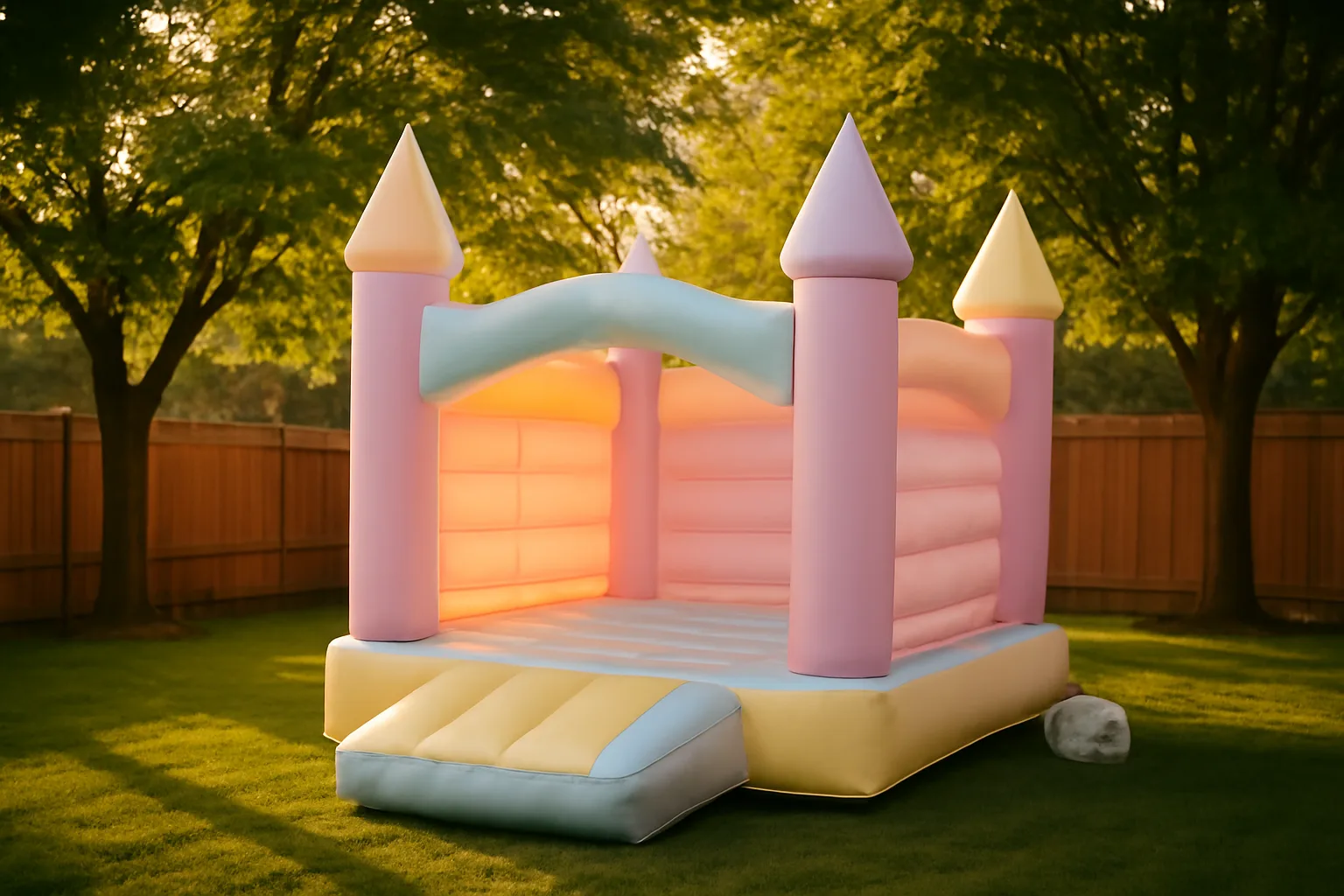
Bounce house rental is a local delivery and setup business. You own commercial inflatables, haul them to a yard or venue, anchor and inflate them for a booked window, then take them back down. The customer is buying time on your gear, not a staffed carnival.
That is the whole product. A weekend castle in a backyard. A wet slide at a school field day. Sometimes tables, a generator, or a popcorn cart ride along because the same truck is already going there.
The Census Bureau files a lot of this work under NAICS 532289, All Other Consumer Goods Rental, which is the bucket that holds party and event gear you hand to a customer and later retrieve [10]. You will also see shops sit in general rental. The code does not license you. It only tells a banker or an insurer how the trade is counted.
People mix this up with indoor trampoline parks and county-fair midways. Those sites have their own ride programs, employees on the pad all day, and a different inspector rhythm. Bounce house rental is mostly portable. You leave. The host is looking at a blower and a pile of kids.
I treat it as a truck-and-trailer trade with a safety plate, not as a “party brand.” If you cannot explain the stake pattern, the wind cutoff on the label, and who is watching the entrance, you do not have a rental. You have a liability.
A 2012 Pediatrics study estimated 64,657 U.S. children were treated in emergency departments for inflatable bouncer injuries from 1990 through 2010 [1]. That number is why schools ask for certificates and why some states shove these units into the amusement ride statute. The business is simple. The paper around it is not imaginary.
How do you start bounce house rental?
You start bounce house rental by building a paper path before you take a deposit. Form a business the IRS can see, get a free EIN, open a dedicated bank account, ask your city if a home occupation or rental yard is allowed, then ask your state whether a portable inflatable is an amusement ride. Buy liability insurance that actually names the activity. Then buy gear that matches ASTM F2374 and the manufacturer manual.
That order matters. A pretty castle in the driveway does not make you legal. A weekend warrior with no policy and a Gmail invoice is how people get banned from park districts.
Here is the sequence I would run, and I would not skip the ugly parts.
Pick an entity. The SBA is blunt about why this is not decoration: “The business structure you choose influences everything from day-to-day operations, to taxes, to how much of your personal assets are at risk.” [4] Sole prop is fast. An LLC costs a state filing (confirm the current fee with your secretary of state) and gives you a cleaner wall between the truck and your house. I would form the LLC in most states even if year one is one unit and a pickup.
Get an EIN. The IRS does not charge for it. Their own apply page says applying is “a free service offered by the Internal Revenue Service” and tells you to ignore sites that bill you for the same form [5]. Use the EIN on the bank account, the insurance application, and the sales tax account if your state taxes rentals.
Ask three desks the same question: do I need a local business license, a sales tax permit, and an amusement ride registration? City hall, the state revenue department, and the state ride or labor board will not give you one combined answer. Write down the name of the person you spoke with.
Quote insurance before you click “buy” on a used slide. If a carrier will not write bounce house rental at all, that is information. Do not hide the use as “general party rental” and hope. Related reading on what policies actually have to say sits in our CGL coverage notes and the walkthrough of certificates venues keep requesting.
Then buy one or two commercial units with a data plate, a blower that matches the unit, ground stakes or water barrels, a spare motor if you can, and a cargo method that does not destroy the vinyl. Learn the set, the tear down, and the drying. Book friends-and-family jobs at a real invoice so your bookkeeping starts honest.
There is no federal bounce house license. Anyone selling you a national permit is selling paper that your state board will not honor.
What licenses and permits do you need?
You need whatever your city, your state tax agency, and (in many states) your amusement ride board each require. There is no single bounce house card that works from Maine to Hawaii. Confirm every form with the desk that issues it.
Most first-year operators end up with some mix of the rows below. The names change. The idea does not.
| Paper item | Who issues it | What it is for |
|---|---|---|
| EIN | IRS | Tax ID on bank, insurance, and payroll forms [5] |
| Entity filing | Secretary of state | LLC or corp on record, if you did not stay a sole prop [4] |
| Local business license | City or county | Permission to operate from that address |
| Sales or use tax permit | State revenue department | Collecting tax if your state taxes equipment rental |
| Ride registration or inspection | State ride, agriculture, or labor board | Annual ID if inflatables are in that statute |
| COI and policy | Insurer | Proof for schools, parks, and HOAs |
A home-based yard can also trip zoning, HOA rules, and fire-lane rules for trailers. I have seen operators pass the state ride sticker and still get a nasty letter from a code officer about commercial vehicles on a cul-de-sac. Call planning, more than the ride board.
If you hire anyone, you pick up I-9 work, wage-and-hour rules, and usually a workers compensation inquiry. Confirm with your state labor agency. Do not pay cash “helpers” and pretend they are customers.
Park districts and schools will add their own permit on top. That is a site permit, not your license to exist. Budget time for it. Nobody has a clean national count of how many extra local forms a Saturday job can grow. The closest honest answer is: if the site is public, assume a packet.
Does your state treat bounce houses as amusement rides?
Sometimes yes, sometimes no, and you cannot guess from a Facebook group. Several states fold portable inflatables into the same amusement ride laws that cover go-karts and folding wheels. Other states stay quiet and leave you with local fire and consumer rules. Read the statute. Then call the board and ask if your exact unit is in scope.
Texas puts operators under Occupations Code Chapter 2151, the Amusement Ride Safety Insurance Act. That chapter is built around insurance and operation rules for amusement rides, not around a cute party brand [2]. If your unit is in scope, you do not “kind of” comply. You either have the policy the statute describes or you do not operate.
Florida’s amusement ride safety law is section 616.242, Florida Statutes. It is a long inspection, insurance, and owner-duty statute, not a brochure [3]. Whether a backyard castle you drop for four hours is in scope is a question for the Florida Department of Agriculture and Consumer Services, not for a national blog. Confirm it.
Pennsylvania still runs operators through the Amusement Ride Inspection Act (1984 Act 81) and the Department of Agriculture’s ride program [11]. New York runs carnival, fair, and amusement device language through Labor Law Article 27, including the definitions in section 870-c [12]. Those are different desks, different stickers, different calendars.
If your state has a ride program, expect some mix of an application, an inspection, an ID plate, and a proof-of-insurance filing. I will not quote a fee or a wait time. Those move. The board’s current form is the only number that counts.
If your state has no ride program, do not throw a party. You still have ASTM practice, the manufacturer plate, local fire rules, and whatever a venue’s risk manager invented. The empty state list is not a permission slip.
What insurance do you need for bounce house rental?
You need a commercial policy that states you rent and set up inflatables. A personal homeowners policy will not do this job. A cheap general liability printout that never mentions amusement devices often fails the first school review.
Most venues ask for commercial general liability and a certificate that names them as additional insured. Many also want motor coverage on the truck and inland marine or scheduled equipment coverage on the vinyl, because a stolen slide is a property claim, not a bodily injury claim. Confirm limits with the venue and with your state ride statute if you have one [2] [3].
I would not deliver a unit without a binder in hand. I also would not take the cheapest “events” policy that excludes wind, set-up, or participants under a certain age. Read the exclusions. If you cannot explain them, you do not know what you bought. We keep a longer pass on why thin policies fail venue checks and on additional insured wording.
Waivers help you tell the story of what the customer agreed to. They do not replace a policy. Courts treat them differently by state, and a minor’s injury is its own mess. Get the insurance. Use a waiver your lawyer actually reviewed. Do not download one from a forum and hope.
If a carrier asks for training records, ASTM procedures, and weather logs, that is a good sign. Give them real paper. Made-up safety manuals are how claims get ugly.
Premiums are local. I will not invent a national price. Call more than one surplus-lines shop that already writes amusement or party rental. If three of them decline, your operation or your claims story has a problem you need to fix before you buy another unit.
What is ASTM F2374 and do you have to follow it?
ASTM F2374 is the Standard Practice for Design, Manufacture, Operation, and Maintenance of Inflatable Amusement Devices [9]. It is the document manufacturers, many inspectors, and a lot of underwriters point at when they say “do it the commercial way.” It is not a federal license. It is the practice standard for how these things are supposed to be built and run.
Do you have to follow it? If your state ride board or your insurer writes it into the rule, yes. If they do not, you should still run to it, because the alternative is “whatever the guy on the used listing did.” I would not buy a unit with no plate, no manual, and no evidence it was built to that practice.
The standard covers design and manufacture, but operators live in the operation and maintenance pieces. Anchoring. Wind. Capacity. Attendant rules. Inspection before every inflation. Repair limits. Those are the pages that belong in the truck, not in a desk drawer.
Manufacturer labels still win day to day. If the label says a max wind and F2374 says something nearby, follow the stricter number and write it in your job log. Do not argue physics with a gust front.
I keep a printed ASTM and weather packet in the cab so I am not scrolling a phone in a driveway. If you want that packet assembled for you, InflatablePath sells a $149 one-time ASTM + Weather Kit on /start. You can also print the practice notes yourself and build the same folder. The folder is the point.
Training is not a weekend meme. Walk every new helper through stakes, deflation, and “we shut it down.” If they cannot do that, they do not go to jobs.
How much money do you need to start bounce house rental?
There is no official national startup figure for bounce house rental. Anyone giving you one tidy number made it up. Costs split across the entity, the insurance deposit, the first unit and blower, a legal way to haul it, repair and cleaning gear, and enough cash to survive a rainout.
I would start with one or two used commercial units that still have a plate and a manual, a cargo van or a small enclosed trailer you can actually load alone, and a policy that will certificate a school. I would not finance a trailer-full of new wet combos before I have repeat Saturday demand.
Waste-of-money pile, from where I sit: lead-gen “territory” packages, vinyl that was built for backyard retail use, giant logo wraps on day one, and booking software you do not need until the paper calendar breaks. A spare blower is not waste. A moisture meter and a real drying plan are not waste. Cheap stakes on hard ground are waste, because the unit becomes a sail.
Insurance and the first mechanical surprise are the two costs new owners undercount. A zipper, a tube, a burned-out motor, a generator that will not start in a cul-de-sac. Hold cash for that.
If a lender or a marketplace asks for NAICS, 532289 is the census box many party rental shops use [10]. That does not set your budget. Your quotes do.
Confirm license fees with the city and the ride board. I will not invent them. They change, and they are not the same in two adjacent counties.
What safety rules apply on every bounce house job?
Every job has the same non-negotiables. Match the blower to the unit. Inspect the vinyl, the seams, the stakes or barrels, and the cords before you inflate. Anchor the way the manual says, on ground that will hold. Keep it inside the posted capacity and the posted age mix. Watch the wind. Shut it down when the label or the weather says so. Do not leave a running unit with no attendant plan.
The injury record is not theoretical. Pediatrics put tens of thousands of child emergency visits on inflatable bouncers across two decades of NEISS data [1]. Collisions, bad landings, and units that move are the boring ways people get hurt. You do not need a rare catastrophe to ruin a business.
I split ages. I do not let adults “just jump once” on a kids’ castle. I pull the unit if the host wants it on a slope, under a power line, or on wet mud that will not hold a stake. That conversation is easier before the blower starts.
Weather is its own file. Heat on vinyl, lightning, and wind all end the job. Write the source you used (a named forecast, an on-site meter) in the log. If a claim comes later, that log is the difference between a story and a record. We keep more on weather and claim problems.
Generators stay outdoors, exhaust away from kids, cords out of the walk line, GFCI where it belongs. Indoor gasoline generation is a carbon monoxide problem, not a party trick.
If the host fights you on shutdown, you shut it down anyway and you document it. You can refund a window. You cannot refund a neck.
What paperwork should you keep in year one?
Keep a job file you could hand to an adjuster or an inspector without flinching. Contract, signed rules, waiver if you use one, certificate sent to the venue, set-up photos of stakes and clearance, weather note, tear-down note, and any incident page. That is the minimum.
Add the boring book. Receipts for the unit, the trailer, fuel, patches, and soap. Mileage. Who helped. Which blower sat on which castle. Serial numbers. Repair dates. ASTM and manufacturer inspection checklists, filled out, not blank.
If something happens, write facts while you are still on site. Time, wind, how many kids, which rule was broken, what you did. Do not write a novel. Do not guess medical outcomes. Our notes on incident documentation are worth a pass before your first busy Saturday.
Invoices should match the bank deposits. Cash jobs that never hit the ledger are how people make a tax year worse than it had to be. The IRS expects a sole prop to put the business on Schedule C [7]. You cannot Schedule C a shoebox you never opened.
Store manuals in two places. One dry copy in the truck. One copy at home. Phones die. Vinyl still needs the stake pattern.
I would not keep customer card numbers on paper in the cab. Use a processor and move on.
How do taxes work for a first-year bounce house rental?
If you are a sole proprietor, you report the bounce house rental on Schedule C with Form 1040. The IRS page on that form is plain: you use Schedule C “to report income or loss from a business you operated or a profession you practiced as a sole proprietor.” [7] An LLC with one owner is often taxed the same way unless you elect otherwise. Confirm that election with a tax pro. I am not your tax pro.
Self-employment tax is real money. IRS Topic 554 puts it at 15.3 percent of net earnings (12.4 percent Social Security plus 2.9 percent Medicare), with an extra Medicare piece above the high-income threshold [6]. That sits on top of income tax. Price your Saturdays like a person who will send the IRS a check.
Sales tax is a state question. Many states tax the rental of tangible personal property. Some exempt certain nonprofit or school jobs. Some want you to collect on delivery fees. Get the written rule from your revenue department. Do not copy a competitor’s invoice and assume they got it right.
Estimated taxes exist because nobody withholds you. Publication 334 is the IRS small-business tax guide if you want the long version in their words [13]. Calendar the dates. A busy June does not impress a missed voucher.
Keep the EIN letter. Banks and insurers ask for it at the worst time [5].
I would pay a bookkeeper for a few hours in month two, not in April. Cheap compared with reconstructing a year of Venmo.
What first-year choices waste money?
Buying retail backyard vinyl and calling it commercial. Paying a lead mill for “exclusive ZIP codes.” Skipping insurance until a park asks. Wrapping the trailer before the phone rings. Hiring a helper you never trained because Saturday got big.
I would also skip most franchise-flavored startup kits that sell you a logo and a dream territory. The scarce things are a writeable policy, a legal place to store wet vinyl, and a unit that still has a manual. Paint is not scarce.
Underpricing to “get reviews” trains your market to expect a number you cannot survive once fuel, patches, and the 15.3 percent self-employment bite show up [6]. Raise the rate when the calendar fills. Do not start at a hobby price.
Another hole: one blower, no spare. When that motor dies at 11 a.m., you are refunding a wedding, not learning a lesson.
Do not argue with venue insurance requirements. If the school wants a higher limit or a waiver of subrogation, price that into the job or decline it. Fighting the risk manager is not a sales skill.
And do not run indoor gasoline generators. That is not frugal. That is how you get a different kind of headline.
How do you confirm the rules for your state?
You confirm bounce house rental rules by calling the desks that can say no, not by collecting blog posts. Secretary of state for the entity. City or county for the local license and the yard. State revenue for sales tax. The amusement ride, agriculture, or labor board for inspection scope. Your insurer for activity language. State DOT if the trailer is heavy.
Ask a question they can answer on the record. “Is a portable commercial inflatable an amusement ride under your program, and what form do I file if it is?” Write the date, the name, and the form number. If they email a link to a statute, keep the email.
Use the primary text. Texas operators start with Occupations Code Chapter 2151 [2]. Florida operators start with section 616.242 [3]. Pennsylvania operators start with Act 81 of 1984 [11]. New York operators start with Labor Law Article 27 and section 870-c [12]. Your state may look like none of those. That is why you call.
If the truck and trailer cross state lines and sit at 10,001 pounds or more GVWR or GCWR, FMCSA’s own registration page is the federal tripwire for a USDOT number in interstate commerce [8]. In-state only is a state DOT question. Confirm it. Do not assume a pickup is invisible.
InflatablePath is an independent publisher, not a law firm and not a rental company. Use this as a map, then verify. If you want the ASTM and weather folder we already mentioned, it is on /start. The statutes still win.
When two agencies disagree, follow the stricter rule and get the disagreement in writing. That is the whole job of year-one paper.
Frequently asked questions
What is bounce house rental?
Bounce house rental is a delivery business. You own commercial inflatables, take them to a site, anchor and inflate them for a booked window, then pack them out. Customers pay for time on the gear. It usually sits in party and consumer-goods rental, not in a staffed amusement park. The hard part is the insurance, ride paper, and set-up rules around that simple loop.
How do you start bounce house rental?
Form an entity, get a free IRS EIN, open a business account, then ask city hall, the tax agency, and the state ride board what they want. Quote a real inflatable liability policy before you buy vinyl. Purchase commercial units with plates and manuals, learn ASTM F2374 plus the label, and invoice a few low-stakes jobs so the books start clean. Confirm every fee with the issuing board.
Do you need a special bounce house license in every state?
No. There is no national bounce house license. Some states register portable inflatables as amusement rides. Others do not. Almost every city still has a business license question, and many states tax equipment rental. Call your ride or labor board and your revenue department. Do not buy a “USA permit” from a private site.
Is ASTM F2374 required by law?
ASTM F2374 is a consensus practice standard for design, manufacture, operation, and maintenance of inflatable amusement devices. It becomes mandatory when a state board, an inspector, a contract, or an insurer writes it in. Even when nobody names it, it is the baseline I would run. The manufacturer plate still governs the unit in front of you.
Can you start bounce house rental as a sole proprietor?
Yes. The IRS expects that income on Schedule C. The SBA notes that structure changes taxes and how much of your personal property is exposed. Sole prop is faster. I would still form an LLC in most states for the cleaner wall, then confirm tax treatment with a CPA. Either way, get the EIN and a dedicated bank account.
Does a signed waiver replace bounce house insurance?
No. A waiver records what the customer agreed to. It does not pay a medical bill or satisfy a school that wants a certificate. Courts also treat waivers for minors differently by state. Buy a commercial policy that names inflatable rental, then use a waiver a lawyer in your state actually reviewed.
Do you need a USDOT number for a bounce house trailer?
You need a USDOT number for interstate commerce when the vehicle or combination hits the federal 10,001 pound GVWR or GCWR threshold, among other FMCSA triggers. Many local operators never cross that line. In-state rules still belong to your state DOT. Weigh the loaded rig and confirm before you assume you are exempt.
Do you charge sales tax on bounce house rental?
Often yes, because many states tax rental of tangible personal property. Some school or nonprofit jobs are exempt if you keep the right certificate. Delivery fees can be taxable too. Get the written rule from your state revenue department and put the permit number on the invoice. Copying another operator’s tax line is not research.
Will a homeowners policy cover bounce house rental?
Almost never for the business use. Homeowners forms are built for personal risks, and business-pursuit language usually knocks this out. You want commercial general liability that states you rent and set up inflatables, plus auto and equipment cover as needed. If a carrier will not write the activity, that is your answer.
How many bounce houses should you buy first?
I would buy one or two commercial units you can load, dry, and certificate, not a fleets-worth. Used gear with a plate and a manual beats new wet combos you cannot keep busy. Add a spare blower before you add a third castle. Grow when weekends are actually full and the drying space still works.
Can you set up bounce houses at apartments, parks, and schools?
Only if that site allows it and you meet their packet. Parks and schools usually want a certificate, additional insured wording, and sometimes an inspection sticker. Apartments add HOA and fire-lane rules. Get written site permission before you take a deposit. Public grass is not automatically open for business.
What wind speed shuts down a bounce house?
The number on the manufacturer label, read with ASTM F2374 and any stricter local rule. It is not one national miles-per-hour figure I can invent for you. Use an on-site reading, not a vibe. If gusts approach the limit, deflate. Document the source you used. Refunding a window is cheaper than chasing a unit across a lot.
Do you have to stay with the bounce house during the party?
Many manuals and venue contracts want a trained attendant or a named host who accepted the rules. Drop-and-go is how units get overloaded and unanchored. I would not leave a running inflatable with no one who knows the shutdown. If the contract says attended, you attend. If it says host-attended, train that host in person.
How do you get a certificate of insurance for a school job?
Ask your commercial insurer for a certificate that names the school or district as additional insured and matches the limits they printed. Send it from the agency, not as a scan you edited. If the activity description does not mention inflatables, the school may reject it. Build that lag into your booking calendar.
Sources
- Pediatrics / PubMed, Thompson et al. 2012 (PMID 23129071): Estimated 64,657 U.S. children under 18 treated in EDs for inflatable bouncer-related injuries from 1990 through 2010; injury counts rose sharply in later years of the window.
- Texas Occupations Code Chapter 2151 (Amusement Ride Safety Insurance Act): Texas requires amusement ride operators to meet Chapter 2151 insurance and operation rules before operating a ride in scope.
- Florida Statutes section 616.242 (Safety standards for amusement rides): Florida’s amusement ride safety statute sets owner, inspection, and insurance duties for rides that fall under section 616.242.
- U.S. Small Business Administration, Choose a business structure: Choice of business structure affects day-to-day operations, taxes, and how much personal property is at risk.
- IRS, Apply for an Employer Identification Number (EIN) online: Applying for an EIN is a free IRS service; third-party sites that charge for the same application are unnecessary.
- IRS Tax Topic 554, Self-employment tax: Self-employment tax is 15.3 percent of net earnings (12.4 percent Social Security plus 2.9 percent Medicare), plus additional Medicare tax above the statutory threshold.
- IRS, About Schedule C (Form 1040): Sole proprietors use Schedule C (Form 1040) to report income or loss from a business they operated.
- FMCSA, Do I need a USDOT number?: A USDOT number is required for specified commercial motor vehicles in interstate commerce, including combinations at 10,001 pounds GVWR or GCWR or more.
- ASTM International, F2374 Standard Practice for Inflatable Amusement Devices: ASTM F2374 is the standard practice for design, manufacture, operation, and maintenance of inflatable amusement devices.
- U.S. Census Bureau, 2022 NAICS 532289 All Other Consumer Goods Rental: NAICS 532289 is the census classification that includes consumer goods rental such as party supply rental.
- Pennsylvania General Assembly, 1984 Act 81 (Amusement Ride Inspection Act): Pennsylvania’s Amusement Ride Inspection Act is the statutory basis for ride registration and inspection duties in that state.
- New York Labor Law section 870-c (Article 27 definitions): New York Labor Law Article 27 includes section 870-c definitions used in the state’s carnival, fair, and amusement device program.
- IRS Publication 334, Tax Guide for Small Business: Publication 334 is the IRS small-business tax guide covering how to report business income, expenses, and related federal tax duties.