Last updated 2026-08-21
TL;DR
Bounce house rental is a local service that delivers, inflates, and later takes down an inflatable for a paid time window. You start with a legal entity, liability insurance that meets state amusement ride rules, any required ride registration, and written weather and setup procedures. Confirm fees and forms with the board that inspects rides where you operate.
What is bounce house rental?
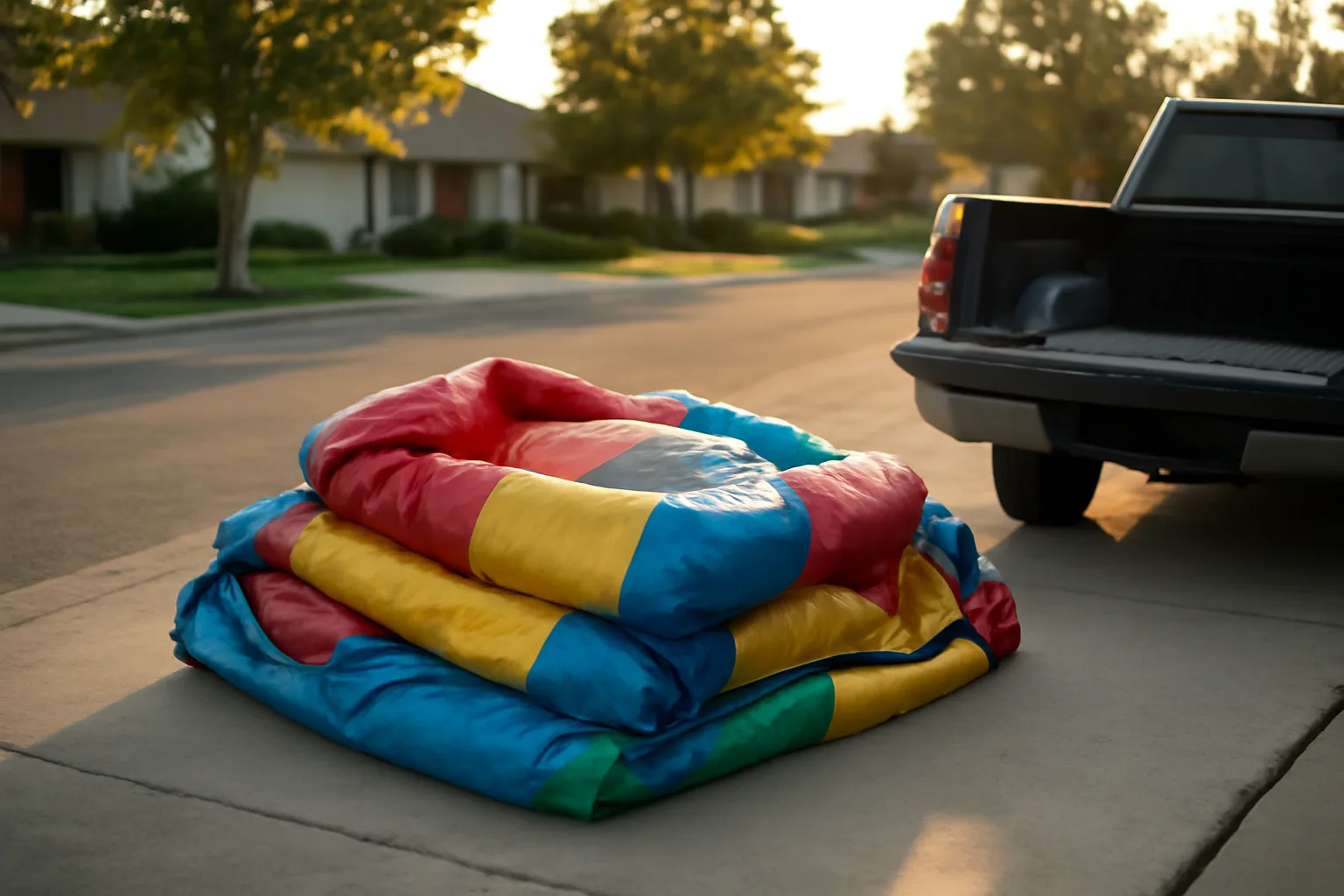
Bounce house rental is a local delivery service. You own inflatable play equipment, take it to a customer site, inflate it for a paid block of hours, then pack it and haul it home. The customer pays for the unit plus your labor and fuel, not a ticket at a gate.
Most bookings are backyard birthdays, school carnivals, church picnics, and company family days. A common window is 4 to 6 hours on site. You can stay with the unit or leave and come back. Staying costs more labor. Leaving only works if the customer actually follows your rules.
The U.S. Census Bureau classifies party and inflatable rental under NAICS 532289, All Other Consumer Goods Rental. [11] That is a rental code, not an amusement park code. Banks and insurers sometimes ask for it on applications.
This is physical work. Wet vinyl is heavy. Driveways crack. Neighbors complain about blowers. If you want a quiet weekday office, pick something else.
The device is an inflatable amusement device under ASTM F2374, the practice for design, manufacture, operation, and maintenance of these units. [3] States that inspect amusement rides often pull bounce houses into that definition. Texas does. Florida does. Ohio does. Some cities never look. You still need insurance.
People search bounce house rental when they want a unit for a Saturday, and when they want to sell the service. This article is for the second group. If you are still weighing the trade against a nearby job, read bounce house rental vs nearby career after you finish the paper path.
How do you start bounce house rental?
You start bounce house rental by making the business legal, buying liability insurance a ride board will accept, checking whether your state registers portable inflatables, then buying a commercial unit and a way to haul it. Do the paper before you take a deposit. A listing with no policy is how people put a house at risk.
Here is the order I would actually use.
Pick a legal structure first. The U.S. Small Business Administration explains sole proprietorships, partnerships, LLCs, and corporations in its choose-a-structure guide. [6] I would form an LLC where I live. It is not magic. It is cleaner than putting every bounce on your personal name.
Get an Employer Identification Number. The IRS online EIN application is free. [5] Banks and insurers ask for it.
Open a dedicated bank account. Mixed money turns tax season into a fight you will lose.
Call commercial insurers that write inflatable or amusement work. Ask what they need for a certificate. Texas Occupations Code Chapter 2151 says a person may not operate an amusement ride without the required insurance. [4] Other states use different chapter numbers and the same idea.
Ask your state agriculture department, labor department, or ride safety office whether portable inflatables need a permit. Florida Statute 616.242 sets safety standards for amusement rides in that state. [8] Ohio Revised Code 1711.53 requires a permit before you operate an amusement ride. [10] Confirm the current form with that board. Do not trust a Facebook group for the filing date.
Buy commercial-grade units with documentation that tracks ASTM F2374. [3] Used backyard toys from a classified ad are a waste of money if you plan to insure them.
Write setup, teardown, weather, and attendance rules. Keep a copy in the truck. Then take a booking.
The SBA register-your-business guide covers state tax IDs, assumed names, and local licenses. [12] It is dull. Do it anyway. For a side-by-side of early choices, see bounce house rental guide 12.
| Paper | Who issues it | When you need it |
|---|---|---|
| Entity formation | Secretary of state | Before banking and insurance |
| EIN | IRS | Before the business bank account |
| Ride permit | State ride board | If your statute covers inflatables |
| Sales tax permit | State revenue department | If your state taxes this rental |
| Certificate of insurance | Your carrier | Before the first paid job |
Confirm every fee with the issuer. National blogs invent numbers.
What licenses and permits do bounce house rental operators need?
There is no single federal bounce house rental license. You need the mix of entity registration, local business license, sales tax permit, and amusement ride permit your state and city actually require. Confirm each item with the board that issues it. Nobody can honestly quote your fee from a national article.
Amusement ride statutes are the ones people miss. Florida Statute 616.242 is that state's amusement ride safety law and it reaches devices operated for the public. [8] Ohio Revised Code 1711.53 is the permit section operators hit before a ride may run. [10] Texas Occupations Code Chapter 2151 regulates amusement ride operation and insurance. [4] If you cross a state line for a wedding, you may trip a second board.
Local pieces still matter. A city or county business license. A fire or parks permit if you set up on public land. A sales and use tax permit if your state taxes rental of tangible personal property. A home occupation permit if units live in a garage.
I would not buy a license package from a random website. The real forms live on .gov pages. Processing times change. This site is an independent publisher, not a law firm and not a filing service.
Some states exempt private backyard rentals from ride inspection. Some do not. Read the definition of amusement ride in your statute. If the definition includes inflatable devices operated for a fee, you are in.
How much does it cost to start bounce house rental?
Startup cost is usually a few thousand dollars on the cheap end and well into five figures if you buy a new combo, a trailer, and a full insurance down payment. Nobody publishes an official national startup number for this trade. The honest range comes from adding line items you can price yourself.
A used commercial wet or dry combo often sits somewhere around $1,500 to $4,000 in the resale market, with new commercial units much higher. A matching blower is a few hundred dollars if it is not bundled. Stakes, a repair kit, a tarp, cords, and a GFCI add another few hundred. The truck or trailer you already own is $0 incremental, or several thousand if you have to buy one. LLC filing is a state fee (confirm with your secretary of state). The insurance binder varies hard by state, claims history, and unit count.
I would start with one good unit, not five cheap ones. Five cheap ones means five repair jobs and an underwriter who asks why your photos look like backyard toys.
IRS Publication 334 is the Tax Guide for Small Business and it is the document I would keep bookmarked for a Schedule C style operation. [7] Equipment is often depreciated. Talk to a CPA who has seen rental fleets. Do not invent a write-off from a forum post.
Compare new versus used strategies in bounce house rental guide 18 if that is the decision that is stalling you.
What insurance do you need for bounce house rental?
You need commercial general liability written for inflatable or amusement operations, with limits the state ride law and the venue will accept. Homeowner policies almost never cover a rental business. Do not test that theory on a broken arm.
Texas Occupations Code Chapter 2151 requires insurance before you operate an amusement ride. The statute says: "A person may not operate an amusement ride unless the person has an insurance policy currently in effect." [4] Confirm the current dollar limit and accepted surplus lines with the Texas Department of Insurance and your carrier. Other states set their own floors. Venues will ask for a certificate naming them as additional insured.
I would also ask about inland marine or equipment coverage for units in the trailer, hired and non-owned auto if a helper drives, and commercial auto on the truck that actually hauls vinyl.
Medical payments and participant legal liability language matter. Some policies exclude athletic participants. Bounce house users can look like participants to a claims adjuster. Read the form.
The U.S. Consumer Product Safety Commission has publicly warned about deaths and serious incidents on inflatable amusement devices, including bounce houses and inflatable slides. [1] That history is why underwriters ask about wind rules, anchors, and attendee limits. If you cannot describe your weather cutoff, you will not like the premium.
Waste of money: buying a cheap one-Saturday event policy and then running 40 more dates on it. Get an annual policy.
What safety standards apply to rental inflatables?
ASTM F2374 is the practice that covers design, manufacture, operation, and maintenance of inflatable amusement devices. [3] If a manufacturer cannot point you at that standard, walk away. Many state ride programs point operators at ASTM language even when they do not sell you a copy of the standard.
The American Academy of Pediatrics HealthyChildren bounce house safety page tells parents to follow posted rules, keep bigger kids off the unit with smaller ones, and shut down in wind or rain. [9] That is also your operating script. You are the adult who enforces it.
A 2012 Pediatrics study estimated 64,657 children younger than 18 years were treated in U.S. emergency departments for inflatable bouncer-related injuries from 1990 through 2010. [2] That number is why your waiver, your attendant rule, and your wind cutoff are not decoration.
The same paper stated: "An estimated 64,657 children younger than 18 years were treated in US emergency departments for inflatable bouncer-related injuries from 1990 through 2010." [2] Use that as the reason you separate age groups even when a parent wants cousins piled in together.
CPSC's 2015 consumer warning on inflatable amusement devices is built around collapse, blow-away, and misuse. [1] Stake or weight to the manufacturer's spec. Follow the stricter of your insurer, your state ride rule, and the manual.
If you want a printed ASTM and weather checklist rather than building one from scratch, InflatablePath sells a $149 one-time ASTM + Weather Kit. Optional. The standard and your ride office forms are free to read. More setup detail sits in bounce house rental guide 24.
How do you price bounce house rental in year one?
Price the delivery, the hours, the unit type, and the risk, not what a national blog called the average. There is no official national rate. I would pull every public competitor in a 25 mile radius for a Saturday 4-hour dry bounce, then sit a little under the polished companies until the calendar fills, unless my unit is clearly nicer.
Add mileage. Add stairs. Add a wet unit premium. Add a holiday Saturday premium. Put a card-on-file damage hold in the contract if your processor allows it.
Year one mistake: discounting every weekday to zero because you are scared. Weekdays can be schools and city rec. Those accounts pay slower and want certificates. Price the certificate work.
Keep a one-page rate card. Dry bounce, combo, water slide, obstacle. Delivery included inside a radius, then a per-mile add. See bounce house rental guide 30 if you want more comparison structure.
I would not copy a $99 special if diesel, wear, and a commercial policy sit underneath the job. You will feel busy and still miss rent. Track cash per hour of labor including drive time. If a job pays $175 and eats 3.5 hours, you made $50 an hour before repairs and insurance. That may be fine. It may not.
After 20 jobs, look at which unit actually booked. Sell the dog. Buy the one people kept requesting.
What paper should you keep for every rental?
Keep a signed rental agreement, a signed waiver if counsel wants one, a certificate of insurance when the venue requires it, a setup photo of anchors and clearances, and a weather note. That file is how you survive a claim.
I would also keep the manufacturer manual and blower spec for that serial number, a repair log, a daily inspection checklist, the payment record, and a customer ID for any card hold.
IRS Publication 334 expects you to keep records that support income and expenses. [7] Digital is fine. A shoe box of Venmo screenshots is not a system.
Waivers do not erase negligence. They help on assumption of risk. Get local counsel to glance at your form once. Template waivers from random blogs miss state language.
If a city park is the site, the park permit and the additional insured certificate go in the same folder as the contract. More contract structure is in bounce house rental guide 36.
Photo the unit at drop-off and at pickup. Marker, burns, and melted vinyl show up later. A timestamped photo has settled more arguments than a paragraph of angry text.
I would keep claim-related files at least as long as your state's statute of limitations for personal injury. Confirm that number with counsel. Kids' injury claims can run longer than adult ones in some states.
Do you need employees or can you run it solo?
You can run bounce house rental solo if you can lift the unit, drive the truck, and accept that two Saturday parties across town will break you. Plenty of first-year operators do it alone. I would. Then I would add a helper for water jobs and anything over a weight I can move without wrecking a shoulder.
The moment you pay someone, federal wage and hour rules can apply. The U.S. Department of Labor Wage and Hour Division Fact Sheet 13 explains how the agency looks at whether a worker is an employee. [13] Calling everyone a 1099 contractor because they helped on Saturday is how you get a nasty letter. If you control the time, the method, and the truck, they look like employees.
I would stay solo until revenue is boringly steady. Payroll tax is real. So is a second back when a wet combo eats a driveway.
Most bounce trailers stay under CDL weights if you keep the trailer small. Confirm GVWR on the door sticker and your state DMV rules. I would not buy a 20-foot triple axle in month one.
What equipment should you buy first?
Buy one commercial dry unit (or a dry and wet combo if your climate actually has a water season), a matching blower, ground stakes and ballast, a heavy tarp, a GFCI cord set, a puncture kit, and a way to haul the bag without destroying your car suspension. That is enough to take money.
Skip the giant obstacle castle until you have a calendar. Skip cheap marketplace blowers that do not match the manufacturer's air volume spec. The unit will look sad and your reviews will say so.
Look for ASTM F2374 alignment from the maker, a serial number, a flame resistant label, repairable vinyl, and a bag you can actually lift. [3] On the used market, ask for the last inspection if your state inspects. Ask why they are selling. A lot of barely used units are storm victims.
I would not finance five units on a high-interest equipment loan in winter. Cash for one unit. Learn the Saturday rhythm. Then buy the slide people kept asking for. More fleet sequencing is in bounce house rental guide 42.
Storage has to be dry and rodent-tight. Mice love vinyl. A storage unit can cost more than your weekday revenue. Do the math before you sign a lease.
How does weather shut down a bounce house rental day?
Wind shuts you down. So do thunderstorms, lightning, and heavy rain on a dry unit. You write the cutoff before the parent argues with you in the driveway.
CPSC has warned that inflatable amusement devices can be deadly in the wrong conditions, and the agency's public warning is built around wind and improper use. [1] Manufacturer manuals usually list a maximum sustained wind. I have seen 15 mph and 25 mph in different packets. Follow the stricter of your insurer, your state ride rule, and the manual.
I would cancel early and offer a reschedule. Fighting a parent to keep a $200 job while gusts lift a corner is stupid. Your contract should say weather is not a you still pay full event if you refuse to set up. Some operators keep a travel fee. That is a business choice. Put it in writing before the deposit.
Heat burns legs on vinyl. Shade and water breaks are on you if you stay on site. Cold makes vinyl crack. Do not unfold a unit like plywood in January.
The National Weather Service wind safety page is a plain public source if you need something to show a customer who thinks a little breeze is fine. [14]
What taxes hit a bounce house rental business?
Income tax on profit, self-employment tax if you are not a corporation paying yourself a wage, and often sales tax on the rental charge. Confirm sales tax with your state department of revenue. Some states tax tangible personal property rental. Some treat more of the job as a service. Bounce house rental sits on that line.
Get an EIN from the IRS for free. [5] Read IRS Publication 334 for how small businesses report income and expenses. [7] I would pay estimated taxes quarterly once the Saturdays add up. A March surprise is worse than a boring quarterly payment.
Some cities tax gross receipts. Some add a local rental tax on top of state sales tax. Confirm. If you hire staff, payroll withholding starts. That is a different pile of forms.
I am not your CPA. This is the list of questions to walk into that meeting with.
Keep mileage logs. The truck is a real expense. Mixed-use vehicles need a method. Publication 334 discusses business expenses and recordkeeping expectations. [7] Collect school and church exemption certificates at booking, not at pickup. You will forget.
Is bounce house rental seasonal or year-round?
In most of the United States it is seasonal. School-year Saturdays and late spring through early fall carry the calendar. Sun Belt water units run longer. Indoor gym rentals can fill winter if you have units that fit through the door and a blower the facility will allow.
I would not buy a fleet sized for June if I live in Minnesota. I would buy a winter side income or a different unit mix (indoor obstacle, sports games) if I need January cash.
Year-round claims on social media usually come from people in long summers or people who also do tables, chairs, and tents. Party rental as a category is broader than bounce house rental. Stay honest about what you actually own. Seasonal mix ideas are in bounce house rental guide 48.
Holiday weekends book first. Memorial Day through Labor Day is the crush in a lot of markets. Weekday church and school jobs are how you stop living only on Saturdays.
Winter storage is part of the business. Clean, dry, off the concrete if you can. A frozen, dirty unit in March is a canceled April.
If you want a single packet of ASTM and weather checklists, the kit on /start is the one InflatablePath sells. You can also build the same paper from the standard and your ride board's forms.
Frequently asked questions
What is bounce house rental?
Bounce house rental is a delivery service. You take an inflatable to a customer site, inflate it for a paid block of hours, then pack it up. Customers buy the unit plus your labor and fuel. Census NAICS 532289 is the usual rental classification. It is not a ticketed park.
How do you start bounce house rental?
Form a legal entity, get a free IRS EIN, open a business bank account, buy amusement-capable liability insurance, then ask your state ride board whether portable inflatables need a permit. Buy one commercial unit with ASTM F2374 paperwork after the insurance conversation. Take deposits only when that paper exists.
Do I need a special license to rent bounce houses?
There is no federal bounce house license. You may need entity registration, a local business license, a sales tax permit, and a state amusement ride permit. Florida Statute 616.242 and Ohio Revised Code 1711.53 are examples of ride laws that can apply. Confirm forms and fees with the board that inspects rides where you operate.
How much insurance do bounce house rental companies carry?
Carry commercial general liability written for inflatable or amusement work, at limits your state ride law and venues will accept. Texas Occupations Code Chapter 2151 requires an insurance policy before you operate an amusement ride. Confirm the current dollar floor with that statute and your carrier. Homeowner policies almost never cover this.
Can I run bounce house rental from home?
Many first-year operators store units in a garage or shed. Check home occupation rules, HOA rules, and whether your insurer will write a policy at a residential address. You still need a business entity, a dedicated bank account, and commercial liability. Neighbors will notice the blower and the trailer.
How many inflatables do I need to start?
One commercial unit is enough to take money. I would not buy five cheap backyard toys. Insurers and customers can tell. Add the second unit after 20 or so jobs show you which style actually books. A matching blower, stakes, ballast, and a real way to haul the bag matter more than fleet size.
What is ASTM F2374 for bounce house rental?
ASTM F2374 is the standard practice for design, manufacture, operation, and maintenance of inflatable amusement devices. Ask manufacturers for documentation that tracks it. State ride programs often point at that language. If a seller has never heard of it, I would not put that unit on a paid job.
Do I need a CDL to haul bounce houses?
Usually no, if the truck and trailer stay under your state's CDL weight threshold. Read the GVWR on the door sticker and confirm with your DMV. I would not buy a huge triple-axle trailer in month one. A small trailer you can legally tow on a regular license is the practical start.
How do I handle sales tax on bounce house rental?
Ask your state department of revenue whether rental of tangible personal property is taxable. Many states tax the rental charge. Some treat more of the job as a service. Collect exemption certificates from schools and churches at booking. IRS Publication 334 covers federal income and expense records, not your state's sales tax rate.
What happens if the wind picks up during a party?
You shut the unit down. CPSC has warned about deadly risk when inflatables are used in the wrong conditions. Follow the stricter of the manufacturer wind limit, your insurer, and any state ride rule. I cancel early and reschedule. Put the weather rule in the contract before the deposit so the driveway argument is shorter.
Should I form an LLC for bounce house rental?
I would. The SBA choose-a-structure guide lays out sole props, partnerships, LLCs, and corporations. An LLC is cleaner than running every bounce in your personal name. It is not a substitute for insurance. You still need a commercial policy and, in ride-law states, the certificate the board will accept.
How long is a typical bounce house rental?
A common paid window is 4 to 6 hours on site, plus your drive, setup, and teardown time. Holiday Saturdays book the long slots first. Price the labor, not only the hours the kids bounce. A short window across town can be a worse job than a longer one near home.
Can I rent bounce houses indoors?
Yes, if the unit fits through the door, ceiling height is safe, the blower is allowed, and the facility wants a certificate of insurance. Gyms and halls can fill winter dates. Measure twice. Indoor jobs still need anchoring or ballast rules from the manufacturer. Confirm fire code with the venue.
What waivers do bounce house rental operators use?
Operators use a signed rental contract plus a liability waiver drafted or reviewed under the law of the state where the job happens. Waivers do not erase negligence. They help on assumption of risk. Keep the signed copy with setup photos and the weather note. Blog templates miss state-specific language.
Sources
- U.S. CPSC, CPSC Warns Consumers of Deadly Danger with Inflatable Amusement Devices (2015): CPSC has issued a public warning about deadly danger and serious incidents involving inflatable amusement devices such as bounce houses.
- Pediatrics, Pediatric Inflatable Bouncer-Related Injuries in the United States, 1990-2010 (Thompson et al., 2012): An estimated 64,657 children younger than 18 years were treated in U.S. emergency departments for inflatable bouncer-related injuries from 1990 through 2010.
- ASTM International, F2374-21a Standard Practice for Design, Manufacture, Operation, and Maintenance of Inflatable Amusement Devices: ASTM F2374 is the practice covering design, manufacture, operation, and maintenance of inflatable amusement devices.
- Texas Occupations Code Chapter 2151, Regulation of Amusement Rides: Texas law requires an insurance policy to be currently in effect before a person may operate an amusement ride.
- IRS, Apply for an Employer Identification Number (EIN) Online: The IRS online EIN application is free.
- U.S. Small Business Administration, Choose a business structure: The SBA explains sole proprietorship, partnership, LLC, and corporation options for new businesses.
- IRS Publication 334, Tax Guide for Small Business: IRS Publication 334 is the Tax Guide for Small Business covering income, expenses, and recordkeeping for small operators.
- Florida Statute 616.242, Safety standards for amusement rides (2023): Florida Statute 616.242 sets safety standards for amusement rides in that state.
- Ohio Revised Code section 1711.53, Amusement ride permits: Ohio Revised Code 1711.53 requires a permit in connection with operating an amusement ride.
- U.S. Census Bureau, NAICS 532289 All Other Consumer Goods Rental (2022): NAICS 532289 All Other Consumer Goods Rental is the classification used for party and similar consumer goods rental.
- U.S. Small Business Administration, Register your business: The SBA register-your-business guide covers state tax IDs, assumed names, and local license steps.
- U.S. Department of Labor WHD Fact Sheet 13, Employment Relationship Under the Fair Labor Standards Act: DOL Fact Sheet 13 explains how the FLSA looks at whether a worker is an employee.
- National Weather Service, Wind Safety: The National Weather Service publishes public wind safety guidance relevant to outdoor operations.