Last updated 2026-08-21
TL;DR
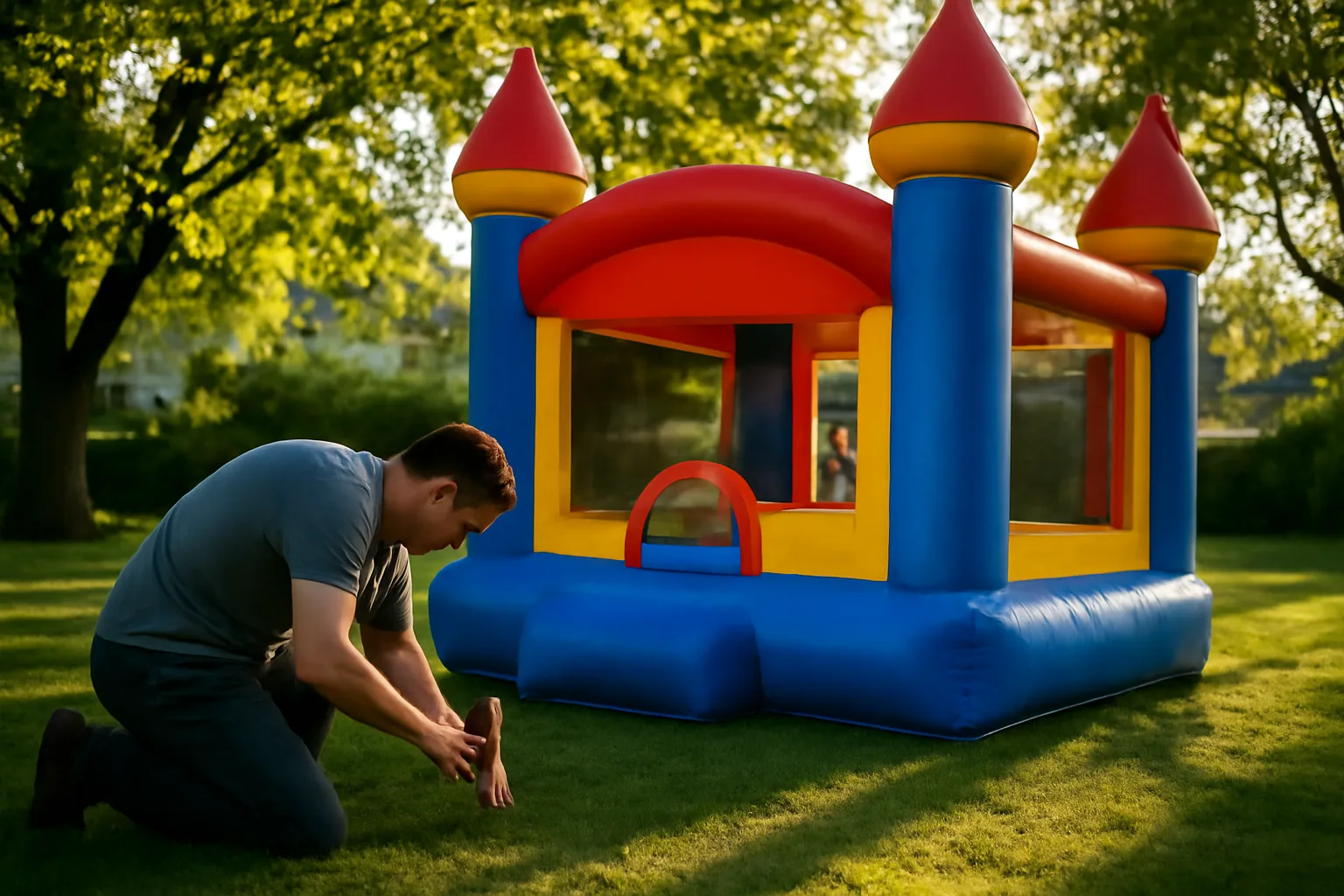
Bounce house rental is a local business that delivers, sets up, and picks up inflatable play devices for parties and events. You start like any small service firm: pick a legal structure, get a free EIN, buy commercial units and insurance, then confirm city permits and whether your state treats inflatables as amusement rides. There is no federal bounce house license.
What is bounce house rental?
Bounce house rental is a short-term equipment hire business. You own commercial inflatable play devices, deliver them to a site, anchor them, run a blower, then deflate, clean, and store the units. Most jobs last a few hours at a private party, school carnival, or company picnic.
It is not a carnival company. It is not a toy shop. The Census Bureau places this kind of consumer goods hire in NAICS 532289, All Other Consumer Goods Rental. [10] That code is for tax and survey paperwork. It is not a permit.
The product people mean is a blower-powered inflatable play device. ASTM F2374 is the consensus standard covering design, manufacture, operation, and maintenance of inflatable play devices. [2] Insurers and some inspectors talk in that language. Parents do not. They say bounce house rental and they mean the castle in the yard.
Customers lump every shape under one name. Operators split the fleet: open jumpers, combo units, obstacle runs, and slides. Wet units change cleanup, electrical load, and sometimes the insurance schedule. I would start dry unless you already know how you will drain and dry vinyl on a Sunday night.
An estimated 64,657 children with inflatable bouncer-related injuries were treated in US emergency departments from 1990 through 2010, according to Pediatrics. [1] Parks ask for certificates because of numbers like that. Carriers ask how you stake because of numbers like that.
A thin residential unit from a general merchandise site is a waste of money if you plan to charge strangers. Commercial vinyl, named anchor points, and a manufacturer operations manual are the baseline. If a maker cannot give you capacity and a wind limit, I would not put that unit in a bounce house rental fleet.
How do you start bounce house rental?
You start bounce house rental the same way you start any small service firm. Pick a legal structure, get tax IDs, confirm local licensing, buy commercial equipment, and put liability insurance in force before the first delivery. There is no federal bounce house rental license.
The SBA 10-step start guide is the boring skeleton: plan, choose a structure, register, get tax IDs, then licenses and permits. [4] Use that page. Do not pay a coach for a relabeled printout of it.
Applying for an EIN costs $0 through the IRS online application. [3] The IRS says, "Applying for an Employer Identification Number (EIN) is a free service offered by the Internal Revenue Service." Skip the sites that charge you for the same form.
My order is not the brochure order. Get an insurance indication first. If a carrier that actually writes party rental or amusement gear will not quote you, stop. Then buy one or two commercial units you can move with the vehicle you already have. Then file the entity and the EIN. Then register for local business tax if your city requires it.
Confirm every board fee with the office that cashes the check. Processing times move. Nobody should promise you an approval date, including this article.
Year one is weekends, weather cancellations, and cleaning. You will spend more hours on text messages than on blowers. That is the job.
If you want the insurance stack next, read what bounce house rental insurance actually covers and how operators prove coverage on site.
Do you need a special license for bounce house rental?
Most bounce house rental operators need a local business license or tax registration, not a national bounce house card. Some states also pull inflatables into amusement-ride statutes. You confirm both. You do not assume.
SBA tells new firms to register the business, then layer federal, state, and local tax IDs and licenses. [9] City hall is where a lot of first-year operators actually get stuck. Home occupation rules, a trailer on a residential street, and customer pickup at the house are local zoning questions. Call zoning. Ask them to put the answer in an email if they waffle.
State ride boards are the second gate. Texas Occupations Code Chapter 2151 regulates amusement rides and requires insurance to operate them. [6] Ohio Revised Code 1711.53 sets permit rules for amusement rides. [11] Pennsylvania publishes amusement ride and attraction rules in 7 Pa. Code Chapter 139. [12] Your inflatable may or may not sit inside those definitions this year. Confirm with the board. A blog list is not the statute.
Many states still have no inflatable inspection program. That is not permission to skip insurance or a city license. It just means the state paper path is shorter.
CPSC does not issue bounce house rental licenses. It publishes injury data and safety warnings. Those warnings still matter in a claim file. They are not a permit.
Paying a filing mill to register your amusement company nationwide is a waste of money. There is no such registry that replaces your city finance desk.
What insurance does bounce house rental usually require?
Bounce house rental usually needs a commercial general liability policy that schedules inflatables, plus hired auto or commercial auto if you deliver. Some states add amusement-ride insurance minimums. There is no single federal dollar limit.
Texas Occupations Code Chapter 2151 is the clean example of a state that ties operation to an insurance policy. [6] Read the current statute and the Texas Department of Insurance amusement ride program for the limits that apply to your class of ride. I will not invent a dollar figure. Boards update those numbers.
Parks, schools, and churches will ask to be additional insured. That is a certificate process, not a handshake. If your agent cannot issue additional insured endorsements on a Saturday morning, you will lose jobs you already quoted.
Do not run bounce house rental on a homeowner policy. Do not buy a cheap general liability quote that excludes amusement devices. Read the exclusion list before you take a deposit.
I would spend more time on insurance in month one than on extra vinyl. Units are replaceable. An uninsured injury is not.
Related reading on this site: state insurance minimums operators actually hit, certificates and additional insureds, and what exclusions sink bounce house rental claims.
What equipment should you buy in year one?
Year one equipment for bounce house rental is a small commercial jumper or combo, the blower the manufacturer specified, stakes and weights, a GFCI-protected cord set, a ground tarp, a cleaner the vinyl maker allows, and a way to move the bag. That is the kit. Most add-ons can wait.
Buy commercial grade. The manufacturer should give you capacity, anchor specs, and a wind limit. If they cannot, walk away. You cannot write those numbers yourself and expect an underwriter to smile.
A trailer is useful once you have two or three units. It is a waste of money if you have one castle and a van that already swallows the bag. Custom art on unit one is also a waste of money. So are LED extras you will forget to charge.
Power is a real constraint. Many backyards have one tired outdoor outlet. A small generator can save a job. It also creates carbon monoxide and fuel handling problems. Store fuel like an adult, not in a hot cargo van next to the vinyl.
InflatablePath sells a $149 one-time ASTM + Weather Kit if you want F2374-oriented notes and weather shutdown language in one packet. Buying ASTM F2374 from ASTM and writing your own weather sheet is the same work with more printing. [2] Either path beats guessing wind on site.
Stakes fail in drought-hard soil and in old asphalt. Carry weights. Operators who only carry stakes learn this on a playground with no grass left.
How much money does bounce house rental take to open?
Nobody publishes a government price index for bounce houses. Dealer quotes move with vinyl, freight, and season. A small used commercial jumper is often in the low thousands of dollars. A new combo with a slide is often several thousand more. Treat that as a shopping range, not a statute.
The costs that are board-confirmable are the boring ones. An EIN is free. [3] State entity filing fees sit on your secretary of state site. City business license fees sit on the city finance page. Insurance is a premium, not a filing. Confirm each figure with the office that takes the money.
IRS Publication 583 walks through starting a business and keeping records, including what receipts to hold. [13] A folder of invoices, policy pages, and inspection checklists beats a fancy app you will not open on Saturday.
I would not finance ten units. Cash for one or two, run a season, then buy the third with profit. Interest on vinyl that sits in a garage is a hobby with a payment book.
Do not buy a turnkey bounce house rental empire from a social ad. You still need local licensing, insurance, and a truck that can move the bags. The ad does not replace that.
Which states treat bounce houses as amusement rides?
Some states treat inflatables as amusement rides. Some do not. The only honest method is to read your state ride statute, then call the agency that inspects rides. Confirm the current definition. Do not copy a map from a forum post.
Texas Occupations Code Chapter 2151 is the amusement ride statute in Texas. [6] Ohio Revised Code 1711.53 is the permit statute to open in Ohio. [11] Pennsylvania amusement ride and attraction rules live in 7 Pa. Code Chapter 139. [12] Those three are examples, not a complete list. Other states have their own chapters. A few exempt inflatables under a size or pressure cutoff. Cutoffs change.
If your state has a ride program, expect some mix of insurance proof, inspection, and an operator ID. If it does not, parks and school districts will still invent their own vendor packet. That packet can be stricter than the state.
Never drop another state's form in your binder and call it compliance. Inspectors can read.
| State example | Where to start reading | What you still do |
|---|---|---|
| Texas | Occupations Code Chapter 2151 | Confirm TDI amusement ride program rules and current insurance language |
| Ohio | Revised Code 1711.53 | Confirm permit and inspection with the state ride office |
| Pennsylvania | 7 Pa. Code Chapter 139 | Confirm whether your inflatables sit in the attraction rules |
| Many other states | No inflatable ride program, or a narrow exemption | Still confirm city licensing, zoning, and insurance |
If you operate across a state line, you confirm both boards. Reciprocity is not a vibe.
What safety rules apply to bounce house rental operators?
Safety rules for bounce house rental come from the manufacturer, ASTM F2374, your insurer, local parks, and, if you have employees, OSHA. [2] [7] No single federal bounce house inspector visits your garage.
The Occupational Safety and Health Act section 5 says, "Each employer shall furnish to each of his employees employment and a place of employment which are free from recognized hazards that are causing or are likely to cause death or serious physical harm to his employees." [7] Setup on the shoulder of a road, chewed electrical cords, and unloading a heavy bag with one teenager are how bounce house rental meets that sentence.
CPSC warned the public in 2001 about wind danger with inflatables. [8] Wind still flips units. Follow the manufacturer's shut-down speed. If a parent argues, you cancel. You can refund. You cannot un-injure a child.
Capacity and mixed-age rules matter more than photos. The Pediatrics analysis is the reminder that this product produces emergency department visits in volume. [1] Write the rules on the contract and on a card at the entrance. Then enforce them when a dad wants to jump with toddlers.
What I actually do in the field: no shoes, no silly string, no flips if the maker forbids them, stakes and weights both on the truck, a weather check the morning of the job and again an hour before setup. Write it. Train whoever goes out.
More on shutdown language and coverage sits in weather shutdown and insurance.
How should you price bounce house rental jobs?
There is no national bounce house rental rate. You price against local competitors, drive time, unit size, and how ugly the setup is. A third-floor walk-up is not a backyard.
I would publish a weekend price and a weekday price. Take a deposit that hurts a little to forfeit. Write the wind and rain rule in the same size type as the price. People only read it when the sky turns.
Undercutting by twenty dollars to get reviews is how you work every Saturday for grocery money. Charge for delivery zones. Charge for extra hours. Do not throw in a popcorn machine you do not own yet.
Track cost per job: fuel, labor hours, payment processing, cleaning chemicals, and a reserve for vinyl repair. If you cannot name those numbers, you are guessing. Guessing feels busy. It is not a margin.
Parks sometimes set vendor rates. Schools sometimes set them. Those are a different channel from retail birthday jobs. Do not let a low park rate become your public list price by accident.
Keep the quote simple. Unit, hours, delivery zone, extra blower or generator if needed, and the cancel rule. Long menus hide the number customers actually compare.
What paperwork should a bounce house rental keep?
Keep a rental agreement, a site inspection checklist, a weather log, an incident form, training notes, and the manufacturer's manual for each unit. Keep the insurance policy, certificates you issued, and your entity documents. IRS Publication 583 is the federal reminder that businesses need records, not vibes. [13]
Photos of stakes in the ground and of the blower setup have ended more lawn damage arguments than any paragraph of legal poetry. Take them before kids get on. Take them again at teardown.
If a state ride board is in play, keep whatever inspection report they issue. If a city business license has an expiration, put it on a calendar. Boards do not call you to remind you.
Digital copies are fine. A binder in the truck is better on a Saturday when the phone is dead and the park attendant wants a certificate now.
Do not collect signed waivers and then ignore your own weather clause. Paper only works if you follow it when a customer is standing in the driveway.
Sales tax on bounce house rental is a state question. Many states tax the rental of tangible personal property. Confirm with your state department of revenue. File on their calendar, not on yours.
Should you form an LLC before the first bounce house rental?
You can start bounce house rental as a sole proprietor. Many people do. An LLC is a state filing plus an operating agreement, not a force field. The IRS business structures page is the tax view of sole proprietor, partnership, corporation, and S corporation. [5] SBA's choose-a-structure page is the plain-language twin. [14]
I would form an LLC once insurance and a real job pipeline exist, or sooner if a venue requires it on the vendor form. I would not delay the first booked party for six weeks of logo work.
An LLC does not replace insurance. People who say they skipped the policy because they filed articles of organization are repeating a myth that dies in a claim file.
Single-member LLC federal income tax default is a disregarded entity in typical cases. Confirm current IRS treatment with IRS materials or a CPA. I am not your CPA.
Registered agent, state annual report, and a separate bank account are the unglamorous parts. Do those. Do not buy a trademark on a name you have not even run for a season.
If you hire, wage rules show up whether you are an LLC or not. Classification mistakes are their own mess. Keep it simple in year one: you on the truck, maybe one trained helper, records for every payment.
What does first-year bounce house rental operations look like?
First-year bounce house rental is a weekend logistics job. You book Friday through Sunday, watch the forecast like it owes you money, and spend Monday cleaning vinyl. Weekdays are school carnivals if you chase them. Or they are quiet.
You will cancel for wind. You will have a no-show site. You will wait for a homeowner who just ran to the store. Build slack into the route. Two jobs a day is plenty until you have a second trained person who can stake without you standing there.
Hire slowly. If you have employees, wage and hour rules apply, and OSHA's general duty still applies. [7] Paying a cousin cash with no records is how people create a second problem next to the first one.
Marketing that works in year one is usually local and ugly: a clean profile on the map listing, a phone that you answer, and being the person who shows up on time. National lead marketplaces take a cut and send you tire kickers. I would skip them until your calendar is actually full.
Cleaning is operations, not a footnote. Sand, cake icing, and grass stains are why vinyl fails early. Follow the cleaner the maker named. Skip household bleach experiments.
InflatablePath is an independent publisher, not a law firm and not a service company. Use /start if you want the checklist version of this path. Confirm every fee, form, and amusement-ride definition with the board that owns it.
Frequently asked questions
What is bounce house rental?
Bounce house rental is short-term hire of commercial inflatable play devices. You deliver, anchor, inflate, then take down and clean the unit. Jobs are usually private parties, schools, and company picnics. Census NAICS 532289 is the typical rental code. It is a logistics business, not a carnival, and it has no federal operator license.
How do you start bounce house rental?
Start like any small service firm. Confirm an insurer will write inflatables, buy one or two commercial units, choose a legal structure, get a free IRS EIN, then check city licensing and your state amusement-ride board. There is no federal bounce house license. Confirm fees with each board. Do not pay a reseller for an EIN.
Can I start bounce house rental as a sole proprietor?
Yes. Many operators start as sole proprietors. The IRS still expects records and tax filings. An LLC is optional at the start unless a venue demands it. An LLC does not replace liability insurance. Confirm entity rules with your secretary of state and tax treatment with IRS structure guidance or a CPA.
Do I need a CDL to haul bounce houses?
Usually no, if your truck or trailer stays under federal CDL weight thresholds and you are not hauling a combination that requires one. Confirm GVWR on the door sticker and your state DMV rules. Do not guess from a forum. Overweight trailers and bad tie-downs are how a Saturday job becomes a roadside problem.
Can I store bounce houses at my house?
Sometimes. Zoning and HOA rules decide it, not your lease with yourself. A trailer on a residential street, customer pickup at the house, and a blower tested at 7 a.m. are the fights. Ask zoning in writing. If they say no, rent storage before you buy a third unit.
Are cheap residential inflatables OK for bounce house rental?
I would not. Commercial bounce house rental needs commercial vinyl, named anchor points, and a manufacturer manual with capacity and wind limits. Many insurers will not schedule a no-name backyard unit. The cheap castle is a waste of money if you cannot put it on a policy or at a park.
What wind speed should cancel a bounce house rental?
Use the manufacturer's shut-down speed, not a number you saw on social media. CPSC has warned about wind danger with inflatables since a 2001 news release. If the maker did not give you a limit, do not rent that unit. Write the cancel rule in the contract and follow it when a parent wants to proceed anyway.
Do schools need to be additional insured on bounce house rental?
Most schools and parks will ask to be named as additional insured and will want a certificate before you unload. That is a policy endorsement process through your agent. Build time for it. A carrier that cannot issue certificates fast will cost you the jobs that pay midweek.
Is bounce house rental income taxable?
Yes. Rental income is business income. You still file. Many states also tax the rental of tangible personal property, which can include inflatables. Confirm sales tax with your state department of revenue. Keep invoices as IRS Publication 583 describes. A separate bank account keeps the year from turning into a shoebox.
How many units do I need to start bounce house rental?
One commercial unit is enough to learn delivery, staking, and weather cancels. Two lets you stack a Saturday. Ten in year one is how vinyl sits in a garage while insurance and marketing lag. I would buy the third unit with profit after you know which size actually books.
Do I need a generator for bounce house rental?
Not on every job. Many sites have an outdoor outlet. A generator saves you when the outlet is dead or too far. It also adds fuel, carbon monoxide, and cord-trip hazards. If you carry one, use GFCI protection and keep exhaust away from kids and from the bounce house rental setup.
Does CPSC license bounce house rental companies?
No. CPSC does not issue bounce house rental licenses. It collects injury data through NEISS and publishes safety warnings, including wind danger. Licensing, if any, is city business registration plus, in some states, amusement-ride statutes. Confirm with your local finance desk and state ride board.
What NAICS code is bounce house rental?
Census NAICS 532289, All Other Consumer Goods Rental, is the usual bucket for party and inflatable hire. Banks and some license forms ask for it. It does not authorize you to operate. You still need local registration, tax IDs, and insurance. Confirm the code on the Census NAICS page if a form demands a number.
How do I get a certificate of insurance for a park?
Ask your agent for a certificate naming the park or city as additional insured, with the limits and wording the park packet lists. Send it before setup day. If your bounce house rental policy excludes amusement devices, the certificate will not save you. Read exclusions when you buy the policy, not at the gate.
Sources
- Pediatrics, Pediatric Inflatable Bouncer-Related Injuries (PubMed 23147930): An estimated 64,657 children with inflatable bouncer-related injuries were treated in US emergency departments from 1990 through 2010.
- ASTM F2374-21 Standard Safety Specification for Inflatable Play Devices: ASTM F2374 is the consensus standard for design, manufacture, operation, and maintenance of inflatable play devices.
- IRS, Apply for an Employer Identification Number (EIN) Online: Applying for an EIN is a free service offered by the Internal Revenue Service.
- U.S. Small Business Administration, 10 steps to start your business: SBA outlines planning, structure, registration, tax IDs, and licenses as the start path for a new firm.
- IRS, Business structures: IRS describes sole proprietor, partnership, corporation, and S corporation tax structures for small businesses.
- Texas Occupations Code Chapter 2151, Regulation of Amusement Rides: Texas Occupations Code Chapter 2151 regulates amusement rides and requires operators to carry insurance.
- OSHA, OSH Act Section 5 Duties: Each employer shall furnish employment free from recognized hazards likely to cause death or serious physical harm.
- CPSC News Release, Wind Danger with Inflatables (2001): CPSC warned consumers of potential wind danger with inflatable amusement devices.
- U.S. Small Business Administration, Register your business: New firms register the business and then obtain required federal, state, and local licenses and tax IDs.
- U.S. Census Bureau, NAICS 532289 All Other Consumer Goods Rental (2022): NAICS 532289 covers all other consumer goods rental, the typical census bucket for party and inflatable hire.
- Ohio Revised Code 1711.53, Amusement ride permits: Ohio Revised Code 1711.53 sets permit and related rules for amusement ride operation.
- 7 Pa. Code Chapter 139, Amusement Rides and Attractions: Pennsylvania amusement ride and attraction rules are published in 7 Pa. Code Chapter 139.
- IRS Publication 583, Starting a Business and Keeping Records: IRS Publication 583 explains recordkeeping for a new business, including what receipts to retain.
- U.S. Small Business Administration, Choose a business structure: SBA summarizes how legal structure choices affect registration, tax, and personal liability questions.