Last updated 2026-08-21
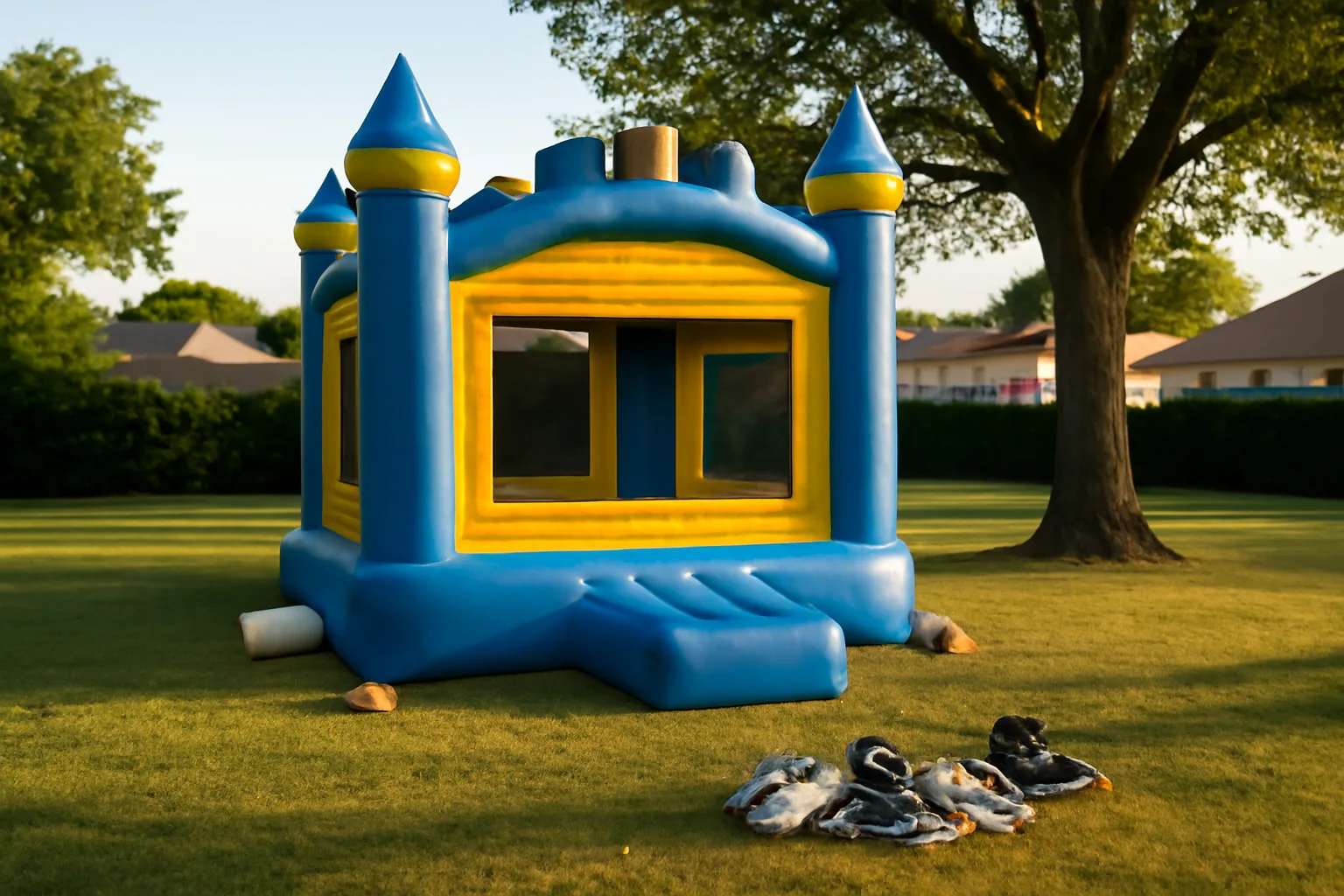
TL;DR
Bounce house rental is paid delivery and setup of inflatable amusement devices. You start with an entity, an EIN when the IRS requires one, commercial gear, insurance, and any state ride permit. Keep wind and inspection paper on every job. Rules split by city and state. Confirm with the board that inspects amusement rides where you operate.
What is bounce house rental?
Bounce house rental is a short-term hire business. You deliver an inflatable amusement device, anchor it, run a blower, watch the sky, then pack it out for a fee.
Most jobs are private parties, school fun days, churches, and company picnics. You are selling time on a standing structure, not a boxed toy. Many party rental shops sit in Census NAICS 532289 (All Other Consumer Goods Rental), though your accountant may pick a different code if you also run a counter rental store. [12]
Here is the part people forget. You put children on vinyl that can leave the ground in wind. That is the whole job, and it is why the paper exists. CPSC recorded 11 deaths from 2003 to 2017 involving inflatables blown over or away by wind. [1] Keep that number next to your price sheet.
A normal booking is a few hours of customer time plus your load-in and load-out. Some towns treat you like any other contractor. Some states treat the unit like an amusement ride. Skip anchoring, attendant rules, or a weather cutoff and you do not have a rental company. You have a weekend hobby with a lawsuit attached.
How do you start bounce house rental?
You start on paper, then you buy vinyl. Reverse that and you will own a unit you cannot put on a school lawn.
Pick a legal form. Do nothing and you are a sole proprietor by default. An LLC is a state filing, not a force field. SBA explains the tradeoffs; I would stay a sole prop until a venue, a broker, or a lender asks for an entity, then file. [5] Get an EIN when you hire, form an LLC, or need it on bank and insurance forms. The IRS says, "Applying for an EIN is a free service offered by the Internal Revenue Service." [3] A sole prop with no employees can use a Social Security number, but many insurers still want an EIN.
File the city or county business license if your town requires one. Pull a sales tax permit if your state taxes party rental, which most states do. Then call the state office that inspects amusement rides and ask, in writing, whether your inflatables need an annual permit. Florida's statute is blunt: "An amusement ride may not be operated without a current permit issued by the department." [9] Ohio bars operation without a permit under Revised Code 1711.53. [13] Texas puts amusement rides under Occupations Code Chapter 2151, including insurance duties. [8] Your county may match none of those. Confirm with the board. Never treat a blog as the permit.
Buy commercial rental-grade inflatables, not backyard vinyl. Match liability insurance. Write a setup sheet from ASTM F2374. [2] Run a handful of low-stakes backyard jobs before you bid a festival. Do not lease warehouse space in month one. One or two clean commercial units, a blower that starts, real stakes or water barrels, a legal trailer, and a phone you answer will beat a wrapped fleet you cannot keep busy.
Do you need a license to rent bounce houses?
Yes. You almost always need some local license, and in several states you also need an amusement ride permit. The mix is local. SBA puts it this way: licenses and permits "depend on your business activities, location, and government rules." [4] Confirm with city hall and the state ride office before you take a deposit.
Think in three stacks, not one magic card. Federal paper is thin at the start (EIN, later payroll forms if you hire). State paper is where ride permits, entity filings, and sales tax live. City or county paper is the business license, occupancy if you store gear in a building, and sometimes a fire inspection for a warehouse.
Florida and Ohio are the clean examples because the statutes say you may not operate without a permit. [9] [13] Texas Chapter 2151 is the insurance-and-ride chapter operators actually get asked about at school gates. [8] Plenty of states still leave backyard party inflatables to local rules. That is not a loophole you should guess at. Email the ride board a photo of the unit and the manufacturer tag and keep the reply.
| Paper | Who issues it | Typical trigger |
|---|---|---|
| EIN | IRS | hiring, an LLC, or insurer request |
| Sales tax permit | state revenue department | taxable rental charges |
| Ride or inflatable permit | state agriculture, labor, or insurance office | public amusement in regulated states |
| Local business license | city or county | operating from an address |
If a clerk says inflatables are "just toys," ask them to put that in writing. If they will not, keep calling the amusement ride desk.
What insurance does bounce house rental actually need?
You need commercial general liability written for amusement or inflatable rental, plus any minimum your state ride statute sets. A homeowners policy will not cover this. Venues will ask for a certificate that names them as additional insured.
Texas Occupations Code Chapter 2151 makes an insurance policy a condition of operating an amusement ride. [8] The dollar floors are in the statute and change by class of ride. Read the current section. Do not copy a number from a forum post.
Schools and parks commonly ask for $1 million per occurrence. That is a contract demand, not a national law. Some festivals want $2 million. Some want a waiver of subrogation. Your broker should already write inflatable operators. If they have never issued a cert with a bounce house schedule, find another broker.
I would not take a job that requires a cert I cannot produce. I also would not buy a $5 million umbrella in month one because a salesperson scared me. Get the limit the venues in your actual market print on their vendor packet, then add inland marine or equipment coverage if the trailer and vinyl would hurt to replace. Confirm every endorsement with the carrier. InflatablePath is not an insurer.
What safety standard covers bounce house rental?
ASTM F2374 is the standard practice for design, manufacture, operation, and maintenance of inflatable amusement devices. [2] Inspectors, insurers, and manufacturers point at it. Own the current edition and build your setup sheet from it, not from memory.
The standard is not a license. It does not replace Florida's permit or Ohio's permit. It is the ops manual the rest of the paper assumes you follow. Anchoring, attendant rules, deflation, daily inspection, and weather cutoffs live here. If your manufacturer's manual is stricter than your habit, the manual wins.
CPSC's 2019 wind warning is the public version of the same idea. The agency said it "warns consumers and event operators of the potential wind-related hazards of inflatable amusement devices, such as bounce houses and inflatable slides." [1] I keep a wind log in the truck. If you want that paperwork bundled, InflatablePath sells a $149 one-time ASTM + Weather Kit; you can also build the same logs yourself from F2374 and the CPSC release.
Training is your name on a page. Send a helper and they need the same staking pattern, the same max occupancy, and the same kill rule for wind. A laminated card in the blower bag beats a speech you gave in March.
How much does it cost to start bounce house rental?
Nobody publishes a clean national price index for this trade. The closest honest answer is a range with ugly variance, because used vinyl, insurance appetite, and city fees do not move together.
New commercial bounce houses I see listed by manufacturers and dealers usually start in the low thousands for a basic unit and climb fast for wet combos and obstacle courses. Used prices are noise. A cheap residential-grade castle is a waste of money if a school inspector or an insurer will not touch it. Budget for extra blowers, repair patches, a ground tarp, real stakes, and ballast barrels, more than the pretty unit in the photo.
Insurance is the line that surprises people. Two surplus lines brokers who already write amusement rental will give you a real quote. I would not trust a blog premium. Entity filing fees are set by your secretary of state. Local licenses are set by your city. Ride inspection fees are set by the state board. Confirm each one. Do not scale to six units until two units are busy on the same Saturday without you skipping anchors.
A trailer and a truck you already own can be enough. A new box truck in year one is usually ego. If the truck's combined rating starts flirting with commercial vehicle rules, stop and read the CDL section before you buy.
What wind and weather rules apply on site?
You shut down when the manufacturer, ASTM F2374, or the local inspector says so, whichever is stricter. Wind is the killer people still shrug off. CPSC is aware of 11 deaths from 2003 to 2017 involving inflatables that were blown over or away by wind. [1]
I use a handheld anemometer, not a phone widget, and I take the reading at the site, not at the house. Gusts matter more than a pretty average. If the forecast is already at the cutoff before I leave the yard, I cancel. A wet deposit fight is cheaper than a unit in a parking lot.
Rain is a product problem as much as a safety problem. Wet vinyl tears, blowers hate puddles, and electrical cords on wet grass is a bad mix. Lightning is an easy call: down, dry, wait. Heat is the one operators forget. Kids get sick, attendants zone out, and dark vinyl cooks bare feet. Shade, water, and a shorter session beat a tough-guy schedule.
Write the cutoff on the contract in plain numbers. Put the same numbers on the attendant card. If a parent argues, you point at the card, not at your mood.
Do you need an EIN and a sales tax permit?
You need an EIN if you have employees, if you form an LLC or corporation, or if a bank or insurer refuses to write you without one. The IRS online application is free. [3] You do not need to pay a third-party site for a number the government issues at no charge.
Sole proprietors with no employees can often use a Social Security number for federal filing and still report the business on Schedule C (Form 1040). [6] That is the normal first-year federal tax paper. It is not optional just because you got paid in cash. Hire someone and you have payroll forms, and the contractor-versus-employee test is a real IRS page, not a vibe. [7]
Sales tax is state law. Party rental is taxable in most states, including delivery fees in some of them. You register with the state revenue department, charge the rate for the job location if that is how your state works, and file on their calendar. Confirm with that department. I would not copy a neighboring state's rule.
Keep invoices that split rental, delivery, and damage waiver if you use one. When an auditor asks how you taxed a Saturday in another county, you want a paper trail, not a memory.
What vehicle and labor rules hit bounce house rental?
Most operators never need a CDL because a pickup and a small trailer stay under the federal commercial motor vehicle threshold. Under FMCSA rules, a CDL class is in play when the vehicle (or combination) hits a GVWR of 26,001 pounds or more, or other listed triggers. [11] Weigh the trailer as loaded, read the door sticker, and confirm. Do not guess from the Craigslist ad.
Pay helpers and you have to decide if they are employees. The IRS test looks at control, not at what you printed on a 1099. [7] A person who only shows up when you call, uses your truck, and follows your staking card looks like an employee. Misclassification is a boring way to blow year two.
OSHA injury logs have a partial exemption for employers with 10 or fewer employees, but that is recordkeeping, not a free pass on safe work. [14] Workers' compensation is state law. Some states require it as soon as you have one employee. Confirm with your state workers' comp bureau. I would not send a teenager in a personal car to collect cash without written rules on driving, lifting, and who talks to the customer.
Still stacking this against a regular job? The comparison in bounce house rental vs nearby career is the honest version of that math.
What paper should you keep for every bounce house job?
Keep a file you could hand an inspector or a claims adjuster on a bad Monday. Contract, signed waiver if you use one, COI sent to the venue, setup checklist, wind readings, incident notes, and photos of anchors before guests arrive.
The injury numbers are why this is not theater. Pediatrics estimated 64,657 children were treated in U.S. emergency departments for inflatable bounce house-related injuries from 1990 through 2010. [10] Your file will not stop every sprain. It will show you ran the device like a rental operator, not like an uncle with a blower.
I take four photos: stakes or barrels, blower plug, entrance, and a wide shot of clear area. I write the anemometer reading and the time. Refuse a start and I write that too. Repair logs belong with the unit, not in a text thread you will delete.
Digital is fine if you can find it offline. A folder per Saturday with the address in the filename is enough. Fancy software is optional. Lost waivers are not.
Which states inspect inflatable rides?
Several states put inflatables inside amusement ride law. Florida requires a current department permit before an amusement ride operates. [9] Ohio requires an annual permit under Revised Code 1711.53. [13] Texas regulates amusement rides in Occupations Code Chapter 2151. [8] Other states use labor departments, agriculture departments, or insurance departments. Some leave private-property party rentals alone and still inspect public events.
There is no single federal inflatable license. CPSC publishes hazard warnings and injury data. It does not mail you a rental card. [1] ASTM F2374 is the voluntary consensus standard manufacturers and many inspectors use. [2] That split is why operators get cocky after one easy county and then fail a school booking two zip codes over.
Call the state board, send the serial plate, and ask whether backyard party rental is in scope. Ask whether a third-party inspector they recognize can sign the annual. Ask the fee. Then believe the letter you get, not a Facebook group. Related checklists live in bounce house rental guide 12 and bounce house rental guide 24 if you want more side-by-side reading after this.
What would I skip in the first year of bounce house rental?
I would skip the warehouse, the wrap, the sixth unit, and the custom mascot. I would skip paying a mill for an EIN. I would skip "we are fully licensed nationwide," because that sentence is false on its face.
I would not skip stakes, ballast, a spare blower, a real anemometer, or the COI process. I would not skip asking the ride board. I would not skip sales tax registration if my state taxes the hire.
Year one is proof you can set, babysit, and recover the same two units without wrecking them. Marketing that outruns operations is how vinyl dies in a parking lot. If you want more comparison pieces after this, bounce house rental guide 36, bounce house rental guide 48, bounce house rental guide 60, and bounce house rental guide 78 are next reads, not substitutes for your state board.
Want the ASTM-style logs in one download? The kit is at /start. InflatablePath is an independent publisher, not a law firm and not a rental company. Confirm fees, forms, and whether your unit is even in scope with the agency that actually inspects rides in your state.
Frequently asked questions
Is bounce house rental a business or a hobby for the IRS?
If you intend to profit and you actually operate, the IRS expects you to report it. Sole props without a separate entity usually use Schedule C with Form 1040. Losses you cannot defend as a real business get hobby treatment. Keep invoices, ads, and repair receipts. Confirm filing with a tax pro who has seen party rental, not with a group chat.
Can I run bounce house rental from my house?
Often at first, if zoning, the lease or HOA, and your insurer allow storage and trailer parking. A quiet residential street can still bar commercial traffic or outdoor storage. Check zoning and the policy, more than the Facebook listing. A small storage unit is cheaper than a cease-and-desist plus an excluded claim.
Are private backyard parties exempt from ride inspections?
Sometimes, in some states, for some devices. Florida, Ohio, and Texas still have amusement ride statutes that can pull inflatables in, especially at public or ticketed events. Private use is the question you ask the state board in writing, with photos of the unit. Do not assume a backyard booking is invisible.
What is ASTM F2374 in plain English?
It is the consensus standard for how inflatable amusement devices should be designed, built, operated, and maintained. Inspectors and insurers treat it as the ops baseline. It is not a government license. Buy the current edition and copy its inspection and anchoring ideas into a one-page sheet your attendant can actually use.
How many bounce houses do I need to start?
One commercial unit you can keep clean, plus a spare blower, is enough to learn the paper and the Saturday rhythm. Two units let you recover if one is down. Six units in month one is how people fund vinyl that sits. Add a piece when two same-day holds are regular, not when a salesperson has a package deal.
Do I need workers' compensation for bounce house rental?
If you have employees, many states require it immediately. If you only pay yourself as a sole prop, rules vary and some states make coverage optional for the owner. Helpers you treat as contractors may still be employees under IRS control tests. Confirm with your state workers' comp bureau before the first paid helper.
What does a certificate of insurance need to say?
It needs your legal name, the policy period, the limits the venue printed, and the venue named as additional insured if they asked. Some want the inflatable schedule listed. Send the cert before the job, not after setup. Your broker should already know amusement rental wording. Confirm endorsements with the carrier, not with a template you found online.
Can I rent to schools without extra paperwork?
Rarely. Schools usually want a COI, additional insured language, sometimes an inspection cert, and a contract on their forms. Some states treat a school carnival as a regulated amusement event even when backyard parties are quieter. Ask the district vendor office and the state ride board. Budget more lead time than a birthday.
Is an LLC required to start bounce house rental?
No. Plenty of first-year operators start as sole proprietors and report on Schedule C. An LLC is a state filing that some venues and insurers like. It is not a substitute for liability insurance or ride permits. I would form one when a real counterparty asks, or when the extra paper is cheaper than arguing with a district vendor packet.
What happens if the wind comes up mid-event?
You evacuate, deflate, and stop. CPSC documented 11 wind-related inflatable deaths from 2003 to 2017. Put the cutoff in the contract so a parent argument does not become a delay. Log the reading. A canceled hour is cheaper than a unit that leaves the stakes.
Do I charge sales tax on delivery fees?
That is state-specific. Some states tax the rental and the delivery as one taxable service. Some split them. Register with your state revenue department and follow their publication on taxable services. Put the tax on the invoice as a separate line so you can defend the return. Confirm, because copying another state's rule is how people get bills.
Where do I confirm my state's bounce house ride rules?
Start with the state agency that already inspects amusement rides. That is often agriculture, labor, or the insurance department. In Florida read statute 616.242. In Ohio read Revised Code 1711.53. In Texas read Occupations Code Chapter 2151. Email a photo of the manufacturer tag. Keep the reply with your COI.
Sources
- U.S. CPSC, 2019 news release on wind-related inflatable hazards: CPSC warned operators about wind hazards of bounce houses and inflatable slides and reported 11 deaths from 2003 to 2017 involving inflatables blown over or away by wind.
- ASTM International, F2374-21: ASTM F2374 is the standard practice for design, manufacture, operation, and maintenance of inflatable amusement devices.
- IRS, Apply for an Employer Identification Number (EIN) Online: Applying for an EIN is a free service offered by the Internal Revenue Service.
- U.S. Small Business Administration, Apply for licenses and permits: The licenses and permits a business needs depend on activities, location, and government rules.
- U.S. Small Business Administration, Choose a business structure: SBA outlines sole proprietorship, LLC, and other legal structures for new businesses.
- IRS, About Schedule C (Form 1040): Sole proprietors report business profit or loss on Schedule C (Form 1040).
- IRS, Independent contractor, self-employed, or employee: IRS classification of helpers depends on facts of control, not on a 1099 label alone.
- Texas Occupations Code Chapter 2151, Regulation of Amusement Rides: Texas regulates amusement ride operation and insurance duties under Occupations Code Chapter 2151.
- Florida Statute 616.242 (2023), Safety standards for amusement rides: Florida law states an amusement ride may not be operated without a current permit issued by the department.
- American Academy of Pediatrics, Pediatrics (2012), bounce house injuries: An estimated 64,657 children were treated in U.S. emergency departments for inflatable bounce house-related injuries from 1990 through 2010, with a 15-fold increase in number and rate from 1995 to 2010 and a mean age of 7.5 years.
- eCFR, 49 CFR 383.5 commercial motor vehicle definition: Federal CDL rules use a GVWR threshold of 26,001 pounds or more (among other triggers) for a commercial motor vehicle.
- U.S. Census Bureau, 2022 NAICS 532289 details: NAICS 532289 covers All Other Consumer Goods Rental, a common code bucket for party and consumer goods rental firms.
- Ohio Revised Code 1711.53, Amusement ride permits: Ohio requires a permit before an amusement ride may be operated in the state.
- OSHA, 29 CFR 1904.1 partial exemption for small employers: OSHA partially exempts employers with 10 or fewer employees from routine injury and illness recordkeeping.