Last updated 2026-08-21
TL;DR
Bounce house rental is short-term hire of commercial inflatables, with delivery, setup, and teardown. You start it on paper: entity, free IRS EIN, liability insurance that meets your state's amusement-ride floor (Texas sets $1 million per occurrence), ASTM F2374 operations, and permits confirmed with the state board. No national license exists. Confirm fees locally. Do not take deposits until the insurance binder is in hand.
What is bounce house rental?
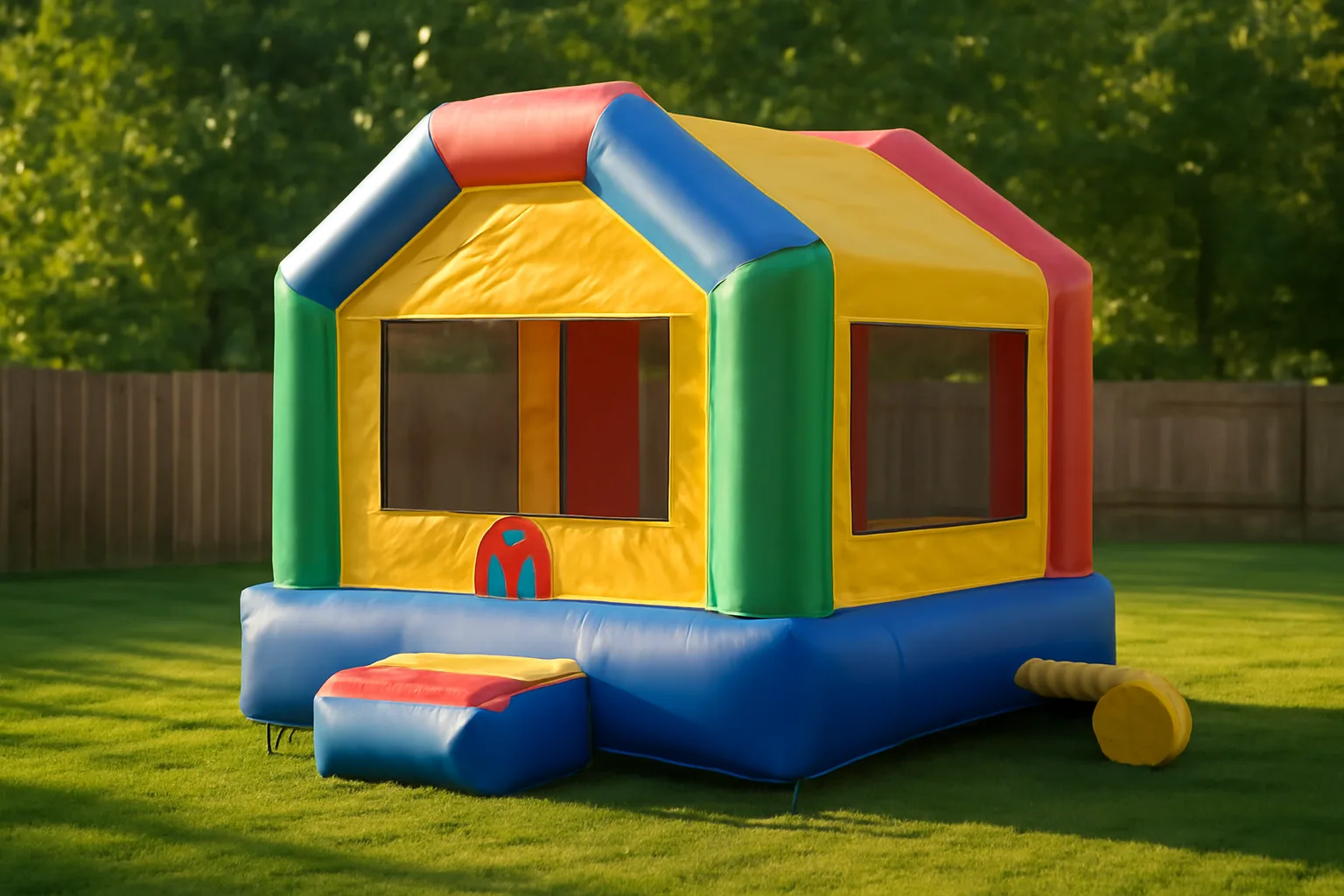
Bounce house rental is a short-term hire business. You own commercial inflatable amusement devices, you deliver them, you stake them, you run a blower, you brief the adult on site, and you pick them up. The unit is the product. The paper is the business.
People mix this up with a toy. A backyard vinyl castle from a big-box aisle is a consumer product. A rental unit is an amusement device. That split decides your insurance, your inspections, and who you can legally put kids on. Treat a consumer castle as inventory and your first claim will teach you the difference.
The work is physical and local. You need a truck or van, a way to store dry units, ground stakes or water barrels, extension cords that match the blower, and a weather call you will actually honor. Most jobs are birthdays, school carnivals, church picnics, and corporate family days. Parks and public festivals often add a second layer of permits the backyard job never asks for.
Injury risk is not a rumor. Pediatrics reported that an estimated 64,657 children 17 and under were treated in U.S. emergency departments for inflatable bouncer-related injuries from 1990 through 2010, and that the count rose 15-fold across that span [1]. That number is why underwriters ask about ASTM practice, anchoring, and attendant rules before they bind a policy.
You are not a franchise of a national brand unless you buy one. You are a local operator with a unit list, a calendar, and a file of certificates. That is bounce house rental.
How do you start bounce house rental?
You start on paper, then you buy vinyl. Do it backward and you own a pile of inventory you cannot legally put on a lawn.
Pick a structure. The U.S. Small Business Administration walks through sole proprietorships, partnerships, LLCs, and corporations, and it is blunt that the choice changes tax, paperwork, and personal liability [3]. I would form an LLC in the state where the truck lives. A sole prop is cheaper on day one and mixes your house with the blower. That trade stops being worth it the moment a child breaks an arm.
Get an EIN. The IRS says plainly that "applying for an EIN is a free service offered by the Internal Revenue Service" [2]. Do it on IRS.gov. Anyone charging you for the number is selling a form the government already gives away.
Register the entity with your state, then ask the city or county what a home-based rental business needs for zoning and a basic business license [9]. That local license is not an amusement-ride permit. People collapse the two and then get surprised at a festival gate.
Call an insurer that already writes amusement inflatables before you click buy on a unit. Ask what they require for ASTM documentation, tagged blowers, training logs, and wind cutoffs. Then buy the unit that fits the policy, not the unit that looks biggest on a product page.
Confirm with the state ride board whether your units count as amusement rides in that state. Florida treats amusement rides as a permitted class of device under statute 616.242 [5]. Ohio requires a permit before you operate an amusement ride [6]. Texas runs a different shop, but it bans operating a ride without a current inspection certificate and a liability policy of at least $1 million per occurrence [4]. Your board, not a Facebook group, is the source.
Only after the binder, the entity, and the board answer would I take a deposit. First-year operators skip that order because they want Saturday revenue. Saturday revenue does not pay the claim.
Do you need a license or amusement ride permit?
There is no federal bounce house rental license. The CPSC does not issue operator cards. What you need is a stack that changes by state and by venue.
Start with the ordinary stack: state entity filing, EIN, local business license, and a sales tax account if your state taxes rental of tangible personal property [9]. That stack gets you a legal firm. It does not get you onto a fairground.
Then ask whether inflatables count as amusement rides where you work. In Florida, amusement ride operation is a statutory permit matter under section 616.242, and you confirm current forms and fees with the Florida Department of Agriculture and Consumer Services, not with a blog [5]. In Ohio, the Revised Code is direct: no person operates an amusement ride without a permit [6]. In Texas, Chapter 2151 of the Occupations Code is the amusement ride safety inspection and insurance act, and the operator paper is an annual inspection certificate plus the insurance policy [4].
A private backyard birthday and a public event are not the same job. A county that shrugs at a Saturday lawn rental may still want a ride permit, a site inspection, or an additional insured endorsement when the same castle sits in a city park. Read the park rules. Call the risk manager. Get the answer in writing.
Fees and processing times change. I will not quote a board's current dollar amount or a wait in days. Confirm those with the board that will stamp the permit. Anyone publishing a national license cost for bounce house rental is inventing a number.
What insurance do bounce house rental companies actually carry?
You carry commercial general liability written for amusement inflatables. Not a homeowners endorsement. Not a generic handyman policy. Homeowners forms exclude business use, and when a child is hurt, that exclusion is the whole story.
Statute floors are real in several states. Texas Occupations Code 2151.101 says a person may not operate an amusement ride unless the person "has an insurance policy currently in effect" in "an amount of not less than $1 million per occurrence" [4]. Ohio sets a statutory insurance floor of not less than one million dollars for amusement ride operation [7]. Other states use different figures or bury the number in a regulation. Confirm it with the board and the carrier. Do not assume $1 million is required everywhere, and do not assume it is enough everywhere.
What I would buy is the policy the amusement market actually issues: CGL with the inflatable schedule named, medical payments, and the ability to certificate additional insureds for parks, schools, and HOAs. Umbrella coverage is a conversation with the same underwriter, not a separate internet purchase.
Certificates are operations, not paperwork. Schools and cities will ask to be additional insured, they will ask for waiver of subrogation, and they will reject a certificate that lists "bounce houses" as "misc. indoor property." Get the schedule right.
Nobody has a clean public dataset of average bounce house rental premiums by county. Carriers price on units, limits, losses, and whether you attend. Any national post that says insurance costs a flat number is marketing.
What equipment standard applies to bounce house rental?
ASTM F2374 is the standard practice for design, manufacture, operation, and maintenance of inflatable amusement devices [8]. States and underwriters point at it because the industry wrote it for bounce houses, slides, and similar inflatables, not because a federal inspector hands it to you at the border.
You need the current edition, not a summary slide. Read the operations and maintenance pieces. Those are the parts that show up in a claim file: anchoring, attendant duties, capacity, weather, deflation, and inspection. Manufacturers still control model-specific wind cutoffs and occupancy. The standard does not replace the spec sheet sewn into the bag.
Commercial units are built for repeated setup. Consumer units are not. I would not put a big-box castle on a rental calendar. Insurers often will not schedule it, and the seams will not survive your fifteenth teardown of June.
Blowers, GFCI, and stakes are part of the device. A castle without a matching blower is a tarp. Keep serials, purchase invoices, and patch logs in one folder. That folder is how you prove the unit on the certificate is the unit on the grass.
If you want the standard and a weather log in one packet, InflatablePath sells a $149 one-time ASTM + Weather Kit. You can also buy F2374 straight from ASTM and keep your own wind log. Either path beats guessing.
How much does it cost to start bounce house rental?
There is no honest national start-cost number I will print as a single figure. Equipment, trailers, insurance, and permits move too much by state and by how many units you buy. Anyone selling a nationwide turnkey for one price is averaging markets that do not belong together.
What you can pin down is the paper that is free or cheap, and the paper that is not. An EIN is free from the IRS [2]. Entity filing is a state fee you confirm with the secretary of state. Local licenses are city or county fees [9]. Insurance is the large recurring check, and it only quotes after the underwriter sees the unit list. The vinyl is the other large check, and used commercial units trade in a market, not at a catalog price.
State-level cost writeups beat a U.S. average. If you are pricing a first year in a specific market, read the local paper on bounce house rental cost in california, florida, georgia, arizona, colorado, and alabama. Those pages will still tell you to confirm current board fees.
What I would spend money on first: one or two commercial units the insurer will schedule, a trailer that stays legal on your roads, stakes and blowers that match, and the policy. What I would not spend on first: eight themed units, a wrap on the trailer, a custom mascot, or a studio-built website. None of that books a job if the certificate is missing.
What paper do you need before the first booking?
Before the first deposit, I want one file in one place.
Entity documents and EIN letter [2] [3]. Local business license if the city requires one [9]. Sales tax permit if your state taxes this rental. The insurance binder and a sample certificate of insurance, with the inflatables scheduled [4] [7]. Manufacturer spec sheets and the ASTM F2374 edition you operate under [8]. A written operations sheet: capacity, shoe rule, adult supervision, weather cutoff, and how you cancel.
If your state ride statute applies to the job, the permit or inspection certificate belongs in that same file, not in a text thread with a prior owner [5] [6]. Texas operators should be able to put a hand on the annual inspection certificate and the $1 million policy the code names [4].
Contracts come next. A rental agreement names the customer, the site, the unit, the time window, the weather rule, the damage rule, and the attending adult. A waiver is not a magic shield, and I would not sell it as one. It is still worth having, drafted for your state, signed by the adult hirer.
Vehicle paper is easy to forget. If you pull a trailer in interstate commerce and the combination is 10,001 pounds GVWR or more, FMCSA says you need a USDOT number [10]. Intrastate rules can echo that threshold. Weigh the truck and trailer as loaded. Do not guess from the brochure.
IRS Publication 334 is the small-business tax guide most sole props and single-member LLCs end up reading, including how Schedule C reporting works [12]. Keep mileage, soap, patches, and permit receipts from week one. Reconstructing a year of blower fuel from memory is a miserable audit.
How do weather and wind rules work on a bounce house rental?
Weather is an operations rule, not a courtesy. High wind, lightning, and heavy rain are why units leave the ground or collapse on kids. Pediatrics documented a large and rising injury count on inflatable bouncers, and wind with poor anchoring is part of that pattern even when the paper does not name every mechanism [1].
I use the manufacturer's posted wind cutoff, then I go more conservative if the site is open, the stakes are in wet soil, or the unit is a tall slide. I do not argue with a customer about whether it looks fine. I look at a measured wind, not at flags on a porch. If I cannot measure, I do not inflate.
Write the cutoff into the contract so a cancel is a contract event, not a fight about the deposit. Say what you do with lightning. Say what you do if the site is mud and you cannot stake. Water barrels are a plan for some surfaces. They are not a plan for a gale.
Keep a job log: time, location, wind reading, decision. That log is tedious until the day you need it. Underwriters and ride boards understand logs. They do not understand "we usually check the phone."
Deflate early. A unit that comes down at the first gust is a good call. A unit that stays up because the party paid for three hours is how operators get famous in the wrong way.
What does first-year bounce house rental operations actually look like?
Year one is fewer units than you wanted, more driving than you budgeted, and a lot of soap.
You will live on a calendar with Saturday stacking. Two setups that looked close on a map are not close in a van with a trailer. I would cap day-one density until I know real load-in times for my own units, not the times a Facebook group quotes.
Cleaning is operations. A wet unit that goes into a bag stays a science experiment. Dry it. Log patches. Retire a unit you cannot make tight. Capacity labels fade, so replace them. Blower GFCI dies on the one job with a bad outlet, so carry a spare.
People will ask you to leave a unit unattended. Your insurer and ASTM practice may not like that answer. I would not leave a commercial inflatable up on a lawn with no responsible adult named in the contract. If the job needs an attendant, price the attendant. Do not donate that labor because you are new.
Employees change the paper. If you hire, federal wage and hour rules apply, and the IRS cares whether those people are employees or contractors [11]. Helpers you only call on Saturdays are often still employees. Get that wrong and the cheap labor becomes a tax bill.
You will cancel for weather and refund more than your pride wants. Build cancel terms you can honor in May. Year one dies on cash-flow surprises, not on a lack of themed castles.
How should you price a bounce house rental?
Price the job, not a national average. Delivery distance, stairs, site surface, attendant time, overnight holds, and how brutal the teardown is at 9 p.m. are the real inputs. A 4-hour backyard drop with easy staking is not a festival install with water barrels and a city additional-insured ask.
I would start from cost: insurance allocated per busy Saturday, fuel, labor hours at a wage you would pay a stranger, wear on vinyl, merchant fees, and a reserve for the patch that ends a unit. Then add margin. If that number lands above the Facebook group, good. Racing to the lowest lawn price is how operators skip stakes.
Deposits should be large enough that a no-show does not eat the fuel. Weather refunds should be written so you are not inventing a policy in the driveway. Damage holds for burns and rips are reasonable. Charging a customer for ordinary dirt is how you earn the reviews you deserve.
Do not copy a price sheet from another state. Permit load and insurance load are not the same in california and alabama. Your number has to survive your board and your carrier, not theirs.
Who inspects inflatables and how often?
It depends on the state, and on whether the job is a regulated amusement ride.
Where a ride statute applies, inspection is not optional. Texas requires an annual inspection by an insurer or a person the insurer contracts with, plus a written certificate, before you operate [4]. Ohio ties operation to a permit issued through its amusement ride program [6]. Florida's 616.242 program is a department permit and inspection structure you confirm with FDACS [5]. I will not print a board's current fee or a promised turnaround. Those move. Ask the board.
Where backyard rentals sit outside the ride program, you still inspect. Pre-use checks are on you: seams, anchor points, blower, tubes, electrical, and the site. Log them. ASTM F2374 is the practice document for that maintenance rhythm [8]. A unit that only gets looked at when a customer complains is already late.
Third-party inspectors and NAARSO-type credentials show up more at public events than on birthday lawns. If a fair or school names an inspector, that person is part of the job cost. Do not show up with a unit that fails a sticker check you could have done in the warehouse.
Manufacturer recall and repair bulletins belong in the same folder as the inspection certs. Vinyl does not become safe because you have not read the bulletin.
What contracts and waivers actually matter?
The rental agreement matters more than the waiver, and the insurance certificate matters more than both when a city is the customer.
Name the parties, the exact unit, the address, the start and end, the attending adult, the shoe and capacity rules, the weather cancel, the damage rule, and the deposit. If you need the site to provide a 20-amp circuit, write that. If you cannot stake in frozen ground, write that. Ambiguity is how you work for free.
Waivers are state-law documents. I am not a lawyer, and this is not a form bank. A waiver can help on ordinary assumption-of-risk fights. It will not save you from gross negligence, and it will not replace the $1 million policy a statute may already demand [4] [7]. Do not tell customers the waiver means the inflatable is safe. That sentence ages badly.
Additional insured requests are contracts too. Read them. Some school riders try to make you responsible for the school's own negligence. Your carrier has to accept the form. You cannot accept a rider your policy rejects and hope nobody notices.
Keep signed PDFs with the job log. A paper packet that lived in the van and blew into a hedge is not a records system.
What first-year bounce house rental mistakes waste money?
Buying consumer vinyl. Buying eight units before a single underwriter has bound you. Taking deposits on an Instagram page with no LLC and no policy. Pricing like the cheapest listing in the metro. Skipping stakes because the grass looks calm. Leaving a unit up overnight in a front yard because the parents asked nicely.
Hiring Saturday helpers as 1099s without looking at IRS contractor rules is another expensive shortcut [11]. So is pulling a heavy trailer across state lines without checking the 10,001 pound USDOT trigger [10]. So is treating a festival like a birthday and skipping the ride permit the board actually requires [5] [6].
I would not spend early cash on wraps, mascots, or lead-gen subscriptions. I would spend it on the policy, on commercial units the policy will schedule, and on a weather rule I will follow. The operators who last look boring on social and current on certificates.
If you want a single next step after this guide, use /start. InflatablePath is an independent publisher, not a law firm and not a service company. Confirm every fee, quota, and form with the board that issues it. Nobody here can promise you an approval or a date.
Frequently asked questions
What is bounce house rental?
It is short-term hire of commercial inflatable amusement devices, usually with delivery, staking, blower setup, a safety briefing, and teardown. It is not the same as owning a consumer backyard castle. Insurance, ASTM F2374 practice, and in some states amusement-ride statutes treat the rental unit as an amusement device. The product is the unit. The business is the paper around it.
How do you start bounce house rental?
Form an entity, get a free IRS EIN, ask the city about a business license, call an amusement inflatable insurer before you buy vinyl, and confirm with the state ride board whether you need a permit. Texas, Florida, and Ohio do not use the same paper. Do not take deposits until the liability binder is in hand. Buy commercial units the policy will schedule, not big-box toys.
Do I need a state amusement ride license for backyard parties?
Maybe. There is no federal operator license. Some states regulate inflatables as amusement rides for any operation, others focus on public events, and some backyard jobs only need a local business license plus insurance. Florida's 616.242 program and Ohio's ride permit statute are examples of real boards. Confirm the job type with your board. Do not trust a national checklist.
Is homeowners insurance enough for bounce house rental?
No. Homeowners policies exclude business use, and a bounce house rental is a business. You want commercial general liability written for inflatable amusements, with units scheduled, plus the ability to certificate additional insureds. Several states also set statutory floors, including Texas at $1 million per occurrence for amusement ride operation. Bind the policy before the first job.
How much liability insurance do statutes actually name?
Texas Occupations Code 2151.101 names not less than $1 million per occurrence for amusement ride operation. Ohio Revised Code 1711.54 names not less than one million dollars. Other states use different figures or put the number in a regulation. Confirm the current floor with the ride board and the carrier. Do not treat $1 million as a universal rule or as automatically enough.
Can I rent consumer-grade bounce houses from a big-box store?
I would not. Consumer castles are not built for repeated commercial setup, and amusement insurers often will not schedule them. ASTM F2374 and manufacturer commercial specs are what underwriters and ride boards expect. If a unit cannot be named on the certificate, it is not inventory. It is a toy you should not put on a paying lawn.
Do I need a USDOT number for my truck and trailer?
If you operate in interstate commerce and the vehicle or combination is 10,001 pounds GVWR or more, FMCSA says you need a USDOT number. Many loaded bounce trailers cross that line. Intrastate rules can be similar. Weigh the loaded combination. Confirm with FMCSA and your state motor carrier office rather than guessing from the trailer brochure.
Do I have to collect sales tax on a bounce house rental?
Often yes, because many states tax rental of tangible personal property. Some treat delivery and labor differently from the unit. Register with your state tax agency and keep the rules for overnight holds versus hourly hires straight. This is not a federal EIN question. Confirm taxable treatment with the state department of revenue before you print a price sheet.
Can I hire Saturday helpers as 1099 contractors?
Often no. The IRS looks at control, not at what you print on the check. If you set the hours, provide the trailer, and direct the setup, those helpers look like employees. Misclassification becomes back taxes and penalties. If they are employees, wage and hour rules apply. Get advice for your facts. Do not copy another operator's everyone-is-1099 habit.
What is ASTM F2374 and do I have to buy it?
ASTM F2374 is the standard practice for design, manufacture, operation, and maintenance of inflatable amusement devices. Ride boards and insurers point to it. Nothing federal mails you a free copy. You buy the current edition from ASTM or use a kit that includes it, then you still follow the manufacturer's spec sheet for wind and occupancy. A summary on a forum is not the standard.
How often do inflatables need inspection?
Where a ride statute applies, follow the board. Texas requires at least an annual inspection certificate tied to insurance before you operate. Ohio and Florida run permit programs you confirm with those departments. Every operator still needs a pre-use check of seams, anchors, blowers, and electrical. Log it. Fees and intervals are board facts, not a national calendar.
What wind rules apply on a bounce house rental?
Use the manufacturer's cutoff, a measured wind reading, and any stricter rule your insurer or ride board writes. Put the cutoff in the contract so a cancel is not a driveway argument. Lightning and failed staking are also stop conditions. Keep a job log of the reading and the decision. It looked okay is not an operations standard.
Should I take deposits before the insurance binder arrives?
No. A deposit makes you a vendor on the hook for a Saturday you may not be allowed to work. Bind the amusement inflatable policy, confirm any ride permit, and then open the calendar. Early deposits feel like traction. They are how first-year operators fund refunds and, worse, work uninsured.
Do I need an attendant at every bounce house rental?
Not always by statute, but often by insurer, ASTM practice, manufacturer rules, or the venue. Public events and schools usually want a named attendant. Backyard jobs at least need a named attending adult in the contract. I would not leave a commercial unit inflated with no responsible person on site. If the job needs you to stay, price that time.
Sources
- Pediatrics (AAP), Pediatric Inflatable Bouncer-Related Injuries in the United States, 1990 to 2010: An estimated 64,657 children ≤17 years were treated in U.S. EDs for inflatable bouncer-related injuries from 1990 through 2010, with a 15-fold increase over that period.
- IRS, Apply for an Employer Identification Number (EIN) Online: Applying for an EIN is a free service offered by the Internal Revenue Service.
- U.S. Small Business Administration, Choose a business structure: SBA describes sole proprietorship, partnership, LLC, and corporation options and how they change liability and tax paperwork.
- Texas Occupations Code Chapter 2151, Amusement Ride Safety Inspection and Insurance Act: A person may not operate an amusement ride without a current inspection certificate and an insurance policy of not less than $1 million per occurrence.
- Florida Statutes section 616.242, Safety standards for amusement rides: Florida statute 616.242 sets the state's amusement ride safety, permit, and inspection framework operators must confirm with FDACS.
- Ohio Revised Code section 1711.53, Amusement ride permits: Ohio law requires a permit to operate an amusement ride in the state.
- Ohio Revised Code section 1711.54, Liability insurance: Ohio requires amusement ride operators to carry liability insurance of not less than one million dollars.
- ASTM International, F2374 Standard Practice for Design, Manufacture, Operation, and Maintenance of Inflatable Amusement Devices: ASTM F2374 is the industry standard practice covering design, manufacture, operation, and maintenance of inflatable amusement devices.
- Federal Motor Carrier Safety Administration, Do I need a USDOT number?: A USDOT number is required for interstate commerce when a vehicle or combination weighs 10,001 pounds GVWR or more.
- IRS, Independent Contractor (Self-Employed) or Employee?: Worker classification depends on IRS common-law control facts, not on the label used on a 1099.
- IRS Publication 334, Tax Guide for Small Business: Publication 334 is the IRS tax guide for small businesses, including Schedule C reporting of business income and expenses.