Last updated 2026-08-21
TL;DR
Bounce house rental is a mobile party-equipment business. You deliver inflatables, stake or weight them, leave them for a paid window, then tear down and clean. Start by forming an entity, applying for a free IRS EIN, buying commercial units that can follow ASTM F2374, and placing liability insurance. Some states inspect inflatables as amusement rides. Confirm licenses and fees with your city, county, and state ride board. No national permit exists.
What is bounce house rental?
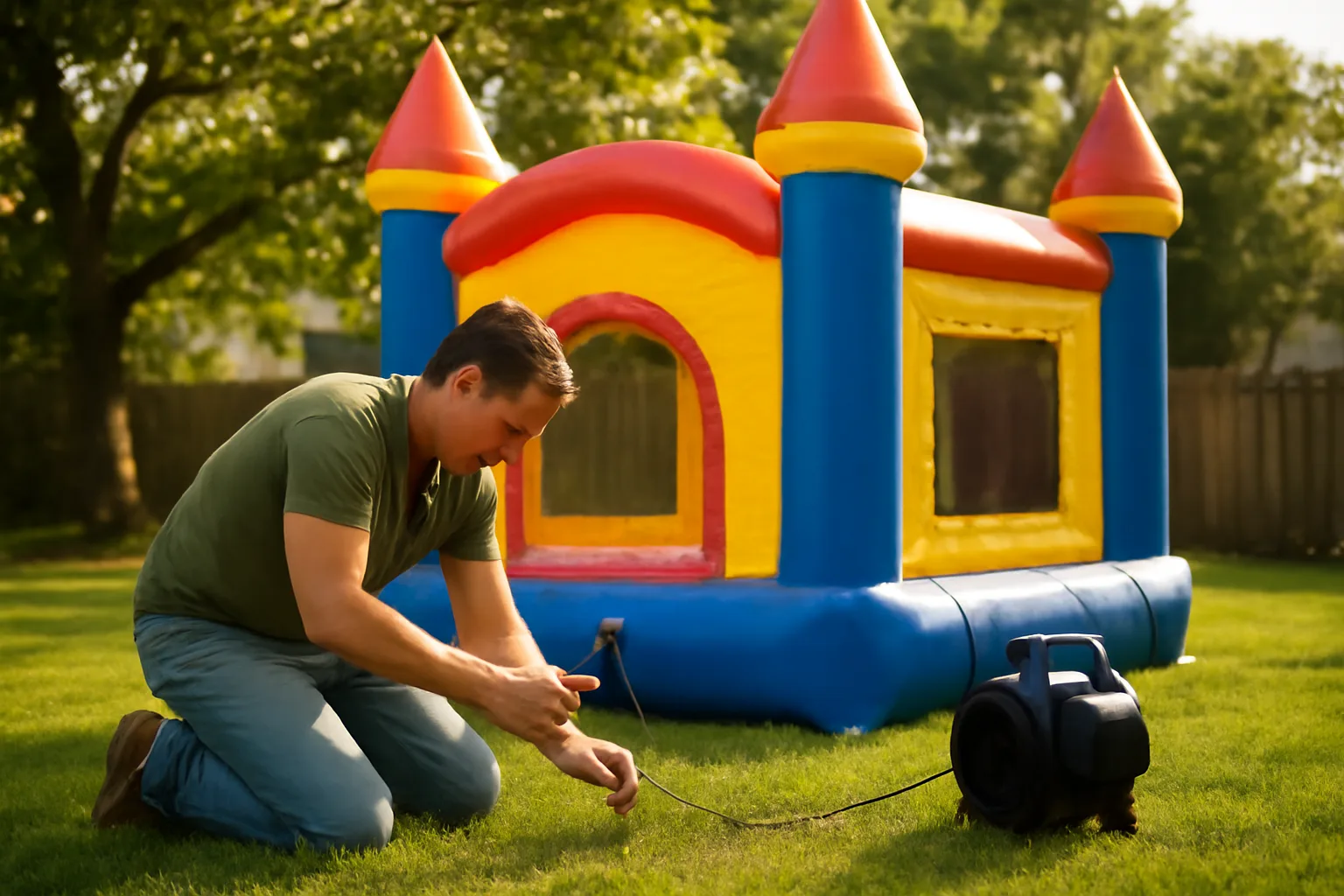
Bounce house rental is a delivery and setup service. You own inflatable play equipment, you haul it to a site, you inflate and anchor it, and you take it back when the booked window ends.
That is not a playground and it is not a storefront. The customer pays for a clean unit, a competent setup, and a certificate of insurance if a park or school asks for one. Most private parties last a few hours on a Saturday. School carnivals and city festivals run longer and often want an attendant on the unit.
The phrase bounce house rental now covers more than the classic castle. Operators also rent combo slides, obstacle courses, inflatable movie screens, and games that still run on a blower. The model does not change. Vinyl, blower, stakes or weights, signed contract, invoice, pickup.
People picture a national chain. There is no federal bounce house license. The U.S. Census Bureau’s 2022 NAICS manual puts many party-rental firms under 532289, All Other Consumer Goods Rental [12]. Some bookkeepers use an amusement code instead. Your accountant can pick the box. The city clerk still wants a local business license either way.
A job has four money moments. Deposit. Delivery. On-site extras such as a generator or an attendant. Pickup and a damage check. If you skip the damage check, you will eat zipper and seam repairs.
I treat this as a Saturday logistics company that happens to use air-supported vinyl. If you hate driving, lifting wet vinyl, and texting a parent at 7 a.m. about a storm cell, this is a bad fit. If you like tight routes and repeat neighborhood weekends, it can work.
How do you start bounce house rental?
You start bounce house rental by making the business legal, then buying commercial gear, then taking money. Reverse that order and you will own a castle you cannot insure.
Form an entity with your state’s secretary of state. An LLC is what I would file in most states, because it keeps the rental activity off your personal name on the invoice. The U.S. Small Business Administration is blunt about why structure matters: “The business structure you choose influences everything from day-to-day operations, to taxes, to how much of your personal assets are at risk.” [2] Sole props are cheaper to open. They also put your house next to the claim if a child is hurt.
Get an Employer Identification Number from the IRS before you buy the first unit. The IRS says, “Applying for an EIN is a free service offered by the Internal Revenue Service.” [1] Ignore sites that charge for that form. Use the IRS page.
Then call a commercial insurer that actually writes amusement or party rental, not a generic homeowner add-on. Ask if they will name a city park as additional insured. If they hesitate, keep calling. After that, read your state amusement-ride statute (more on that below) and your city business-license page. Confirm every fee with the board that invoices it. Nobody can honestly quote your local fee from a national article.
Only then buy equipment. One commercial dry unit, matching blower, stakes and weights, a ground tarp, a GFCI, and a way to haul it. Book weekends. Clean until you are sick of it. Add a second unit when the first one is actually double-booked, not when a salesman says you need a fleet.
A 2012 Pediatrics study estimated 64,657 U.S. children under 18 were treated in emergency departments for inflatable bouncer-related injuries from 1990 through 2010 [6]. That is why insurers and some state ride boards treat this like a ride, not a toy. Plan the paper first.
Do you need a license to rent bounce houses?
You need whatever license your city, county, and state ride program actually issue. There is no single national bounce house rental permit.
Almost every operator needs a local business license or tax certificate. Many cities treat you like any other home-based service. Some want a home-occupation review if units sit in a driveway. Confirm that with the clerk. Do not guess from a Facebook group in another county.
A second layer shows up in states that regulate amusement rides. Texas Occupations Code chapter 2151 sets insurance and operating rules for amusement rides [3]. Florida Statute 616.242 is the amusement-ride safety statute the Florida Department of Agriculture and Consumer Services enforces [4]. Ohio Revised Code 1711.53 says no person shall operate an amusement ride without a permit from the director of agriculture [5]. Washington’s RCW 67.42.020 requires an amusement-ride permit before operation [10]. Your inflatable may or may not sit inside those definitions. Read the definition section, then call the program and ask them to confirm scope. Do not treat a blog list as the board’s answer.
| State program to read | Statute or code | What you confirm with the board |
|---|---|---|
| Texas amusement rides | Occupations Code ch. 2151 | Whether your inflatable is a ride, plus the current insurance floor |
| Florida amusement rides | Statute 616.242 | Permit, inspection, and insurance the department wants this year |
| Ohio amusement rides | ORC 1711.53 | Agriculture permit before you operate |
| Washington amusement rides | RCW 67.42.020 | Ride permit before operation |
Other states stay quieter and leave you with city rules plus insurance. That is not permission to skip the check. It means the check is a phone call, not a myth that “nobody regulates bounce houses.”
School districts, parks, and churches will add their own vendor packet. Those packets are private contracts, not licenses, but they block the job if you cannot produce them.
What insurance does a bounce house rental company need?
You need commercial general liability written for inflatable amusement, plus auto coverage on the vehicle that hauls the gear. Many venues also want an additional-insured endorsement and a waiver of subrogation. Equipment (inland marine) coverage is optional until you cannot replace a slashed unit out of cash.
Texas Occupations Code chapter 2151 sets amusement-ride liability insurance at not less than $1 million per occurrence [3]. Read the current subsection on the statute page before you repeat that number to an underwriter, because legislatures amend floors. Florida’s ride statute also ties operation to insurance. Confirm the dollar figure with FDACS and with your carrier, not with a national average someone invented.
Homeowner policies exclude business use. A personal umbrella will not save a rental claim. If an agent tries to “add a rider” on your house policy, get a second agent who already writes party rental.
I would not open without at least the limit your busiest venue prints on its permit. Parks often print $1 million. Some print $2 million. Ask for a sample certificate before you pay a deposit on vinyl.
Workers’ compensation is a state question the moment you have employees. OSHA’s general duty clause still applies if you employ people: each employer shall furnish a workplace “free from recognized hazards that are causing or are likely to cause death or serious physical harm” [11]. Blowers, stakes, truck ramps, and wet vinyl are recognized hazards. Train like you mean it.
Waivers help. They do not replace insurance. A signed PDF will not pay a hospital.
What safety standard covers bounce house rental gear?
ASTM F2374 is the standard practice for design, manufacture, operation, and maintenance of inflatable amusement devices [7]. Insurers, ride inspectors, and serious manufacturers point at that document. It is not a federal law. It is the yardstick people use when they decide whether your unit is a rental or a backyard toy.
The U.S. Consumer Product Safety Commission has repeatedly told the public to use caution with inflatable amusement devices, including anchoring, supervision, and weather [8]. CPSC is not your local license bureau. It is the injury agency. Ignore it and you will look reckless in a claim file.
A 2012 Pediatrics study estimated 64,657 children under 18 were treated in U.S. emergency departments for inflatable bouncer-related injuries from 1990 through 2010, and the count rose 15-fold across that span [6]. Lower-extremity injuries and fractures show up a lot in that literature. That is the safety case for capacity limits, no shoes, no flips, and no mixing toddlers with third graders.
Buy units built for commercial rental, with a serial number, a manufacturer manual, and a blower matched to the rating on the tag. Residential “birthday” vinyl from a general marketplace is a waste of money if you plan to rent it. Many carriers will not write it. Some state inspectors will fail it.
Anchoring is not optional. Stakes in soil. Weights on asphalt. Manufacturer manuals list point counts. I follow the manual even when a customer says the grass “looks fine.” Wind is how units leave the ground. More on that below.
How much does it cost to start bounce house rental?
Nobody publishes a clean national startup total that I trust. The closest honest answer is a stack of invoices you collect yourself: entity filing (state fee, confirm with the secretary of state), a free IRS EIN [1], a commercial unit and blower (get three manufacturer quotes this week), insurance (get three carrier quotes), a local business license (confirm with the city), and a vehicle you already own or a used trailer whose GVWR you can actually tow.
I would not budget from a YouTube “$10k empire” video. Those videos skip inspections, sales tax bonds, and the month the unit sits because of rain.
Used commercial gear can be rational if you get the serial, the manual, photos of every seam, and a blower that matches. Used backyard gear is how people burn a season. Repair costs on cheap vinyl show up fast.
Local price reality varies hard. If you want market context, read bounce house rental cost in california, bounce house rental cost in florida, bounce house rental cost in arizona, and bounce house rental cost in georgia. Those pages are about local paper and pricing, not a promise of your revenue.
Skip the wrapped sprinter, the custom logo blow-up cube in the yard, and the five-unit package discount until weekends are actually full. Cash in year one belongs in insurance, a reliable truck, and one unit that passes a picky inspector.
A longer first-year walkthrough lives in a practical bounce house rental guide for first-year operators if you want the same path in a different cut.
What paperwork do you file in the first year?
Year-one paper is boring and it is the job. Entity formation. EIN. City or county business license. Sales tax permit if your state taxes this rental. Insurance application and every additional-insured request. Ride-program forms if your state says the inflatable is a ride. A written rental contract. An incident log. Maintenance notes after every job.
Sole proprietors report on Schedule C (Form 1040). The IRS publishes an about-page for that schedule and walks small businesses through it in Publication 334, Tax Guide for Small Business [9] [14]. LLCs taxed as disregarded entities often still land on Schedule C. Confirm the box with a CPA who has other rental clients. I would not use a random “tax pro” from social media.
Keep photos of every setup: stakes or weights, blower plug, clear exit, nearby fences. Keep the weather screenshot you used to go or cancel. That file is how you talk to an adjuster.
If you hire help, add I-9, state new-hire reporting, and whatever wage notice your labor department prints. Confirm those forms with the state labor site. Processing times change. I will not invent one.
Bank account in the business name. Deposit the customer money there. Mixing rent and party deposits is how people lose track of sales tax.
Contracts should say who provides generators, what wind or lightning cancels, who is allowed on the unit, and how damage is priced. Plain language. If a clause feels clever, a judge may hate it.
For another pass at the same startup sequence, see what bounce house rental is and the real startup path.
How does weather change bounce house rental jobs?
Weather is the uncredited partner in bounce house rental. Wind lifts units. Rain soaks vinyl and turns pickup into a two-hour fight. Lightning ends the job even if the customer already paid.
Follow the manufacturer’s wind limit and ASTM F2374 practice, not a guest’s “it feels fine” [7]. I cancel early and refund or rebook. Fighting a parent in a gusty cul-de-sac to keep a Saturday deposit is how people get videoed next to a bouncing, unanchored castle.
CPSC’s public caution on inflatable amusement devices includes weather and anchoring for a reason [8]. If you need the ASTM practice and a weather checklist in one packet, InflatablePath publishes a $149 one-time ASTM + Weather Kit. The standard itself still comes from ASTM International. Read that document. Do not rent on vibes.
Write the cancel rule in the contract before season starts. Name who decides (you). Name rain versus wind versus heat. Soft ground will not hold stakes. Have weights in the truck for parking-lot jobs or go home.
Heat matters for attendants and for kids in vinyl boxes. Water, shade, timed sessions. There is no prize for a three-hour continuous bounce in July sun.
Build a go / no-go habit: check a forecast the night before, the morning of, and when you park. Screenshot it. If you are unsure, take the cancel. One bad wind event wipes a year of deposits.
Do you collect sales tax on bounce house rental?
Many states tax the rental of tangible personal property, and an inflatable is tangible. Some states tax amusement. A few treat parts of the invoice as a service. You confirm this with your state department of revenue, not with a national myth.
If the state taxes the rental, you register, you collect, you file. Publication 334 is the IRS small-business tax guide for federal income tax, not your state sales-tax rule [9]. Do not mix those two systems.
Itemize delivery separately only if your state actually treats delivery as nontaxable. Some do. Some do not. A CPA who files returns in your state is worth more here than a new booking app.
Resale certificates show up when you buy vinyl. Commercial manufacturers often want a resale or exemption certificate. Confirm the form number with the revenue department. I would not buy a “package” of units in cash from a private seller and then argue it was wholesale.
City lodging or “entertainment” taxes almost never apply to a backyard drop-off. Festival promoters sometimes withhold a vendor tax. Read their packet.
Track gross receipts from day one. The first sales-tax notice is easier if your numbers already exist.
How do you price bounce house rental without copying Facebook?
Price from your costs and your calendar, then glance at local ads. Copying the cheapest castle in the group chat is how you work Saturdays for grocery money.
Add insurance, fuel, cleaning time, repair reserve, payment fees, and the hours you actually sit in traffic. Then divide by the weekends you can really work. Winter is dead in a lot of markets. A July Saturday is not a February Saturday.
Charge more for long carries, upstairs rooms (I would refuse most of those), sites that need a generator, and same-week bookings that wreck the route. Discount only for weekday church or school jobs that fill an empty trailer.
Deposits should be large enough that a no-show hurts them more than you. I like a deposit that covers fuel and a lost slot. Confirm card-charge rules with your processor and your state.
Local rate context is uneven. Use bounce house rental cost in colorado or bounce house rental cost in alabama as a starting map, then call two venues and ask what certificate limit they print. That limit tells you more about your real cost than a Facebook number.
Do not publish a “from $99” price if your insurance load cannot support it. You will attract the customer who also fights the weather cancel.
What should you buy first (and skip)?
Buy one commercial dry bounce house in a size you can set alone, the matching blower, a ground cloth, steel stakes, asphalt weights, a mallet, a GFCI, a duct-tape kit you will actually hate using, and straps that fit your trailer or van. That is the starter kit.
Skip water units until you have a drying plan. Wet vinyl in a closed trailer will smell like a claim.
Skip the 40-foot obstacle course until you have a crew and a place that will let you use that footprint. Most suburban yards will not.
A cargo van or a pickup plus a trailer both work. Watch the GVWR sticker. FMCSA’s CDL rules generally pull in vehicles at 26,001 pounds GVWR and up, with extra towing combinations that can require a Class A [13]. Most party vans sit under that line. Confirm your door sticker and your state DMV chart. Do not assume “it is just a trailer.”
I would skip custom wraps, branded tents, and a second phone line until the first unit is booked most weekends. I would not skip a hand truck and knee pads. Your back is the real capital asset.
Generators: buy one only when you keep losing jobs that lack an outlet. Borrowing a loud, ungrounded unit from a neighbor is a bad look and a bad electrical idea.
How do you confirm state amusement ride rules?
You confirm state amusement ride rules by reading the statute, then emailing or calling the named agency, then keeping their written answer with the unit file. That is the whole method.
Start with the definition of “amusement ride” or “inflatable.” Then read the permit, inspection, and insurance sections. Texas Occupations Code chapter 2151 [3], Florida Statute 616.242 [4], Ohio Revised Code 1711.53 [5], and Washington RCW 67.42.020 [10] are four real places to begin if you operate there. If you operate somewhere else, search your state agriculture, labor, or insurance department for “amusement ride” and read that document. Confirm fees, inspection windows, and whether a home-use inflatable is even eligible. I will not invent a fee or a processing time.
If the board says inflatables are out of scope, keep the email. Your insurer will still want ASTM-minded operations [7]. City parks will still want a certificate.
If you want a checklist of that paper path, start at /start. InflatablePath is an independent publisher, not a law firm and not a service company. For a shorter version of this same explanation, what bounce house rental is and how you actually start covers the opening moves again.
No approval is guaranteed. Boards change forms. Read this year’s page.
Frequently asked questions
What is bounce house rental?
Bounce house rental is a local delivery business. You bring an inflatable play structure to a site, anchor and inflate it, leave it for a paid window, then pick it up and clean it. Customers buy setup labor, a clean commercial unit, and your insurance certificate, not a store-bought toy.
How do you start bounce house rental?
Form an entity, get a free IRS EIN, place commercial liability insurance, and check city licenses plus any state amusement-ride program. Buy one commercial unit with a matching blower only after a carrier will write it. Confirm every government fee with the board that charges it. Do not buy vinyl first.
Is a bounce house considered an amusement ride?
Sometimes. Texas, Florida, Ohio, and Washington are examples of states with amusement-ride statutes that may pull inflatables into permit and insurance rules. Other states leave you with city licenses. Read the definition in your state code and ask the named agency to confirm scope in writing.
Do I need a CDL to haul bounce houses?
Usually no, if your van or truck-and-trailer stay under federal CDL weight triggers. FMCSA generally treats 26,001 pounds GVWR as the Class B line, with heavier towing combinations treated as Class A. Read the door sticker and your state DMV chart. Do not guess from the trailer’s sales ad.
Can I rent a backyard inflatable I bought online?
You can try. Many commercial insurers will not write it, and some state inspectors will fail it. ASTM F2374-minded operators buy commercial units with serials, manuals, and matched blowers. Cheap residential vinyl is a common first-year waste.
What is ASTM F2374?
ASTM F2374 is the ASTM International standard practice for design, manufacture, operation, and maintenance of inflatable amusement devices. It is not a federal statute. Insurers and ride inspectors still treat it as the professional baseline. Buy the current edition from ASTM and follow the manufacturer manual with it.
How many bounce houses do I need to start?
One commercial dry unit you can set alone. Add a second unit when the first is truly double-booked on the same dates, not when a package deal looks cheap. Extra vinyl that sits in a trailer still needs insurance and still ages in the folds.
Do customer waivers replace liability insurance?
No. A waiver can help a defense. It does not pay medical bills or satisfy a city that wants a certificate naming the park as additional insured. Carry commercial general liability written for inflatables, then use a plain-language waiver on top.
What wind or weather should cancel a bounce house rental?
Follow the manufacturer limit and ASTM F2374 practice, then cancel early for lightning, unstable gusts, or soil that will not hold stakes. Write the rule in the contract so you decide, not the host. Screenshot the forecast you used. Weights belong on the truck for hard surfaces.
Do I need to collect sales tax on bounce house rental?
Often yes, because many states tax rental of tangible personal property. Some treat parts of the invoice as a service. Register only after you read your state revenue department’s rental-tax page or ask them directly. Federal Publication 334 does not answer the state sales-tax question.
How do I get a certificate of insurance for a school or park?
Ask your commercial carrier for a certificate that names the venue as additional insured and matches the limit printed in their vendor packet. Send the request days before the event. If your agent cannot issue that form, you have the wrong policy for bounce house rental.
Is bounce house rental full-time income in year one?
Usually not. Demand clusters on warm weekends and collapses in bad weather. Nobody has a trustworthy national income series for first-year operators. Plan a second income source, price from real costs, and treat year one as a test of routes, repairs, and cancel discipline.
Sources
- U.S. Small Business Administration, Choose a business structure: Business structure influences operations, taxes, and how much personal assets are at risk.
- Texas Occupations Code Chapter 2151, Regulation of Amusement Rides: Texas sets amusement-ride operating and insurance rules, including a statutory liability insurance floor of not less than $1 million per occurrence.
- Florida Senate, Florida Statute 616.242 (2023): Florida Statute 616.242 is the state amusement-ride safety law operators must read for inflatable scope, permits, and insurance.
- Ohio Revised Code 1711.53, Amusement ride permits: Ohio requires a permit from the director of agriculture before a person operates an amusement ride.
- Pediatrics, US pediatric inflatable bouncer-related injuries, 1990-2010: An estimated 64,657 children under 18 were treated in U.S. emergency departments for inflatable bouncer-related injuries from 1990 through 2010, a 15-fold increase over the period.
- ASTM International, ASTM F2374: ASTM F2374 is the standard practice for design, manufacture, operation, and maintenance of inflatable amusement devices.
- U.S. CPSC, inflatable amusement devices caution (2019 news release): CPSC urges caution with inflatable amusement devices, including attention to anchoring, supervision, and conditions of use.
- IRS Publication 334, Tax Guide for Small Business: Publication 334 is the IRS tax guide small businesses use for federal income-tax rules, including Schedule C style reporting.
- Washington State Legislature, RCW 67.42.020: Washington requires an amusement-ride permit before operation.
- OSHA, OSH Act Section 5 duties: Employers must furnish employment free from recognized hazards likely to cause death or serious physical harm.
- U.S. Census Bureau, NAICS 532289 (2022): NAICS 532289 is All Other Consumer Goods Rental, a classification many party-rental firms use.
- FMCSA, Commercial Driver's License (CDL) drivers: Federal CDL classes are tied to vehicle weight ratings, with 26,001 pounds GVWR as a central Class B threshold.
- IRS, About Schedule C (Form 1040): Sole proprietors report business profit or loss on Schedule C (Form 1040).