Last updated 2026-08-21
TL;DR
Bounce house rental is a local delivery business. You store, haul, set up, and take down inflatable play structures for parties, then charge a day rate. Starting means forming a business (often an LLC plus a free IRS EIN), buying commercial units and liability insurance, and checking whether your state treats inflatables as amusement rides. There is no single national license. Confirm fees with your board.
What is bounce house rental?
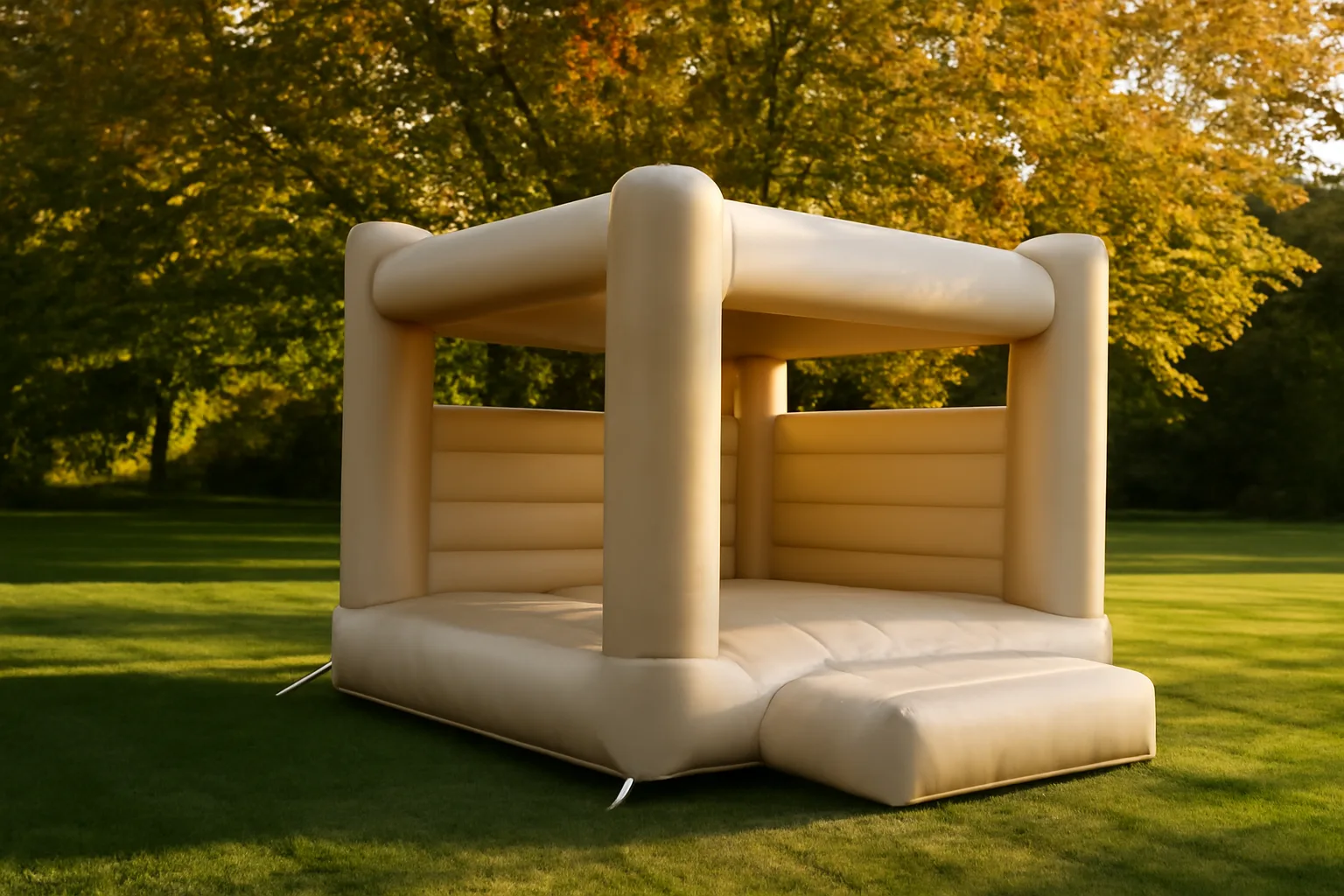
Bounce house rental is a local delivery and setup service. You own inflatable play gear, haul it to a site, anchor it, run the blower for a booked window, then pack it out. The customer is buying a few hours of a structure on their grass, not a ticket to a park.
People call the same work jumper rental, moonwalk rental, or inflatable rental, depending on the town. The unit can be a dry castle, a combo with a slide, a water slide, an obstacle, or a cluster of smaller pieces. The business is the truck, the calendar, and the paper that lets you set that unit down without getting shut off.
You make money on weekends and lose sleep on wind. Rain kills water jobs and some dry jobs. Heat cooks vinyl if you store it wet. The work looks simple from the driveway. It is simple. It is also physical, seasonal, and easy to underprice.
This is not a franchise category with one rulebook. It sits in a messy gap between consumer product rental and amusement ride law. Some states barely notice a backyard castle. Others fold inflatables into ride inspection programs and want certificates, insurance floors, and annual stickers. You have to read your state, not a Facebook group.
Safety is not a slogan here. An estimated 64,657 children 17 and under were treated in U.S. emergency departments for inflatable amusement device related injuries from 1990 through 2010, according to a Pediatrics analysis of CPSC NEISS data [1]. The same paper reported that the number of those injuries increased 15-fold across that span [1]. That is why operators who last more than a summer buy commercial vinyl, follow ASTM F2374 practice, and carry real liability coverage [2] [3].
A clean rental day looks like this. You confirm the yard (grade, overhead lines, pet fences), check the wind, arrive early, stake or weight to the manufacturer spec, do a walk-around, get an adult signature, start the blower, and stay reachable. Then you pick up on time and dry the unit before it goes back on the shelf. Miss the drying step and you grow mildew. Miss the wind check and you make the news.
How do you start bounce house rental?
You start bounce house rental by building the paper path first, then buying gear. Form a business, get a free IRS EIN, open a dedicated bank account, talk to an insurer who actually writes inflatables, and ask your state whether your units count as amusement rides. Only then do you spend money on castles and a trailer.
Most people invert that. They buy a used unit off a marketplace, take a Saturday job, and discover the park wants a certificate of insurance with a $1 million limit and an additional insured endorsement. Now you are improvising. Don't.
Pick a structure first. A single-member LLC is the common first move because it is simple and it separates the unit from your house, at least on paper. The U.S. Small Business Administration walks through sole proprietorship, partnership, LLC, and corporation tradeoffs on its choose-a-structure page [6]. An LLC is not magic. It does not replace insurance. It does help you look like a vendor parks will book. The IRS also publishes a plain LLC overview if you want the federal tax framing before you file with the state [12].
Get an EIN next. The IRS is blunt: "Applying for an EIN is a free service offered by the Internal Revenue Service." [4] Skip the random sites that charge you for that form.
Register where your state and city tell you to register. That can mean a state business filing plus a local business tax certificate. The SBA register-your-business guide is the federal map, not a substitute for your secretary of state or city hall [9].
Ask the ride question early. In Texas, Occupations Code Chapter 2151 sets operation and insurance rules for amusement rides, including a liability policy "in an amount of not less than $1,000,000 per occurrence" for covered operations [7]. Florida runs a parallel amusement ride statute at section 616.242 [8]. Your inflatables may or may not be pulled in. Confirm with the board that actually inspects rides in your state. If you are in California, start with the state license writeup at bounce house rental license in California and the startup walkthrough at how to start bounce house rental in California. Arizona and Alabama have their own paper, and it is not the same stack (how to start bounce house rental in Arizona, how to start bounce house rental in Alabama).
Buy commercial units, a clean blower set, stakes and weights, a tarp, a moisture plan, and a trailer you can load without wrecking your back. Skip the residential toy-grade castle. Insurers and ASTM practice assume commercial construction [2].
Write a one-page operating rule you will actually follow: max riders, no shoes, no flips, adult supervision, wind cutoff from the manufacturer tag. Train anyone who helps you. Then take paid work.
Do you need a license to rent bounce houses?
There is no federal bounce house rental license. What you need is a stack that changes by state and sometimes by city: a business registration, a local business license, sales tax permission if your state taxes rentals, and, in some states, an amusement ride permit or inspection sticker.
That is the whole answer, and it annoys people who want a single PDF.
Ride states treat many inflatables as amusement devices. Texas Chapter 2151 is the statute to read if you operate there [7]. Florida's section 616.242 is the statute to read if you operate there [8]. Those pages list inspection, insurance, and operating duties. Do not trust a forum summary of the dollar amounts or the inspection interval. Open the current statute and call the agency that enforces it.
Other states are quieter. Some only care if you set up at a public fair. Some cities still want a home-occupation permit if units live in your garage. HOA rules can block street-side loading even when the city does not.
If you want the state-level paper, use a state page, not this national overview. Utah's path is its own pile (Bounce house rental license in Utah: what you actually need). Vermont is smaller and still not automatic (bounce house rental license in Vermont). Colorado operators should start at how to start bounce house rental in Colorado.
I would budget a full afternoon per state you plan to cross. Crossing a state line for a wedding can drag you into a second ride program. Confirm that before you quote the job.
| Paper | What it actually is | Who confirms it |
|---|---|---|
| EIN | Federal tax ID, not a license | IRS EIN application [4] |
| Entity filing | LLC or other structure | Secretary of state / SBA map [6] [9] |
| Local business license | City or county permission to operate | City hall or county clerk |
| Sales tax permit | Permission to collect if rentals are taxable | State department of revenue |
| Ride permit or sticker | Only if your state treats inflatables as rides | State ride board, then the statute [7] [8] |
How much money does first-year bounce house rental take?
Nobody publishes a clean national index for first-year bounce house rental spend. The only federal number you can take to the bank on day one is the EIN, which costs $0 if you apply on IRS.gov [4]. Everything else is a quote you have to collect yourself.
Your real checks go to four places. Legal formation (state LLC filing, which you confirm on your secretary of state's fee page). Insurance (a commercial general liability policy that actually names inflatables, plus any ride-statute minimum). Equipment (commercial vinyl units, blowers, stakes or water barrels, a repair kit). Rolling stock (trailer or van, plus ramps and straps).
I would not buy a fleet. One or two versatile combos beat six novelty shapes that sit idle on weekdays. Used commercial units can be fine if you inspect seams, step pads, and blower specs. A cheap residential unit that an insurer will not schedule is a waste of money.
Storage is the cost people forget. Vinyl needs dry, rodent-tight space. A damp shed will eat a unit in a season. If you do not have that space at the house, price a storage unit before you bid the first Saturday.
Labor is you, at first. That keeps payroll off the table. It also means your Saturday capacity is two, maybe three, drops if they sit close together. Do not invent a first-year revenue target from a national blog. Build it from your drive time and the weekends you can actually work.
Get the insurance quote and the unit quotes in the same week. Those two numbers decide whether this is a side business or a fantasy.
What insurance do bounce house rental operators actually buy?
You need a commercial liability policy written for inflatable amusement devices, with limits that satisfy both your state ride statute (if any) and the venues that hire you. Texas Occupations Code Chapter 2151 requires covered amusement ride operators to carry liability insurance of at least $1,000,000 per occurrence [7]. Many parks and schools want that same $1 million on a certificate, plus they want to be additional insured.
Homeowner insurance is the wrong tool. Say that to the carrier in writing if you are tempted. Most personal policies exclude business activity. A certificate from a surplus lines or specialty amusement market is what booking managers recognize.
Ask the broker four things. Are inflatables scheduled or blanket? Is setup and takedown covered, or only the hours the unit is on rent? What is the wind and weather exclusion? Will they issue additional insured endorsements the same day a park asks?
Medical payments coverage is small money and does not replace liability. Umbrella coverage can wait until you have more units and bigger venues, unless a school district already wants a higher limit printed in the bid. Confirm the number they printed, not a number you saw on a blog.
If a state ride law applies, the insurer or their inspector may also do the annual mechanical inspection. That is how Texas writes the inspection duty [7]. Florida's amusement ride statute is the page to read for the parallel duties if you operate there [8]. Build the inspection month into your calendar so you are not dark in June.
What is ASTM F2374 and do you have to follow it?
ASTM F2374 is the consensus practice for design, manufacture, operation, and maintenance of inflatable amusement devices [2]. CPSC pointed operators at that practice when it issued its inflatable amusement device safety alert [3]. It is not a federal license. It is the standard your insurer, your manufacturer manual, and a plaintiff's expert will all reach for after a bad day.
Read the scope. It covers how units are built and how they are run. For you, the operator pieces matter more than the factory weld spec. Anchoring, attendant rules, rider limits, weather shutdown, inspection, and repair records live in that practice [2].
I keep a printed manufacturer manual in the trailer and a simple log: date, site, wind, unit ID, issues, repairs. That log is boring. It is also the thing that shows you were not guessing.
If you want the ASTM text plus a weather checklist in one pile, InflatablePath sells a $149 one-time ASTM + Weather Kit. You can also buy F2374 straight from ASTM and write your own wind sheet. Either works. The waste of money is operating with no written cutoff at all.
CPSC's public posture is prevention: follow the practice, watch the weather, supervise. The agency's 2015 safety alert sits on CPSC.gov and is still the federal page most people are sent to [3]. Pair that alert with the actual F2374 document, not with a summary someone posted in a group [2].
Can you run bounce house rental from a house and a trailer?
Yes, plenty of owner-operators run bounce house rental from a house, a garage, and a trailer. Zoning and the fire marshal can still say no. Check home-occupation rules and any HOA covenant before you park a long trailer on the street every Friday.
The truck question is simpler than forums make it. A regular driver license covers most half-ton and three-quarter-ton setups. Federal CDL rules kick in when the vehicle is a commercial motor vehicle under 49 CFR 383.5, including combinations with a GVWR of 26,001 pounds or more [10]. Weigh the loaded trailer and read the door sticker. If you are under that threshold, do not pay for a CDL class you do not need.
Parking the trailer at a storage lot is a clean workaround when the neighbors complain. Factor that monthly bill into every Saturday quote.
Employees change the picture. Once someone else is lifting units for you, you have wage rules, possible workers' compensation, and a real workplace. The IRS EIN page is also the start of payroll accounts if you hire [4]. I would stay owner-operator until the calendar is full enough that you are turning away weekend work.
Gate width and yard access matter more than people admit. Measure the customer's gate before you leave home. A 36-inch gate and a wet combo do not mix. That is an operations problem, not a branding problem.
How do taxes work for bounce house rental?
You will pay ordinary income tax on net profit, and if you are a sole proprietor or a single-member LLC defaulting to that treatment, you will also pay self-employment tax. The IRS states: "The self-employment tax rate is 15.3%." [5] That 15.3 percent is 12.4 percent Social Security plus 2.9 percent Medicare [5]. It applies to net earnings from self-employment, with the usual Social Security wage base cap that the IRS updates. Confirm the current wage base on IRS.gov, not on a blog.
Sales tax is a state question. Many states tax tangible personal property rentals. Some exempt certain party rentals. Your state department of revenue publishes the rule. Register if they tell you to collect. Do not wait for an audit to find out.
Estimated quarterly payments keep you out of underpayment mess. IRS Publication 334 is the small business tax guide to keep on the shelf [11]. The LLC page is worth one read so you know how the default tax treatment works before you elect anything fancy [12].
Track mileage, blower replacement, seam repairs, soap, fuel, and insurance. Those are real costs. A shoebox works until it does not. I would open a separate checking account the day the EIN arrives [4]. Mix personal groceries with blower receipts and you will hate April.
What weather and anchoring rules apply on a rental day?
Your shutdown number is the one printed by the manufacturer for that unit, not a number you liked on a forum. ASTM F2374 expects operators to run inflatables inside the practice and the manufacturer's limits [2]. CPSC's safety alert exists because inflatables get loose in wind [3].
If the tag says 15 mph, you are done at 15. If it says 20, you are done at 20. I treat gusts, not averages, as the trigger. A cheap handheld anemometer is not fancy. It ends arguments with a parent who wants you to just try.
Lightning means you kill the blower and clear the unit. Standing water under a dry castle is a slip problem and a blower problem. Extreme heat cooks kids and cooks vinyl. You already know this. Write it into the rental contract so the cancel call is a policy, not a fight.
Anchoring is not optional. Stakes in soil, weights on asphalt, and no creative hope on a breezy ridge. Count the anchor points the manual shows. Use all of them. A missing stake is how a unit walks.
I would rather refund a wind day than explain a airborne castle. Put the cancel rule in the confirmation email so it is not a surprise at 9 a.m.
How should you price a bounce house rental day?
You price bounce house rental by the local weekend market, your drive time, and your real cost per outing, not by a national average. There is no trustworthy government series for party-rental day rates. Anyone quoting a single U.S. price is inventing a midpoint.
I would pull ten local competitors for a Saturday four-hour dry castle inside 20 miles. Sit in the middle until your calendar fills, then raise weekends first. Weekdays are leftover capacity. Price them to cover fuel and wear, or park the trailer.
Charge for distance. A 40-mile one-way job is not the same product as a neighborhood drop. Charge for stairs, rooftop decks, and sites that need heavy weights instead of stakes. Charge a same-day rush only if you can still do the wind check and the walk-around. Free extra time is how Saturday turns into a 14-hour shift.
Deposits should be enough that a no-show hurts them more than you. Weather cancels should be written. I refund or rebook when I shut a job down for wind. I do not refund when they ignore the site-prep list and the unit cannot go up.
Keep the rate card short. Dry castle, wet combo, obstacle, delivery bands. If you need a spreadsheet with 40 SKUs in month two, you bought too much inventory.
What paperwork do parks and customers ask for?
Parks, churches, and schools will ask for a certificate of insurance, often $1 million, often with the venue named as additional insured [7]. Some want the endorsement form, more than a description. Some want an inspection sticker if your state ride program issues one [7] [8].
Cities sometimes want a special event permit for public property. That is the venue's permit or yours, depending on the city. Confirm who pulls it before you quote.
A customer waiver is useful and limited. It tells people the rules and documents that an adult accepted them. It does not bless a bad anchor or a unit you knew was torn. Keep the language plain. Keep the signed copy.
I also send a site checklist with the confirmation: flat area, overhead clearance, gate width, pet plan, water access if it is a wet unit. Half of day-of chaos is a gate that is too narrow.
For the state-by-state permit flavor, read a license guide before you advertise in that state. Bounce house rental license in Arizona is a fair example of how different the paper can look next door.
What is a waste of money in year one?
Skip the giant inventory. Skip the custom wrap on a trailer you do not own yet. Skip lead-buying services that promise a full summer. Skip residential units you cannot insure. Skip hiring a crew before you can describe the job in one page.
Do spend on commercial vinyl, a policy that will actually defend you, stakes and weights, and a drying plan. Do spend an afternoon on your state ride statute if you have one [7] [8]. Do keep the IRS pieces boring and on time [4] [5] [11].
Year one is a routing and reputation business. On-time drop-offs and dry, clean vinyl get you rebooked. A third theme castle does not.
Watch the injury literature if you need a reason to stay strict on rules. Pediatrics documented a sharp rise in inflatable-related emergency visits over two decades [1]. That is not a reason to panic. It is a reason to run the unit like an amusement device, not like a backyard toy [2] [3].
InflatablePath is an independent publisher, not a law firm and not a rental company. If you want the kit path after you have read the statutes yourself, the start page is /start. Confirm every fee, quota, and inspection slot with the board that collects the money. Nobody can honestly guarantee approval or timing.
Frequently asked questions
What is bounce house rental?
It is a local delivery service. You own inflatable play structures, haul them to a yard or venue, anchor them, run a blower for a booked window, and take them down. Customers pay a day rate. You are not operating a park. You are running gear, a trailer, and the paper that lets the unit sit on someone else's grass.
How do you start bounce house rental?
Form an entity, get a free IRS EIN, open a separate bank account, and get a commercial inflatable liability quote before you buy vinyl. Then ask your state whether the units count as amusement rides. Buy commercial gear and a trailer only after that paper exists. Confirm every state fee with the board that charges it.
Is there a national bounce house rental license?
No. The federal government does not issue a bounce house rental license. You may need a state entity filing, a local business license, a sales tax permit, and, in some states, an amusement ride inspection or permit. Texas Chapter 2151 and Florida section 616.242 are examples of ride statutes you must read if you operate there.
Can I start with a household inflatable from a big-box store?
I would not. Insurers and ASTM F2374 practice assume commercial construction, anchoring points, and manuals. A residential castle is hard to schedule on a real policy and easy to wreck. Buy used commercial vinyl if you need to save money, and inspect seams and blowers before you hand over cash.
Do I need a CDL to tow bounce houses?
Usually no, if your loaded combination stays under federal commercial motor vehicle thresholds. Under 49 CFR 383.5, a CDL path applies to combinations with a GVWR of 26,001 pounds or more, among other triggers. Read the door sticker, weigh the loaded trailer, and confirm with your state driver license office.
What insurance limit do parks usually ask for?
Many parks and schools ask for $1 million per occurrence and an additional insured endorsement. Texas writes a $1,000,000 per occurrence floor into its amusement ride statute for covered operations. Your venue may ask for more. Get the requirement in writing and send it to a broker who already writes inflatables.
Do bounce house rentals charge sales tax?
Often yes, because many states tax tangible personal property rentals. Some carve out exceptions. This is a department of revenue question, not a guess from a national article. Register if they tell you to collect. Keep the tax in a separate pot so you do not spend it.
What wind speed is too high for a bounce house?
The number on that unit's manufacturer tag is the number that counts. ASTM F2374 ties operation to the practice and the maker's limits. I shut down on gusts, not on a friendly average. Lightning ends the job. Write the cutoff into the contract so a cancel is a rule, not a debate on the lawn.
How many bounce houses do I need to start?
One or two commercial combos is enough. A dry castle plus a wet/dry combo covers most backyard Saturdays. Extra novelty shapes sit idle on weekdays and still need insurance, storage, and drying. Add a unit when weekends are full and you are turning away nearby jobs.
Are customer waivers enough if a child gets hurt?
No. A waiver records the rules and that an adult accepted them. It does not fix a missing stake, a torn floor, or a unit left up in wind. Carry real liability coverage, follow the manufacturer manual and ASTM F2374 practice, and keep a simple inspection log.
Can I rent bounce houses across state lines?
You can quote the job, but the second state may treat the unit as an amusement ride and want its own inspection, insurance proof, or permit. Read that state's ride statute before you drive. A wedding 30 miles over the line can be a different paper path than your home county.
How long is a typical bounce house rental window?
Four hours on site is a common backyard booking, plus your setup and takedown time. Parks and schools may want a longer block. Price the drive and the extra hour separately. Free overruns wreck Saturday routing and leave the next customer waiting in a driveway.
Do I need employees in year one?
No. Stay owner-operator until you are turning away profitable weekend work. Helpers trigger wage rules, possible workers' compensation, and a real workplace. If a friend lifts a unit for cash, treat that as hiring and get the tax and insurance answer first.
Sources
- Pediatrics, Injuries Associated With Inflatable Amusement Devices (2012): An estimated 64,657 children ≤17 were treated in U.S. EDs for inflatable amusement device injuries from 1990 through 2010, and injury counts rose 15-fold over that period.
- ASTM F2374 standard practice page: ASTM F2374 is the standard practice covering design, manufacture, operation, and maintenance of inflatable amusement devices.
- CPSC, Safety Alert on Inflatable Amusement Devices (2015): CPSC issued a public safety alert on inflatable amusement devices and pointed operators toward recognized safety practice including ASTM F2374.
- IRS, Apply for an Employer Identification Number (EIN) online: Applying for an EIN is a free service offered by the Internal Revenue Service.
- IRS, Self-Employment Tax (Social Security and Medicare Taxes): The self-employment tax rate is 15.3 percent, made of 12.4 percent Social Security and 2.9 percent Medicare.
- U.S. Small Business Administration, Choose a business structure: SBA outlines sole proprietorship, partnership, LLC, and corporation options for new firms.
- Texas Occupations Code Chapter 2151, Regulation of Amusement Rides: Texas amusement ride operators covered by Chapter 2151 must meet inspection rules and carry liability insurance of at least $1,000,000 per occurrence.
- Florida Statute § 616.242 (2023), Safety standards for amusement rides: Florida Statute 616.242 sets safety, inspection, and insurance duties for amusement ride owners; operators must confirm whether inflatables fall under the current definition.
- U.S. Small Business Administration, Register your business: New businesses register at the state and often local level; SBA maps the federal overview of that process.
- eCFR, 49 CFR § 383.5 Definitions: A commercial motor vehicle under CDL rules includes combinations with a GVWR of 26,001 pounds or more.
- IRS Publication 334, Tax Guide for Small Business: Publication 334 is the IRS small business tax guide covering income, expenses, and self-employed filing basics.
- IRS, Limited Liability Company (LLC): The IRS explains default federal tax treatment of LLCs, including single-member LLCs.