Last updated 2026-08-18
TL;DR
Florida has no standalone bounce house rental license. You do have to register your business with Sunbiz, collect and remit the 6% state sales tax plus local surtax on rentals, carry commercial general liability insurance, and follow ASTM F2374 safety practice. Most counties and cities also require a local business tax receipt. No state amusement-ride permit applies to standard inflatables.
Do you need a license for bounce house rental in Florida?
No. Florida has no inflatable amusement license at the state level. The Florida Department of Agriculture and Consumer Services (FDACS) regulates amusement rides under Chapter 616, Florida Statutes, but standard bounce houses, water slides, and combo units rented for private parties sit outside that definition.
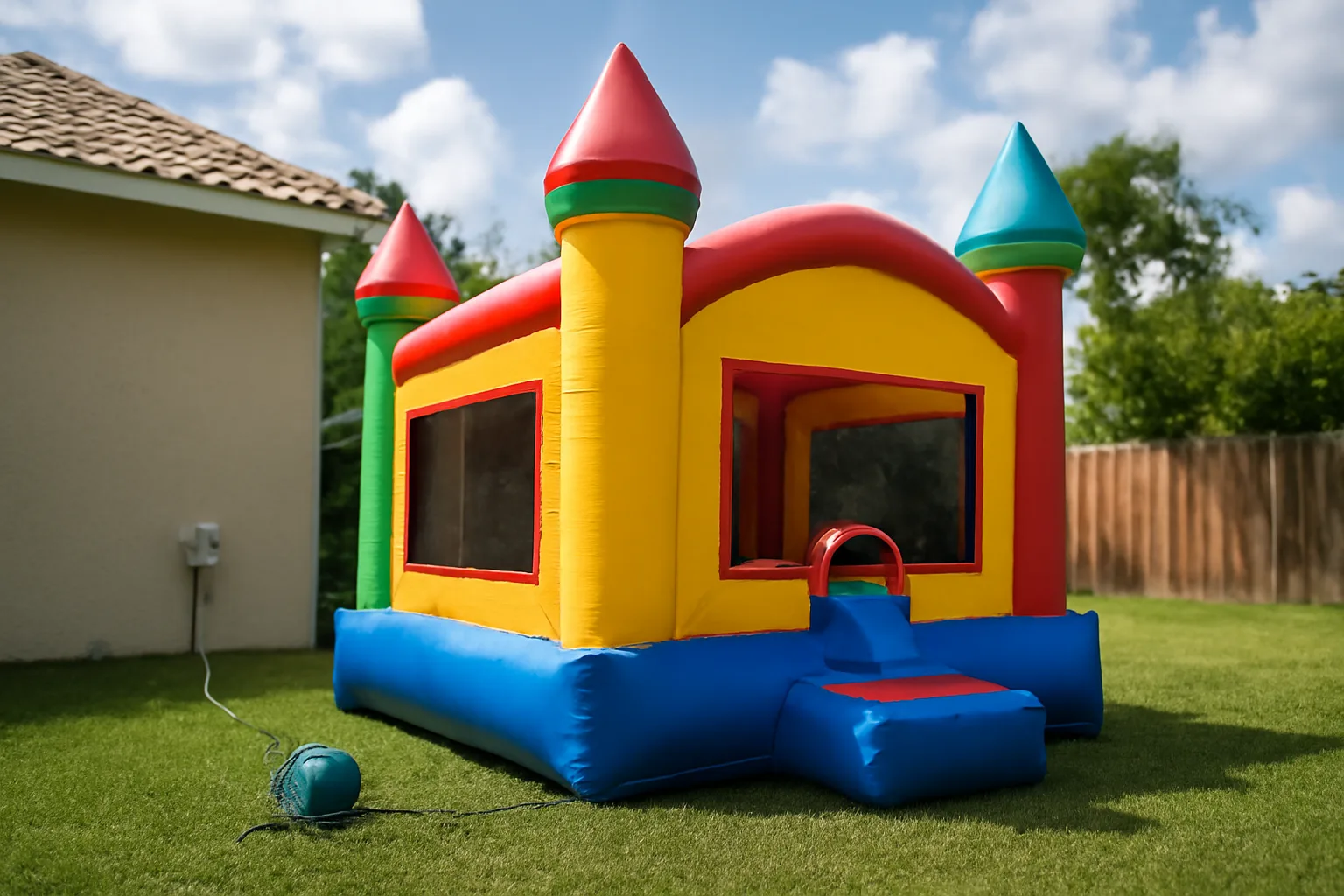
Chapter 616.242, Florida Statutes, exempts "nonmechanical playground equipment, including, but not limited to, swings, seesaws, stationary spring-mounted animal features, rider-propelled merry-go-rounds, climbers, slides, trampolines, and physical fitness devices." [1] Most bounce houses and inflatable slides read as nonmechanical playground equipment under that language. FDACS does not inspect or permit a typical bounce house rental operation.
Here's what you actually need. A registered business entity. A Florida sales tax registration. A local business tax receipt in most municipalities. The rest of this guide walks the exact paper you file, what each step costs, and the shortcuts that will burn you.
How much does bounce house rental cost in Florida?
Rental rates move with unit size, hours, and city. Based on 2025 price sheets from six Florida operators, a standard 13x13 castle bounce house rents for $175 to $250 for a 6-hour residential party. Wet/dry combo units with a slide run $275 to $400. Large obstacle courses or 5-in-1 combos land at $425 to $600. An all-day (8-hour) setup with two units usually runs $450 to $700.
The cost that matters to you is your startup and annual overhead. It looks roughly like this.
| Expense | Lower end | Upper end | Notes |
|---|---|---|---|
| Sunbiz LLC filing | $125 | $125 | Flat one-time state fee; registered agent service adds $50-$75 [2] |
| Sales tax registration | $0 | $0 | No fee to register with the FL Department of Revenue [3] |
| Local business tax receipt | $25 | $150/yr | Set locally; confirm with your city clerk and county tax collector [4] |
| Commercial general liability | $800 | $2,400/yr | Depends on units, revenue, and experience; first-year operators often pay $1,400-$2,000 |
| ASTM F2374 reference | $149 one-time | -- | InflatablePath's kit includes the standard plus weather guidance [5] |
Nobody has clean statewide insurance averages for this niche. The ranges above come from three Florida brokers who write inflatable policies and two owner-operators. Your first-year administrative cost, before you buy a single bounce house, usually lands between $1,100 and $2,700.
The inflatable itself is a separate line. A commercial-grade 13x13 bounce house from a verified distributor runs $900 to $1,800 shipped. A wet/dry combo pushes $1,800 to $3,200.
How do you register a bounce house rental business with Sunbiz?
Start at Sunbiz, the Florida Division of Corporations. You need a legal entity, and a single-member LLC is the default pick for most operators because it walls off personal assets from business liability.
Go to sunbiz.org, make an account, and file Articles of Organization for a Florida Limited Liability Company. The filing fee is $125. [2] File online during business hours and approval is often same day, usually inside 24 hours.
You also name a registered agent. You can be your own if you have a Florida physical address and you're around during business hours to accept legal mail. A commercial registered agent runs $50 to $75 a year. I pay for one and use it as the LLC address so my home stays off the public record.
After the LLC clears, get an EIN from the IRS. It's free and instant online. You'll use that EIN for your sales tax registration and to open a business bank account.
Do you need a Florida sales tax registration for bounce house rentals?
Yes. Bounce house rentals are taxable in Florida. Florida Administrative Code Rule 12A-1.005 treats the rental of tangible personal property as a retail sale subject to sales tax. [6] You collect and remit tax on every rental.
The state rate is 6%. Each county adds a discretionary sales surtax between 0.5% and 2%. [8] Miami-Dade County totals 7%. Orange County totals 6.5%. You charge the combined rate for where the inflatable is delivered and set up, not where your business sits.
Register at floridarevenue.com. No fee. You'll get a Certificate of Registration (Form DR-11) with your sales tax number. File electronically. A $250 rental delivered in Miami-Dade in January 2025 means collecting $17.50 in tax ($250 x 7%).
The Florida Department of Revenue puts it plainly: "Every person who desires to engage in or conduct business in this state as a dealer...must register with the Department and obtain a certificate of registration." [3] The definition of "dealer" covers anyone who rents tangible personal property. You rent inflatables, so you're a dealer.
Do Florida cities require a local business tax receipt?
Most do. Florida counties and cities can levy a local business tax under Chapter 205, Florida Statutes. [4] The fee is set locally. Orange County charges $30.58 for a "rental of tangible personal property" classification. Miami-Dade lands near $100 depending on the exact classification. Some municipalities stack their own receipt on top of the county one.
You need this before you start operating. Chapter 205 reaches any person maintaining a permanent business location or branch. Run the business out of your garage and you still have a permanent business location. Call your city clerk and your county tax collector. Ask specifically about a business tax receipt for a rental business with no public storefront.
A few small unincorporated pockets may not require one. Budget for it anyway. Setting up at a city park with no business tax receipt is a bet you don't want to make. Florida code enforcement does follow up on competitor complaints and park-permit checks.
Do you need insurance to rent bounce houses in Florida?
The state doesn't require commercial general liability insurance. Try booking without it anyway. Parks, schools, HOAs, and churches nearly all want a certificate of insurance naming them as an additional insured before you set foot on their property.
A $1 million per occurrence / $2 million aggregate policy is the industry floor. Many venues now ask for the $2 million aggregate, especially on combos and water units. Florida operators report premiums from $800 for a small, experienced outfit with one dry unit up to $2,400 for a first-year business running three units including a wet slide.
Brokers like CIAA, J.A. Walters, and Ryan Specialty write inflatable-specific policies. Your application lists your units, your annual revenue estimate, your safety protocols, and whether you stake and sandbag. Expect the underwriter to want photos of your equipment and a copy of your setup checklist.
Insurance is your biggest recurring overhead. It's also the single line that decides whether venues book you. Line it up before you spend a dollar on marketing.
Does Florida require ASTM F2374 for bounce houses?
Florida has not written ASTM F2374 into state law. No inspector shows up to certify your units against it. The standard still runs your business for three hard reasons: insurance underwriting, venue contracts, and civil liability.
ASTM F2374 is the Standard Practice for Design, Manufacture, Installation, Operation, and Maintenance of Inflatable Amusement Devices. It's the recognized safety benchmark. If there's an incident and your procedures didn't match F2374, plaintiff's counsel will point at the gap. Your policy likely requires you to follow it. [7]
The standard covers wind speed limits (25 mph maximum for most units unless the manufacturer plate says lower), anchoring (quantity and rating per anchor point), blower rules (continuous operation, GFCI protection), operator attendance (continuous supervision while occupied), and emergency evacuation.
InflatablePath sells a one-time ASTM + Weather Kit with the standard and operational guidance for $149. [5] It's not a license and not a certification. It's a reference. I keep my copy in the van and a laminated summary at every event.
What pays off in practice: write a setup and weather checklist that cites F2374 anchor counts and wind limits, use it every time, and document every use. That paper is your best defense when something goes sideways.
What about the Florida Amusement Device and Attraction Permit?
Someone will tell you that you need a Chapter 616 permit from FDACS. For a standard bounce house rental business, you don't. Here's the reasoning.
Chapter 616.242 defines the amusement rides FDACS regulates and exempts a long list, including "nonmechanical playground equipment" like trampolines, slides, and physical fitness devices. [1] The Bureau of Fair Rides Inspection does not treat portable inflatable bounce houses as permitted devices unless they're part of a permanent facility with mechanical components.
The line moves the moment you add mechanical motion. A mechanical bull, a zip line, or a mechanically driven ride changes the analysis. A bounce house, water slide, obstacle course, or combo unit rented to backyard parties does not.
Verify it for your own setup. Call FDACS Bureau of Fair Rides Inspection at (850) 921-1530 and describe your equipment. Your mix might draw a different answer than a plain inflatable would. Ask for the guidance in writing, or note the date and the inspector's name. That record protects you if an interpretation shifts later. [9]
How long does bounce house rental take in Florida?
Two timelines live inside this question: how long a delivery takes, and how long it takes to be legally ready to rent.
On delivery, most Florida operators run 30 to 90 minutes of drive time, 15 to 30 minutes of setup, and 20 to 40 minutes of teardown. A 6-hour rental eats 7 to 8 hours of your day counting travel, setup, teardown, cleaning, and drying. Wet units take longer to dry, so add 30 to 45 minutes after the event.
Getting legal is the bigger question. Here's the realistic sequence.
| Step | Typical time in Florida |
|---|---|
| Sunbiz LLC filing | Same day online, usually within 24 hours |
| IRS EIN | Instant online |
| FL sales tax registration | 1-2 business days online |
| Local business tax receipt | Same day to 2 weeks by municipality |
| Insurance binding | 3-10 business days after a complete application |
| Total: file to first rental | 2 to 4 weeks if you work in parallel |
Insurance is almost always your slow lane, because underwriters ask follow-up questions about your safety plan and equipment. Submit that application first and keep your equipment specs handy. Sunbiz, EIN, and sales tax can all happen in the same week while insurance is pending.
The fastest realistic path is roughly 11 days: an LLC carried over from a prior venture, sales tax cleared online in two days, a business tax receipt handled at the clerk's counter in under an hour, and an insurance binder in about 8 days. Your real number depends on your city's receipt turnaround and your broker's backlog.
What weather risks affect bounce house rentals in Florida?
Florida hands you weather no other state does. Afternoon thunderstorms fire most days from June through September. Wind can jump from 5 mph to 35 mph in minutes.
ASTM F2374 sets a 25 mph maximum wind speed for most inflatables unless the manufacturer plate says lower. Plenty of Florida operators run a stricter house rule: if the forecast shows gusts above 20 mph in the rental window, they cancel or reschedule at no charge. That's not code. That's survival.
Heat is its own hazard. Blowers pull ambient air. On a 95-degree afternoon, the inside of a bounce house can hit 110 degrees. Cap continuous play at 15 to 20 minutes for young kids on hot days. Put out water and shade. No statute says so, but every experienced operator covers it in the setup talk.
Lightning means immediate evacuation and deflation. Florida leads the country in lightning deaths. Your checklist needs a lightning rule with clear customer messaging: at the first thunder, kids come out, blowers go off, and the unit deflates within 90 seconds.
Your policy may exclude wind or lightning damage unless you meet specific conditions. Read the exclusions. Some require you to begin deflation at 20 mph wind or when lightning is within 10 miles. Ask your underwriter before you find out the hard way.
What records do you need for a Florida bounce house rental?
Three records need to stay current: sales tax collected and remitted, your local tax receipt renewal, and a per-event safety log.
For sales tax, file online at floridarevenue.com and keep every rental invoice with the tax line broken out separately. If you get audited, the auditor wants proof you collected the right rate for the right county and remitted on time. A spreadsheet with date, customer, county, rental amount, tax collected, and filing period does the job.
Your local business tax receipt renews once a year, generally by September 30. [4] Put it on the calendar. Chapter 205 delinquency penalties run in steps up to 25%.
For safety, log each event: wind speed at setup and each hour, anchor count and type against manufacturer spec, blower placement with GFCI confirmed, peak number of kids inside, any incident or near-miss, and deflation time. That log is gold if a claim or lawsuit ever lands. It's also how you show a venue you run a real operation.
Nobody reads these logs until something goes wrong. When it does, the log is what separates a defensible business from a liability disaster.
What should you do first when starting bounce house rental in Florida?
Get your insurance binder before your first booking. Register with Sunbiz and the Department of Revenue in week one. Walk into your city clerk's office for the business tax receipt instead of mailing the form. That in-person conversation gets you straight answers on zoning and park rules the website will never post.
Don't skip the weather kit, and don't assume FDACS won't care if your unit is bigger or mechanically different from a plain inflatable. Call them. The number is (850) 921-1530.
Bundle the standard with protocols you can adapt, or build your own from scratch, but have ASTM F2374 on hand and carry a wind meter. The $149 up front looks tiny next to a single claim for an improperly staked unit caught in a Florida gust front.
Frequently asked questions
Do I need a state license to rent bounce houses in Florida?
No. Florida issues no state-level inflatable rental license. Standard bounce houses and inflatable slides are exempt from Chapter 616 amusement ride regulation as nonmechanical playground equipment. You do need a business registered with Sunbiz, a Department of Revenue sales tax certificate, and, in most cities, a local business tax receipt.
What is the sales tax rate for bounce house rentals in Florida?
The state base rate is 6% on the rental charge. Add the county discretionary sales surtax where you deliver the unit, which runs 0.5% to 2%. Miami-Dade totals 7%. Orange County totals 6.5%. You collect and remit based on the delivery location, not your business address.
How long does it take to get legally ready for bounce house rental in Florida?
A Sunbiz LLC filing is same day online. Sales tax registration takes 1 to 2 business days. The insurance binder takes 3 to 10 business days. A local business tax receipt runs same day to two weeks by municipality. Total launch time is 2 to 4 weeks if you work the steps in parallel.
How much does commercial liability insurance cost for a bounce house business in Florida?
Expect $800 to $2,400 a year for a $1M per occurrence / $2M aggregate policy. First-year operators with a few units typically pay $1,400 to $2,000. Wet units and slides push premiums higher. Rates vary by broker, experience, equipment, and how well you document safety.
Do I need a local business tax receipt in my county?
Most Florida counties and many cities require one under Chapter 205. Orange County charges $30.58 for a rental classification. Miami-Dade runs near $100. Call your city clerk and county tax collector to confirm your exact fee. Some unincorporated areas may not require one, but budget for it.
Does Florida inspect bounce houses?
No. There's no routine state inspection for standard inflatables. FDACS does not inspect or permit bounce houses under Chapter 616. You're responsible for maintaining units to ASTM F2374 and manufacturer specs. Insurance carriers may still ask for equipment photos and safety documentation before they bind.
What wind speed limit applies to bounce houses in Florida?
ASTM F2374 sets a 25 mph maximum wind speed unless the manufacturer plate specifies lower. Given Florida's fast-moving storms, many operators run a stricter 20 mph gust rule and deflate immediately. Check your insurance policy, since some require deflation at a set wind speed or lightning distance.
Can I rent bounce houses from my home address?
Yes, but you still need a local business tax receipt even when home-based. Some residential zoning codes restrict commercial storage or customer traffic, so check with your city zoning office. Using your home as the LLC registered agent address puts it on the Sunbiz public record; a paid agent keeps it private.
Is a wet/dry combo slide treated differently under Florida law?
Not for licensing. A water slide or combo unit stays exempt from Chapter 616 as nonmechanical playground equipment. Insurance premiums and venue requirements are often stricter for wet units. Follow the additional ASTM guidance for water slides and document your setup carefully.
What paperwork does a venue typically ask for?
A certificate of insurance naming them as additional insured, your business tax receipt or Sunbiz filing, and sometimes a signed waiver or ASTM compliance checklist. Parks that require an event permit may also ask to see your sales tax registration.
Does Florida require a blower safety check or electrical license?
No. There's no separate blower or electrical license for standard inflatable setup using listed blowers with GFCI protection on standard outlets. If you install permanent electrical service at a commercial location, that work needs a Florida licensed electrician and a permit.
What if I add a mechanical bull to my rental operation?
A mechanical ride with powered motion likely falls under Chapter 616 and requires an FDACS amusement device permit with inspection. Call the Bureau of Fair Rides Inspection at (850) 921-1530 and describe the exact equipment before you buy or advertise it.
Sources
- Florida Statutes, Section 616.242: Exempts nonmechanical playground equipment, including trampolines and slides, from amusement ride regulation under Chapter 616.
- Florida Division of Corporations (Sunbiz): The filing fee for Florida Articles of Organization for an LLC is $125.
- Florida Department of Revenue, Sales and Use Tax: Every person engaging in business as a dealer, including anyone renting tangible personal property, must register with the Department and obtain a certificate of registration, at no fee.
- Florida Statutes, Section 205.042, Local Business Tax: Authorizes counties and municipalities to levy a local business tax on any person maintaining a permanent business location.
- InflatablePath, ASTM + Weather Kit: One-time $149 kit includes an ASTM F2374 reference and operational weather guidance materials.
- Florida Administrative Code Rule 12A-1.005: Rental or lease of tangible personal property is treated as a taxable retail sale subject to sales tax.
- ASTM International, F2374 Standard Practice: Standard covers wind limits, anchoring, blower operation, supervision, and emergency procedures for inflatable amusement devices.
- Florida Department of Revenue, Discretionary Sales Surtax Information (Form DR-15DSS): County discretionary sales surtax rates range from 0.5% to 2% and apply based on where the rental is delivered.
- FDACS, Fair Rides Inspection: The Bureau of Fair Rides Inspection administers Chapter 616 amusement device regulation and permit requirements.