Last updated 2026-08-21
TL;DR
Bounce house rental means you own commercial inflatables, deliver them, set them up, and take them down for a fee. There is no federal bounce house rental license. You form a business, get a free IRS EIN, buy insurance that names inflatables, check whether your state inspects amusement rides, and run jobs with contracts, anchors, and weather call-offs. Confirm every permit with the board that issues it.
What is bounce house rental?
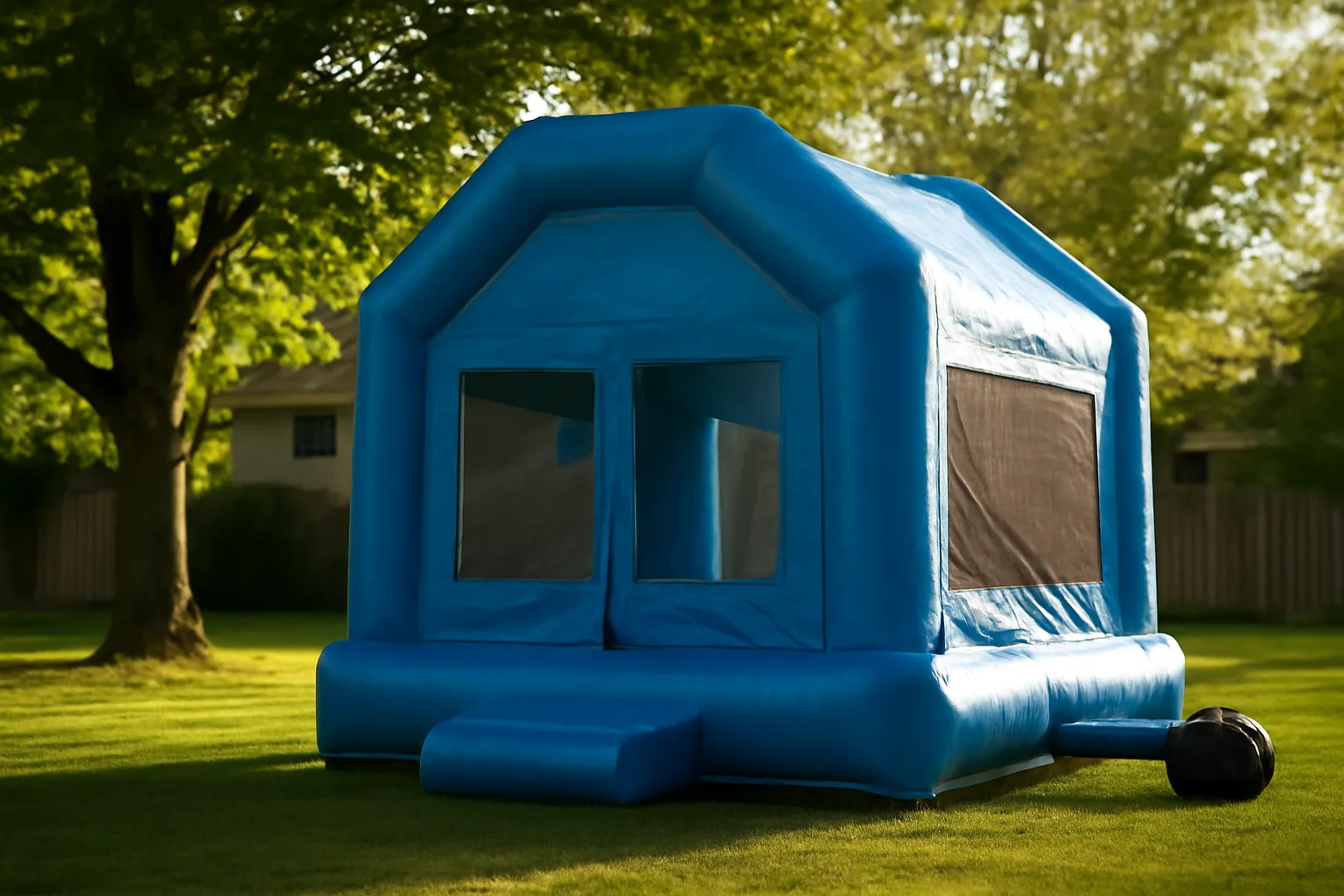
Bounce house rental is a delivery and setup business. You own commercial inflatables, haul them to a yard or parking lot, inflate them, watch the stakes, then pack them out. The customer pays for a time window, not for a building you staff all week.
It is ordinary consumer-goods rental with a safety tail. The U.S. Census Bureau files this kind of shop under NAICS 532289, All Other Consumer Goods Rental, which covers establishments that rent consumer goods outside the big named categories like video or formal wear.[1] You are closer to a tent-and-chair outfit than to a theme park, until a state amusement-ride statute pulls you in.
The unit mix is simple. Castles, combo slides, obstacle courses, a blower for each inflatable, stakes or water barrels, and often a small generator when the site has no outlet. A trailer or a van with a hitch does the hauling. Setup is the product. Teardown is the product. The vinyl sitting in storage is not.
People mash this together with indoor playgrounds, trampoline parks, and permanent carnival midways. Those businesses have different inspectors, different staffing, and different insurance. A mobile company that only does backyard birthdays can still get treated as an amusement ride in some states. That is a board question. It is not a national myth you copy from a Facebook group in another time zone.
I would describe the job in one sentence on every contract: we deliver, we install per the manufacturer, we leave written rules, we pick up. If a customer wants you to stay as an attendant, that is a different job and a different price. Do not blur it.
How do you start bounce house rental?
You start by forming a real business, getting a free IRS EIN, buying insurance that actually names inflatable amusement devices, and checking whether your state inspects portable rides. There is no federal operator card. Do not buy ten castles until a carrier will write the account.
Here is the order I would use. Pick a legal name and see if the secretary of state will take it. File an LLC unless you truly want personal assets on the same page as a bounce injury (I would not). Get an EIN. Open a bank account in the business name. Call insurance markets before you click buy on a used unit. Then, and only then, confirm local business tax, zoning for storage, sales tax, and any amusement-ride file.
The U.S. Small Business Administration structure guide is the right first read on LLC versus sole proprietorship versus corporation. It is not bounce-house specific. It still saves you from filing the wrong thing because a YouTube video sounded confident.[3] Licenses after that are local and state. The SBA licenses and permits page says the mix depends on your activities and location, which is the whole truth in one line.[4]
Equipment comes after paper. One or two commercial units, matching blowers, stakes that belong to those units, and a trailer you can reverse on a Saturday. Residential-grade “backyard” houses from general marketplaces are a waste of money for rental. Seams fail, insurers ask questions, and you cannot point to a commercial ops manual.
Also a waste: a wrapped van, a $5,000 brochure site, and paying a random website to “file your EIN.” The IRS does that for free.[2] Spend the cash on vinyl, a hitch that is not sketchy, and a policy you can hand a school district.
If you want state-level paper, start with a real state guide, not a national checklist. California and Alabama are different jobs. Read how to start bounce house rental in California or how to start bounce house rental in Alabama and then call the board named in that state.
Do you need a federal bounce house rental license?
No. The federal government does not issue a bounce house rental license. You will not find a USDA card, a CPSC operator badge, or an IRS “rental permit.” What you will find are tax IDs, vehicle rules, and product-safety guidance that still leaves the operator card to the states.
Federal touchpoints are boring and real. Income tax. Self-employment tax if you are not a corporation paying you wages. An EIN if you have employees, a bank that wants one, or a state that asks. Motor carrier registration if you cross state lines with a heavy enough truck and trailer. That is it for most backyard operators.
CPSC does not license you. It publishes injury data and warnings. In 2011 the agency warned the public about wind and inflatable amusement devices, including the risk that units can be lifted off the ground when they are not anchored as the manufacturer requires.[12] That is guidance and hazard communication. It is not a permit you hang in the cab.
ASTM F2374 is a voluntary consensus standard, not a federal license. States and insurers point to it. You still buy the standard and run the practice. You do not mail ASTM an application.
Someone will try to sell you a “national bounce house license.” Walk away. Ask them which statute number they mean. Then go read that statute yourself.
What licenses and permits do you actually need?
You typically need a state entity filing, a local business tax receipt or home-occupation clearance for storage, a sales tax permit if your state taxes equipment rental, and, in some states, an amusement-ride registration or inspection. Confirm each one with the issuer. Do not treat a blog list as the board.
The SBA licenses page is honest about the mess: what you need depends on activity and location.[4] Bounce house rental sits in that mess. A city may only care that you have a business tax certificate and that you are not storing 14 trailers on a residential lot. A state agriculture or labor department may also want an amusement ride file. Those are different windows, different forms, different fees. Fees change. Confirm them.
Texas Occupations Code Chapter 2151 (Regulation of Amusement Rides) is the kind of statute people forget exists until a venue asks for proof. It requires liability insurance before a person operates an amusement ride, and it sets minimum limits in the statute text. Read the current section and confirm with Texas agencies before you advertise in that state.[5]
Florida’s amusement ride safety statute is section 616.242. It is long. It builds an inspection and insurance structure for amusement rides. Whether a given inflatable falls inside that statute, sits exempt, or gets treated as something else is a Florida Department of Agriculture and Consumer Services question, not a guess from a national article.[6]
Use a table, then call the board.
| Paper item | Typical issuer | What you confirm |
|---|---|---|
| EIN | IRS | Free filing, no third-party fee |
| Entity (often LLC) | State secretary of state | Name, registered agent, annual report |
| Amusement ride file | State ride, labor, or agriculture board | Whether inflatables are in scope |
| Sales tax permit | State revenue department | Whether tangible rental is taxable |
| Local business tax | City or county | Home storage and sign rules |
| USDOT number | FMCSA | Interstate and 10,001 lb threshold |
California paper is its own stack. If that is your market, use bounce house rental license in California and then the state and city sites it points to. Same pattern for bounce house rental license in Utah and bounce house rental license in Vermont.
How much insurance do you need to rent bounce houses?
You need a commercial general liability policy that lists inflatable amusement devices, plus commercial auto, plus inland marine (or a floater) on the houses themselves. Personal auto and a homeowner policy will not do this. If a carrier will not name the activity, you do not have coverage, you have a story.
There is no single federal limit. Venues often ask for $1 million per occurrence and want a certificate with them named as additional insured. Some school districts ask for more. Texas puts a statutory insurance requirement on amusement ride operators in Occupations Code Chapter 2151; the dollar floor lives in that chapter, so read the current text rather than copy a number from memory.[5] Florida’s section 616.242 also builds insurance into amusement ride operation. Confirm the current amounts with the statute and the state agency, because boards amend numbers and exemptions.[6]
I would not take a deposit on a job until I had a binder in hand. I would also not cheap out on the auto policy. The loss you actually have, most years, is a scraped trailer, a backing incident, or a blower tossed in a driveway. The loss that ends the company is a kid and a wind event.
Waivers are not insurance. They can support assumption-of-risk facts. They do not let you skip stakes. They do not bind a minor the way people think they do in every state. Get the form from a lawyer licensed where you operate. Do not download one from a forum.
What equipment and standards apply to commercial inflatables?
Commercial rental units should be designed, built, operated, and maintained in line with ASTM F2374, Standard Practice for Design, Manufacture, Operation, and Maintenance of Inflatable Amusement Devices.[7] That is the document insurers and ride boards keep pointing at. Buy it from ASTM. Do not run on a photocopied checklist someone titled “ASTM” in a group chat.
Buy commercial vinyl from a manufacturer who will send an ops manual, a capacity chart, and an anchoring plan. Match the blower to the unit. Carry extra stakes, repair material, and a way to measure wind at the site, not at the airport 20 miles away. If the manual says weights instead of stakes on asphalt, bring the weights. Do not invent a system with cinder blocks and hope.
Injury data is why this is not a toy business. A Pediatrics study of U.S. emergency department records estimated 64,657 children younger than 18 were treated for inflatable bouncer-related injuries from 1990 through 2010 (95 percent confidence interval 32,710 to 96,604). That interval is wide because the estimate comes from a national sample, not a census of every hospital. It is still the closest peer-reviewed national picture we have, and it is why mixed-age piles on a castle are a bad idea.[8]
CPSC’s 2011 warning on inflatable amusement devices is the federal weather headline: wind can lift a unit that is not anchored to the manufacturer’s instructions.[12] I shut down earlier than salespeople like. A lost house is cheaper than a lawsuit, and a lawsuit is cheaper than a funeral. If you want a one-time paper pack that maps ASTM F2374 checkpoints next to weather call-off rules, InflatablePath sells an ASTM + Weather Kit for $149. You can also buy F2374 yourself and write the same checklist in a binder.
What does first-year bounce house rental operations look like?
First year is Saturdays, weather, and repair. Weekday school and church jobs exist, but they do not show up because you printed flyers once. You live on weekends, you lose weekends to wind and rain, and you spend Mondays on patch kits and oil changes.
Nobody has good public data on bounce house rental profit by zip code. BLS does not publish an owner-operator series for this exact shop. The closest honest method is counting weekend parties in a 30 to 45 minute radius and seeing how many already have vendors. If three companies already cover every Saturday, your fourth trailer does not magically create a fourth party.
Paper on every job: signed contract, site notes, photos of stakes or weights, blower running, weather log, pickup condition. Keep it. If you are a sole proprietor or a default single-member LLC, that operating profit lands on Schedule C (Form 1040). The IRS page on Schedule C is the right filing map, not a TikTok tax guru.[11]
If you are self-employed, self-employment tax sits on top of income tax. The IRS states, “The self-employment tax rate is 15.3%.” That 15.3 percent is 12.4 percent social security and 2.9 percent Medicare.[10] Budget it. People skip this and then act shocked in April.
Staffing is the quiet killer. One person can run a small route. Two jobs at the same 2 p.m. window means a helper you actually train, or a job you decline. Untrained cousins on a blower are how seams rip and how kids get hurt. Train, or say no.
For a state-flavored operations path, how to start bounce house rental in Arizona and how to start bounce house rental in Colorado walk the local paper without pretending the climate is the same.
Do you need a USDOT number to deliver bounce houses?
You need a USDOT number when FMCSA’s test says you do, not when a Facebook comment says “all trailers.” FMCSA’s registration page says you need a USDOT Number if the vehicle is used in interstate commerce and has a GVWR, GCWR, GVW, or GCW of 10,001 pounds or more, whichever is greater.[9]
Weigh the combination. A three-quarter-ton pickup plus a loaded bounce house trailer sits near that line more often than new owners expect. GVWR is the rating on the door sticker and the trailer plate, not your guess after a dump-run. If you never leave your state, interstate FMCSA rules may not be the ones that bite. Intrastate motor carrier rules still might. Confirm with your state DOT or DMV, not with me.
A CDL is a different threshold. FMCSA says you must have a CDL to operate, among other categories, a vehicle with a GVWR of 26,001 pounds or more.[14] Most backyard combos never get there. Some big water-slide operations do. Read the door sticker. If you are close, stop guessing.
Paying a broker to “register your truck” before you know GVWR and interstate use is a waste. The FMCSA page is short. Use it.
How are bounce house rentals taxed?
Profit is taxable income. Equipment rental is often taxable sales in states that tax tangible personal property rentals. Those two sentences are the whole federal-plus-state picture. The details are local, and they change.
Get an EIN if you need one. The IRS says, “Applying for an EIN is a free service offered by the Internal Revenue Service.” It also warns you about websites that charge for that free service.[2] I would not pay them.
Self-employed net earnings take the 15.3 percent self-employment tax the IRS publishes, with the social security wage base sitting on the 12.4 percent piece.[10] W-2 wages out of an S corp are a different design with payroll tax and reasonable-salary facts. I would not install that in month one just to look clever. File what you are.
Sales tax is the one new owners skip, then get a letter. Many revenue departments tax the rental of tangible goods, which is exactly what a castle is. Some tax delivery. Some tax labor if you unbundle it wrong. Confirm with your state department of revenue. Do not copy a neighboring state’s rule.
Deduct ordinary expenses you can prove: insurance, fuel, repairs, storage, merchant fees. Keep receipts. The IRS Schedule C instructions are the map for sole props.[11] I am not your accountant. If the first year is real money, pay one.
What safety and weather rules actually matter on site?
Anchor the unit the way the manufacturer drew it. Measure wind at the site. Separate kids by size. Do not mix toddlers with teenagers on a castle. Those four rules prevent more grief than any slogan on a van.
ASTM F2374 is the operations and maintenance practice for inflatable amusement devices. It is not optional in any company I would run, even if your state has not adopted it by name.[7] CPSC’s inflatable warning is the federal weather flag: high wind and poor anchoring are how units leave the ground.[12]
I will not invent a single national shut-down speed. Manuals differ. Boards differ. A number you saw in a group chat may not be the number on your unit. Put the manufacturer limit in the contract and in the driver’s phone. If trees are laying over, I am already packing. You can refund a weather call. You cannot un-injure a child.
The Pediatrics estimate of 64,657 pediatric ED visits from 1990 through 2010 is the study I would hand a new attendant. Most of those cases are not horror-movie events. They are collisions, awkward landings, and mixed-age chaos. Attendants and age grouping are cheaper than pretending vinyl is harmless.[8]
Photos of stakes are not vanity. They are how you prove you did the job when someone later says you did not.
What paperwork should you keep on every bounce house rental job?
Keep a signed contract, a payment record, any additional-insured certificate the venue demanded, setup photos, a wind note, and an incident form even when nothing happened. If a claim comes six months later, memory is not a file.
The contract should say what you deliver, the time window, the customer’s site duties (outlets, pets, underground irrigation), the weather call, the damage hold, and who may jump. Write in plain English. If a park wants extra insured status, issue the certificate from the carrier, not a Word doc you typed.
Hire help and federal wage and hour law can apply. DOL Fact Sheet 13 explains how the Fair Labor Standards Act looks at an employment relationship rather than at the label you put on a helper.[13] Paying cash and calling someone a contractor does not end the analysis. If they only work for you, use your blower, and follow your route, you may have an employee. Confirm with counsel. Misclassifying a Saturday kid is a dumb way to meet a wage investigator.
State ride files, if you have them, belong in the same glove box as the insurance certificate. So does the manufacturer manual. Inspectors and claims adjusters both like original documents.
InflatablePath is an independent publisher, not a law firm and not a service company. When you want the kit mapped onto a first-year binder, use /start. For a state paper path that is actually a board path, keep going with how to start bounce house rental in Alaska or bounce house rental license in Alaska and then the agency named there.
Frequently asked questions
What is bounce house rental?
It is a mobile rental trade. You own commercial inflatables, deliver them, inflate and anchor them, then pick them up. Customers pay for a time window at a home, school, or park. It is consumer-goods rental under NAICS 532289, not a federal license class. Some states still treat the units as amusement rides. Confirm that locally.
How do you start bounce house rental?
Form an entity, get a free IRS EIN, open a business bank account, and get liability insurance that names inflatables before you buy vinyl. Then confirm local business tax, sales tax, zoning for storage, and any state amusement-ride file. Buy commercial units with real manuals. Skip van wraps and paid EIN websites. Confirm every fee with the issuer.
Is there a federal bounce house rental license?
No. There is no federal operator license for bounce house rental. Federal pieces are tax IDs, self-employment or payroll tax, CPSC safety warnings, and FMCSA rules if you haul interstate at 10,001 pounds or more. Operator permits, if they exist, come from states or cities. Ask for a statute number if someone sells you a “national license.”
How much does it cost to start a bounce house rental business?
Nobody publishes a solid national average, and I will not invent one. The first commercial unit, blower, stakes, trailer, insurance down payment, and storage usually dwarf the LLC filing. Residential-grade houses look cheap and then fail. Get an insurance quote before you shop vinyl. Confirm state ride fees with the board that charges them.
Do I need an LLC to rent bounce houses?
No statute I know forces an LLC just because you rent inflatables. I would still file one. Sole proprietorship puts bounce claims next to your personal assets. The SBA structure guide is the plain overview of LLC versus sole prop versus corporation. After you pick, get the EIN and a bank account in the business name.
What NAICS code is bounce house rental?
The Census Bureau’s NAICS 532289, All Other Consumer Goods Rental, is the usual bucket for shops that rent consumer goods outside the named specialty categories. It is a statistics code, not a license. Banks and some applications ask for it. Do not confuse it with an amusement park NAICS unless you actually run a park.
Can I use a homeowner or personal auto policy?
No. Those policies are not built for commercial inflatable amusement devices or for delivery for a fee. You want commercial general liability that names the activity, commercial auto, and inland marine on the units. If a carrier will not write inflatables, stop buying equipment. A waiver does not replace that policy.
Do customer waivers replace insurance?
No. A waiver can support assumption-of-risk facts. It does not pay a hospital bill and it does not bind minors the same way in every state. You still need a real liability policy, manufacturer anchoring, and age grouping. Have a lawyer in your state draft the form. Forum templates miss local law.
What wind speed is too high for a bounce house?
Use the number on your manufacturer manual and ASTM F2374 practice, not a single national myth. CPSC has warned that wind can lift poorly anchored inflatables. I pack up when the site is clearly windy, even if a salesperson promised a higher cutoff. Put the call-off rule in the contract so a refund is not an argument in a driveway.
Do I need a CDL or a USDOT number?
Most backyard combos do not need a CDL. FMCSA puts the common CDL GVWR line at 26,001 pounds. A USDOT number is a different test: interstate commerce and 10,001 pounds GVWR or GCWR, among other cases. Weigh the truck and trailer. Confirm intrastate rules with your state DOT.
Are bounce houses legally amusement rides?
Sometimes. Some states fold commercial inflatables into amusement-ride statutes such as Texas Occupations Code Chapter 2151 or Florida section 616.242. Other states leave backyard rental to local business tax and insurance. The classification changes what you file and what you inspect. Confirm with the ride board, agriculture department, or labor agency in your state.
How do I get an EIN for bounce house rental?
Apply on the IRS EIN page. The IRS says applying is a free service and warns about sites that charge for it. You get the number online for a responsible party with a Social Security number in most cases. Banks, payroll, and many state applications will ask for it. Do not pay a mill for a free form.
Do I charge sales tax on bounce house rental?
Often yes, if your state taxes the rental of tangible personal property. Some states also tax delivery. Confirm with your state department of revenue and put the tax on the invoice the way that department wants it. Income tax on profit is separate. Self-employment tax is 15.3 percent of net earnings if you are self-employed, per the IRS.
Where do I confirm my state’s bounce house rental rules?
Start with the secretary of state (entity), the revenue department (sales tax), the city or county (business tax and storage), and whichever agency inspects amusement rides (often agriculture, labor, or public safety). Read the statute they enforce. Then call them. State how-to guides help you find the board. They do not replace it.
Sources
- U.S. Census Bureau, NAICS 532289 All Other Consumer Goods Rental (2022): Bounce house style consumer rental activity is classified in NAICS 532289, All Other Consumer Goods Rental.
- IRS, Apply for an Employer Identification Number (EIN) Online: Applying for an EIN is a free IRS service; the IRS warns about websites that charge for it.
- U.S. Small Business Administration, Choose a business structure: SBA explains LLC, sole proprietorship, corporation, and related structure choices for new businesses.
- U.S. Small Business Administration, Apply for licenses and permits: Federal, state, and local licenses depend on business activities and location.
- Texas Occupations Code Chapter 2151, Regulation of Amusement Rides: Texas statute requires liability insurance and other rules before a person operates an amusement ride.
- Florida Statutes § 616.242 (2023), Safety standards for amusement rides: Florida section 616.242 sets statewide amusement ride safety standards, including inspection and insurance architecture.
- ASTM International, F2374-22 Standard Practice for Inflatable Amusement Devices: ASTM F2374 covers design, manufacture, operation, and maintenance of inflatable amusement devices.
- Pediatrics, Thompson et al., Pediatric Inflatable Bouncer-Related Injuries, 1990 to 2010: Estimated 64,657 U.S. ED visits for children under 18 with inflatable bouncer-related injuries from 1990 through 2010.
- FMCSA, Do I need a USDOT number?: A USDOT number is required for interstate commerce when GVWR/GCWR/GVW/GCW is 10,001 pounds or more, among other tests.
- IRS, Self-employment tax (Social Security and Medicare taxes): The self-employment tax rate is 15.3 percent (12.4 percent social security and 2.9 percent Medicare).
- IRS, About Schedule C (Form 1040): Sole proprietors report profit or loss from business on Schedule C (Form 1040).
- CPSC News Release, Warning on inflatable amusement devices (2011): CPSC warned that inflatable amusement devices can be hazardous in wind if not anchored per manufacturer instructions.
- U.S. DOL WHD Fact Sheet #13, Employment Relationship Under the FLSA: FLSA coverage depends on the employment relationship, not only on the contractor label a business uses.
- FMCSA, Commercial Driver's License (CDL): A CDL is required to operate a vehicle with a GVWR of 26,001 pounds or more, among other categories.