Last updated 2026-08-21
TL;DR
Bounce house rental is a local service that delivers, sets up, and picks up inflatable play structures for parties and events. You start it like other small service shops: form an entity, get a free IRS EIN, check whether your state treats inflatables as amusement rides, carry insurance, and buy commercial units. Fees and inspections vary. Confirm them with the board that issues the paper.
What is bounce house rental?
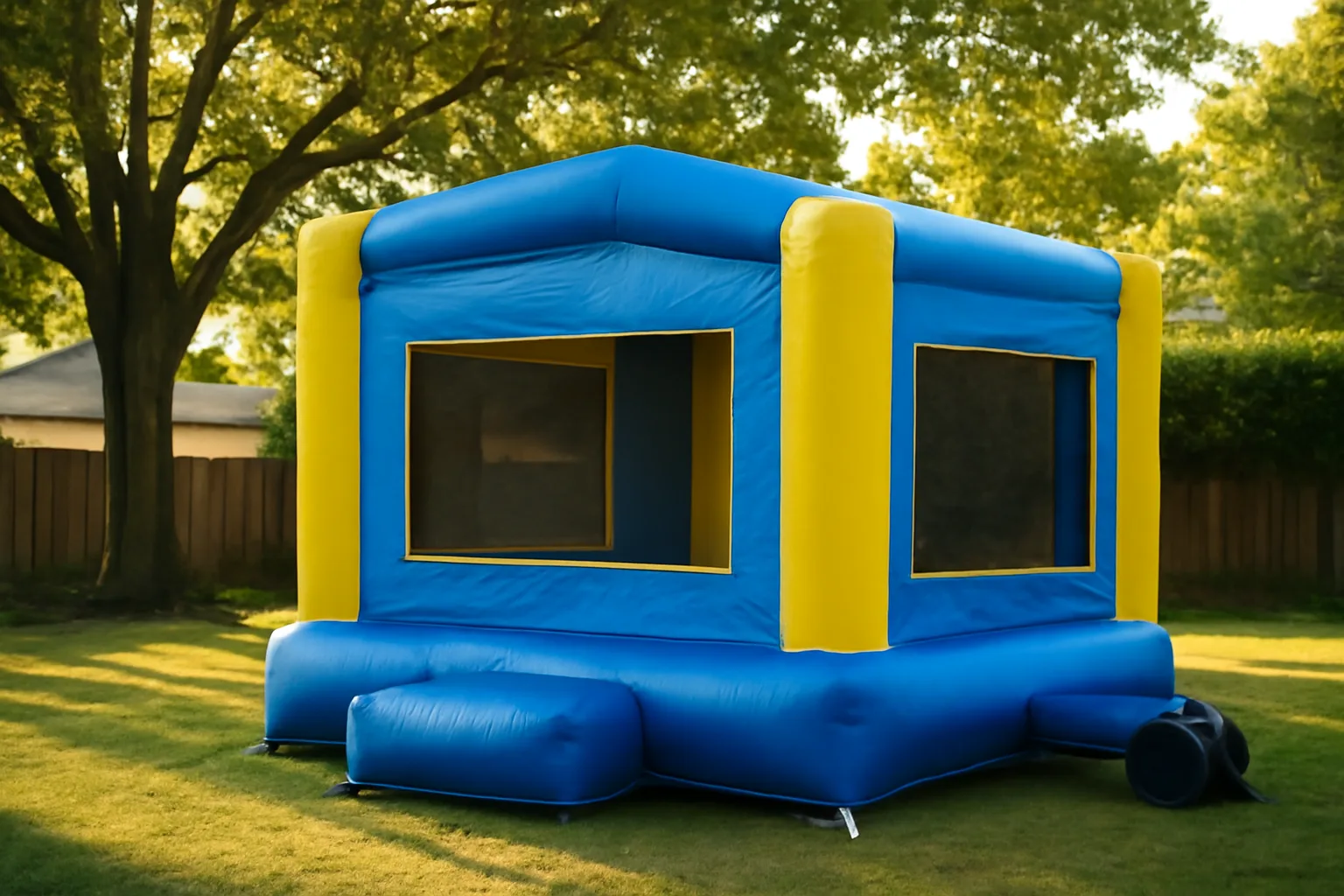
Bounce house rental is a local delivery and setup service. You own inflatable play structures, haul them to a site, anchor them, run a blower, and take them back when the booked block ends. The customer pays for use, not for the unit. That is the product.
Most jobs are birthday parties, school carnivals, church picnics, and company family days. You are not selling toys. You are selling time, labor, and the risk that sits on your policy. If you skip that last part, the rest of this guide will feel like paper for its own sake. It is not.
Shops land in a few Census boxes. NAICS 532284 is recreational goods rental. NAICS 532289 is a broader consumer goods rental bucket that party shops often use when they also roll tables and tents. The code does not license you. It just tells a banker or an insurer what you look like on paper.
A bounce house is an inflatable amusement device. ASTM International writes the practice most carriers point at, ASTM F2374, for design, manufacture, operation, and maintenance of those devices [8]. Some states go further and call the same unit an amusement ride. That label can pull you into annual inspections, decals, and statutory insurance rules. Other states leave you with a city business license and whatever your carrier demands. There is no national bounce house license.
People treat this like a weekend favor that needs no entity and no contract. You can try that. I would not. One claim, one park rule, or one sales tax letter will eat a season of Saturday jobs. Treat bounce house rental as a real service shop from the first deposit.
How do you start bounce house rental?
You start bounce house rental by forming a business, getting a free federal EIN, checking your state's amusement ride rules, buying insurance and commercial inflatables, then taking paid bookings. That is the order I would use. Paper first. Equipment last. Buying a used castle before you know if your state inspects inflatables is how people strand cash.
Form an entity your state recognizes. The U.S. Small Business Administration walks through structures on its choose-a-structure page [2]. Most operators pick an LLC because insurers and parks already know what it is. A sole proprietorship is legal. It also parks a claim next to your house. I would not do that once a blower is in the field.
Get an Employer Identification Number from the IRS. "Applying for an EIN is a free service offered by the Internal Revenue Service" [1]. Anyone charging you for an EIN is selling a form you can file yourself. Then register the firm where you live and pull the local tax and zoning paper the city actually issues [3][4][12].
Next, read whether your state treats inflatables as amusement rides. Texas does, under Occupations Code chapter 2151 [6]. Florida does, under section 616.242 [5]. Ohio requires a permit before you operate an amusement ride [9]. Pennsylvania registers amusement rides under 7 Pa. Code chapter 139 [11]. If you work in Florida or California, start with those board notes, then confirm the current form with the agency. Never trust a blog for the fee.
Insurance comes before the first deposit. Then you buy commercial units built to the ASTM practice, not backyard toys. Then you write a contract that names wind, capacity, sober adult supervision, and what happens when the yard is mud. Then you take money. That is how you start bounce house rental.
Do you need a license to rent bounce houses?
You need whatever license your city, county, and state actually issue for your activity. There is no single federal bounce house license. The SBA states that most small businesses need licenses and permits from more than one level of government [3]. In this trade that mix is usually a general business license, a sales tax permit if your state taxes the rental, and, in ride states, an amusement device or ride operator permit.
Federal paper is thin. You may need an EIN [1][12]. You do not need a USDA or DOT operator stamp to rent a castle. Product safety agencies write rules for devices. They do not license your van.
State paper is where people get surprised. If the unit is an amusement ride in that state, you may need an annual inspection, a decal, and proof of insurance before you set up. Texas says a person may not operate an amusement ride unless the person "has had the amusement ride inspected at least once a year by an insurer or a person with whom the insurer has contracted" [6]. Ohio is just as blunt. No person shall operate an amusement ride in that state without a permit issued under Ohio Revised Code 1711.53 [9].
Local paper still matters in states with no ride program. Cities attach home-occupation rules, trailer parking rules, and park vendor permits. A county health shop does not usually license a dry castle. A fire marshal might ask about generators at a festival. Ask. Do not guess.
Confirm every fee and form with the board that prints the permit. I will not quote a national wait. Times change. If you need a state map, use the board pages for Alabama, Colorado, Connecticut, and Delaware, then call the agency listed on the current application.
What insurance do bounce house rental shops actually carry?
You need commercial general liability written for inflatable or amusement operations, plus coverage on the truck and the units. In ride states the statute may set a floor you have to meet before you operate. Read the current text. Texas Occupations Code chapter 2151 is one place that pairs an annual inspection with a required insurance policy [6]. Confirm the dollar amount on the statute and with the Texas Department of Insurance. Do not copy a number from a forum post.
I would not open with a tiny personal policy even in a state that is silent. Parks, schools, and many HOAs will ask for a certificate naming them as additional insured. If your limit cannot clear that gate, those jobs stay closed. Ask the carrier if they have actually paid inflatable claims and if they require ASTM F2374 practices [8]. If they stare at you, keep shopping.
Inland marine or scheduled equipment coverage pays when a unit is stolen off a trailer. A homeowner policy will not. Commercial auto matters because a personal auto policy often drops you the moment you take a paid load. An umbrella is optional in year one. I would buy it after the first school district contract, not before you have a second unit.
Workers' comp is a state rule once you have employees. If you are solo, some states still want a waiver on file. Confirm with your labor department. Do not take a friend's "I never had it" as law.
Premiums move with claims, zip code, and whether you do water slides. I will not invent a monthly price. Get two quotes from carriers that already write inflatables. If a quote looks cheap and the application never asked about anchoring or wind, assume the claim file will be ugly.
How much money do you need to start bounce house rental?
Nobody publishes a clean national startup total for bounce house rental. The closest honest answer is a stack you build yourself: entity and permit fees (confirm locally), an insurance down payment, one or two commercial units, a blower per unit, stakes and straps, a used trailer or van, and a reserve for the first repair. Units dominate the check.
A new commercial dry castle from a known builder costs more than a used one with faded seams. I will not post a fake average price because listings swing with size, brand, and whether the seller will pass an insurer look-over. Get written specs. Ask if the unit was built to ASTM F2374 [8]. If the seller cannot say, walk.
I would start with two dry units, not eight. One is always in the shop or on a long job. Two lets you book a Saturday without stacking setups you cannot make. Water slides wait until you have a hose plan, a dryer, and extra liability comfort. Cheap residential party inflatables are a waste of money in a rental fleet. Insurers and ride inspectors treat them as toys.
Skip the trailer wrap, the custom mascot, and a big generator if every site you book has an outlet. A long, heavy-gauge cord and a GFCI block will do more work in year one. Spend on straps rated for the unit, proper ground stakes or water barrels for asphalt, and a contract a lawyer in your state has actually read.
Cash reserve matters more than a third castle. A blower dies on a Saturday. A seam opens. You refund or you lose the referral. Keep enough to replace one blower and refund one weekend without touching rent.
What safety rules and ASTM practices apply?
ASTM F2374 is the practice the trade points to for how inflatable amusement devices get designed, built, run, and maintained [8]. It is not a government license. It is the document insurers, some state ride programs, and serious builders treat as the baseline. Buy units from people who can show they build to it. Keep the manufacturer manual. Train anyone who sets up for you on that manual, not on a 12-minute video.
Injury risk is not theoretical. A 2012 Pediatrics study estimated 64,657 children were treated in U.S. emergency departments for inflatable bouncer-related injuries from 1990 through 2010 [7]. Younger kids take a lot of those hits. Mixed ages on one bed is how collisions happen. Your rules should split big kids and little kids, cap the count, and require a sober adult at the entrance. Put that in the contract and on a card you leave on site.
Anchoring is not optional. Follow the manufacturer's stake pattern. Grass, sand, and asphalt need different hardware. Water barrels on pavement only work if they meet the weight the builder specified. I have no patience for "we never stake at birthday parties." Wind does not care that the deposit cleared.
If you want a single packet that lines ASTM language up with weather shut-down checks, InflatablePath publishes a $149 one-time ASTM + Weather Kit. You can also do the work with F2374 and the builder's manual and never buy a kit.
Daily look-overs catch open seams, soft blowers, and missing stakes before a kid does. Log what you see. Ride states will ask. A paper log is dull and useful.
Which states treat bounce houses as amusement rides?
Several states inspect or permit inflatables as amusement rides. Texas, Florida, Ohio, and Pennsylvania are four with statutes or codes you can read yourself [5][6][9][11]. Many other states do some version of this. Many do not. The only safe move is to read the current amusement ride definition in your state and ask the agency if inflatables are in or out.
| State | Inflatables often pulled into ride rules | Where to read it |
|---|---|---|
| Texas | Yes | Occupations Code ch. 2151 [6] |
| Florida | Yes | Fla. Stat. 616.242 [5] |
| Ohio | Yes | Ohio Rev. Code 1711.53 [9] |
| Pennsylvania | Yes | 7 Pa. Code ch. 139 [11] |
Arizona and Georgia are not "no rules" just because they are not in that table. They may still have local permits. They still have lawsuits. Definitions change when a legislature adds the word inflatable to a ride statute. A guide from 2019 can be wrong.
If you cross a state line for a job, you may pick up that state's ride rules for the day you operate there. I would not assume your home permit travels. Call the destination board. Get the answer in writing if you can.
Some cities run their own inspection even when the state is quiet. Festival promoters will ask for a third-party sticker you have never heard of. Budget a day. Confirm the fee with whoever stamps the unit. I will not invent it.
What paperwork do you file in the first year?
Year one paper is an entity filing, an EIN, a local business license, a sales tax account if your state taxes rentals, insurance certificates, ride permits if you are in a ride state, and a written contract for every job [1][3][4][12]. If you operate as a sole proprietor, the IRS still wants the income on Schedule C (Form 1040). The IRS page on that form says you use it "to report income or loss from a business you operated or a profession you practiced as a sole proprietor" [10].
Keep a folder per unit: purchase invoice, manufacturer manual, photos of serial numbers, repair invoices, daily inspection logs. Ride inspectors like boring folders. So do insurers after a claim.
W-9s, additional-insured certificates, and park use permits show up the first time you book a city pavilion. Build lead time for those. Do not promise a school you can send it this afternoon until you have done it once.
I would track every job on one spreadsheet: date, site, unit, wind at setup, wind at teardown, incident blank, payment. That is not software. That is how you notice a unit that keeps coming home dirty or a site that always lies about outlets.
You do not need a trademark in year one. You do not need a resale certificate unless you also sell goods. You do need to know if your city bans commercial trailers in the driveway. Ask zoning before you wrap anything.
How do bounce house rental prices and deposits work?
Rental prices are local. A dry castle in a cheap metro is not a dry castle in a coastal weekend town. I will not post a fake national rate. Pull five competitors in your zip code, match unit size, and sit in the middle until you have reviews. Going lowest just trains customers to call you last.
Charge a delivery fee that matches drive time, not a flat hope. Fuel and two people on a Saturday are real. Weekend and holiday premiums are normal. Multi-day school jobs should not use the Saturday party price.
Take a deposit that hurts to abandon. I like half up front, balance before setup, card on file for damage. Cash-only shops still exist. They also lose the paper trail you want after a tear. Put weather in writing. If you cancel for wind, say whether the deposit rolls or returns. If the customer cancels late Friday, say what they forfeit. Ambiguity is how Saturday morning turns into an argument in a driveway.
Watch unlimited time and keep-it-overnight add-ons. Overnight means the unit sits unsupervised. Your contract should say who is liable when a cousin tries a backflip after dark. I would price overnight like a different product, not a small extra.
What equipment should you buy first?
Buy one mid-size commercial dry bounce house and one obstacle or combo that still fits your trailer, both from a builder who will say ASTM F2374 out loud [8]. Match the blower to the unit. A tired blower is how beds go soft and kids hit the floor. Stakes, straps, a ground cover if the builder wants one, a GFCI, and a real repair kit go in the same order.
Skip the giant wet/dry castle as your first buy. It is heavy, it needs water rights at the site, and it dries slowly. Skip foam pits unless you like cleaning. Skip cheap vinyl with no serial plate. Your insurer may not cover it. Your inspector will not stamp it.
Trailer versus van is a math problem. A van keeps units dry and hidden. A trailer hauls more and teaches you about tongue weight. Weigh the loaded rig. Under 49 CFR 383.5, a commercial motor vehicle includes a vehicle with a GVWR of 26,001 pounds or more [13]. Most light bounce loads stay under that line, but your door sticker and trailer plate are the numbers that matter, not a forum post. Confirm whether your combo needs a CDL before you book a two-unit Saturday.
Used units: inspect every seam, every mesh window, the number of D-rings, and whether patches sit on load paths. Ask for the last inspection if it came from a ride state. A bargain from a shut-down shop can be a gift or a pile of hidden mildew.
What weather rules shut a bounce house down?
You shut a bounce house down when wind, rain, lightning, or site flooding makes the unit unsafe under the manufacturer's limits and your contract. There is no national mph number I can stamp on this page. ASTM F2374 tells operators to follow design and operating limits, including environmental conditions [8]. The builder's manual is the first number you obey. If the manual names a wind line, that is your line, not a group chat poll.
I cancel when the forecast at setup already sits on that line. Waiting to see how it feels is how units become sails. Open-sided slides catch wind worse than a low castle. Wet vinyl gets slick. Lightning means everyone out. Kids first. Always.
Write the weather rule in the booking email and the contract. Name who decides. If you decide, say so. Customers will pressure you. The Pediatrics injury estimate is why you do not need their permission to shut it down [7].
A cheap anemometer in the kit is worth more than a branded canopy. Check wind at the site, not at an airport 30 miles away. Stakes that actually hold beat any slogan about safety culture.
How do taxes work for bounce house rental?
You report bounce house rental income as business income. Sole proprietors use Schedule C [10]. Many single-member LLCs land in the same place. Payroll taxes start when you have employees. Sales tax is a state and city question. Some states tax tangible personal property rentals. Some treat amusements differently. I will not guess your rate. Ask the state department of revenue and get the account number before you take the first card payment.
The SBA tax ID page explains that an EIN identifies the business for federal taxes [12]. Use it on the insurance policy and the bank account. Mixing personal and business accounts is how a simple year becomes a long April.
Deduct ordinary expenses: units your CPA puts on a depreciation schedule, insurance, fuel, permit fees, repairs, phone. Meals with yourself in the van are not a plan. A CPA who has filed a rental or party company return is worth one conversation in January, not a full-time bookkeeper in month two.
Estimated taxes exist if you will owe. Confirm current IRS rules for your filing status. InflatablePath is an independent publisher, not a law firm and not a rental company. If you want the kit after you have read your statute, use /start. Confirm every fee, form, and inspection rule with the board that issues the paper.
Frequently asked questions
What is bounce house rental?
Bounce house rental is a delivery service. You own inflatable play structures, set them up at a customer's site for a booked block of time, then pack them out. The customer pays for use and labor, not for the unit. It is a local service business, not a federal franchise and not a toy store.
How do you start bounce house rental?
Form an entity, get a free EIN from the IRS, check whether your state treats inflatables as amusement rides, buy liability and auto coverage, then purchase commercial ASTM-built units. Write a contract that covers wind and supervision before you take a deposit. Confirm every license fee with the board that prints the permit. Do not buy eight units first.
Do I need an EIN to rent bounce houses?
If you hire anyone, open a business bank account, or file as anything but a bare sole prop under your SSN, get an EIN. The IRS application is free. The SBA treats the EIN as the federal tax ID that identifies the firm. I would get one before the first paid job even as a solo operator.
Is a bounce house an amusement ride?
Sometimes. ASTM F2374 treats it as an inflatable amusement device. Texas, Florida, Ohio, and Pennsylvania are among the states that pull many inflatables into amusement ride inspection or permit rules. Other states do not. Read the current definition where you operate and ask the agency. Do not guess from a national blog.
How much insurance do I need for bounce house rental?
Enough to satisfy your state ride statute, if you have one, and enough to clear park and school certificate requests. Ride states often set a statutory floor. Confirm that number in the current code. I would not open on a tiny personal policy. Get quotes from carriers that already write inflatables and ask if they require ASTM practices.
Can I run bounce house rental from my house?
Maybe. Zoning and home-occupation rules decide, not a national custom. Some cities ban commercial trailers in driveways or limit customer pickup. Ask planning before you wrap a trailer or stack units against a fence. A quiet LLC filing does not override a zoning letter.
Do I need a CDL to haul inflatables?
Usually not, if your truck and trailer stay under the 26,001-pound GVWR line in 49 CFR 383.5 and you are not hauling 16 or more passengers or hazmat. Weigh the loaded rig. Read the door sticker and the trailer plate. A heavy combo can cross the line even if "everyone in the group" says they drive on a regular license.
Are residential bounce houses OK for rental fleets?
I would not use them. Insurers and ride inspectors treat backyard units as toys. They often lack the serial plates, anchor points, and build practice commercial carriers want. A cheap residential castle that you cannot insure is a waste of money, even if the listing looks huge for the price.
What wind speed shuts a bounce house rental down?
The number in your manufacturer's manual, not a national slogan. ASTM F2374 points operators at design and operating limits, including weather. If the manual names a wind line, that is your shut-down. Check wind at the site with a simple meter. Cancel when the forecast already sits on that line.
Do I charge sales tax on bounce house rental?
It depends on your state and city. Some tax tangible personal property rentals. Some treat amusements under a different rule. Ask the department of revenue and get an account before you take cards. I will not invent your rate. Put tax in the invoice so a Saturday deposit does not come up short.
How many bounce houses do I need to start?
Two commercial dry units is what I would buy. One is always dirty, torn, or stuck on a long job. Eight units in month one is how people fill a storage unit and starve the insurance payment. Add a water slide only after you have hose access, dry time, and a carrier that will write it.
What happens if a child is hurt on my inflatable?
You follow the contract, document the scene, call your carrier, and do not freelance a medical opinion. A 2012 Pediatrics study estimated 64,657 child emergency visits tied to inflatable bouncers from 1990 through 2010, so this file is not rare. Your logs, stakes, capacity rules, and certificate of insurance are what the claim turns on.
Can I set up a rental bounce house in a public park?
Only if the park department allows it and you bring whatever certificate, permit, and additional-insured wording they name. Many cities treat this as a vendor or special-use issue even when the state has no ride program. Ask before you quote the job. A private birthday in a public shelter can still need paper.
How long does a bounce house permit take?
There is no honest national processing time. Ride states, cities, and park desks all run their own queues, and those queues change. Anyone quoting a fixed wait on a blog is guessing. Ask the board that issues the form you actually need, and do not book a school date on a hoped-for stamp.
Sources
- IRS, Apply for an Employer Identification Number (EIN) Online: Applying for an EIN is a free service offered by the Internal Revenue Service.
- U.S. Small Business Administration, Choose a business structure: SBA guidance on selecting a recognized legal structure such as an LLC or sole proprietorship when launching a firm.
- U.S. Small Business Administration, Register your business: New firms register with the state and complete local registration steps where they operate.
- Florida Senate, Florida Statute 616.242 (2023): Florida sets safety standards, inspection, and permit rules for amusement rides, a category that can include inflatables.
- Texas Legislature, Occupations Code Chapter 2151: Texas requires an amusement ride to be inspected at least once a year by an insurer or a person with whom the insurer has contracted, and requires an insurance policy currently in effect.
- Pediatrics, Inflatable Bouncer-Related Injuries in Children (2012): An estimated 64,657 children were treated in U.S. emergency departments for inflatable bouncer-related injuries from 1990 through 2010.
- ASTM International, F2374 Standard Practice for Inflatable Amusement Devices: ASTM F2374 is the standard practice for design, manufacture, operation, and maintenance of inflatable amusement devices.
- Ohio Revised Code section 1711.53: Ohio requires a permit issued under 1711.53 before a person may operate an amusement ride in the state.
- IRS, About Schedule C (Form 1040): Schedule C is used to report income or loss from a business operated as a sole proprietor.
- Pennsylvania Code, 7 Pa. Code § 139.4: Pennsylvania registers amusement rides and attractions under 7 Pa. Code Chapter 139.
- eCFR, 49 CFR 383.5 Definitions: A commercial motor vehicle under the CDL rules includes a vehicle with a GVWR of 26,001 pounds or more.