Last updated 2026-08-18
TL;DR
Colorado treats bounce houses as amusement rides. You need a state permit from CDLE's Oil and Public Safety division for every inflatable device before you rent it out. No separate bounce house business license exists, but you do need a Colorado business registration, a sales tax account, liability insurance, and local permits in many cities. Typical rentals run $150 to $400 for four hours. Setup takes 30 to 60 minutes per unit.
Do you need a license for bounce house rental in Colorado?
Yes and no. Colorado has no separate bounce house rental license. What it has is a state device permit. Colorado Revised Statutes 8-20-101 defines "amusement ride or device" to include inflatable devices that use air pressure for structural support [4]. The Division of Oil and Public Safety, inside the Colorado Department of Labor and Employment, runs the Amusement Rides and Devices Program. That program requires an annual permit for every inflatable device you operate before you rent it out [2].
You still need the normal business paper. Form an LLC with the Colorado Secretary of State. Get a state sales tax account if you rent to Colorado customers, because renting tangible personal property is taxable here [3]. Many cities and counties add a general business license on top. Denver is one of them [7].
The state does not require a special operator certification, but OPS can ask for training records or inspection reports. Think of it this way. The state permit is your operating authority for the device. The local business license is your right to do business in that city. Both matter, and skipping either one can shut you down.
What Colorado agency handles bounce house permits?
The Colorado Division of Oil and Public Safety, Amusement Rides and Devices Program, handles inflatable amusement device permits. It sits under the Colorado Department of Labor and Employment. You submit an application for each device, pay the fee, and pass an inspection before the first use. The permit is annual. OPS also investigates complaints and can shut down an unpermitted inflatable [2].
The application asks for device manufacturer, model, serial number, your insurance certificate, and inspection date. Fees change, so confirm current rates on the OPS page. I will not quote a permit fee here, because OPS updates its fee schedule and you should not plan around a stale number.
Comparing states? California and Florida run different permit structures. Colorado's OPS program is one of the cleaner state-level regimes for inflatables.
How much does bounce house rental cost in Colorado?
No state board sets rental prices. You set your own. Based on public operator listings across the Denver and Colorado Springs metros in 2025, a standard 13x13 bounce house rents for about $150 to $400 for four hours. Larger combo units and water slides run $250 to $600 for the same window. Delivery is usually separate, $25 to $75 inside a 15-mile radius.
Those are planning ranges, not regulated tariffs. Buying instead of renting? A new commercial-grade unit costs $2,000 to $5,000. A used unit in good shape runs $1,000 to $3,000. I could not find a government-published average price for Colorado bounce house rentals, so treat these as market observation, not a guarantee.
Your filing costs are small next to the equipment spend. The chart below shows Colorado's state filing fees from the Secretary of State [1]. Those are fixed numbers you can build a budget around.
How long does a bounce house rental take in Colorado?
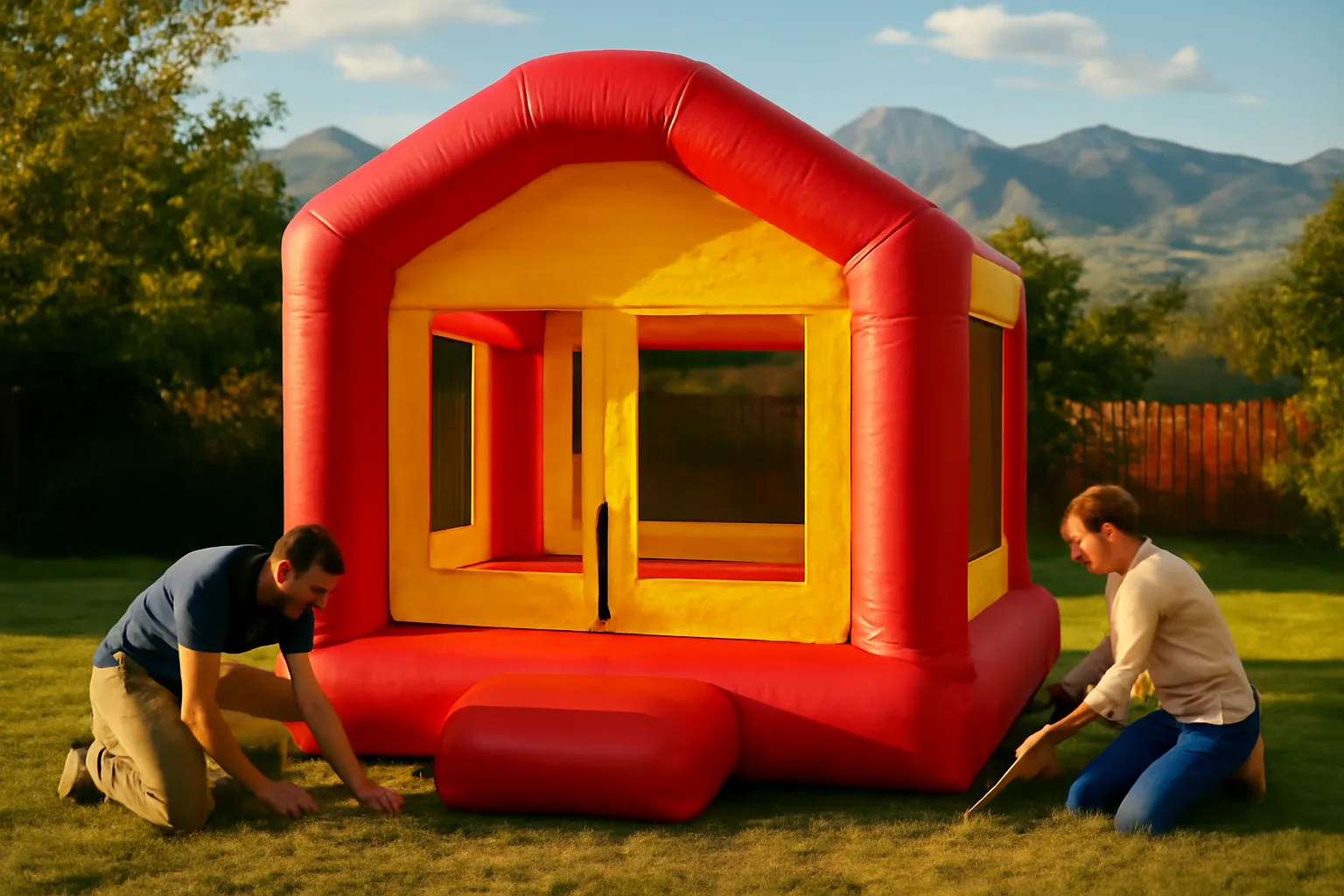
A standard setup takes 30 to 60 minutes for a single bounce house. That covers rolling out the unit, staking or weighing it down, connecting the blower, inflating, and doing a safety walk-around. Breakdown takes another 30 to 45 minutes. So a four-hour rental usually means a 5.5 to 6 hour block from arrival to departure.
Big combos, water slides, and multi-unit events take longer. Allow 60 to 90 minutes for setup and 45 to 60 for breakdown per large unit. Colorado altitude above 5,000 feet does not stop blowers, but some older blowers inflate slower in thin air. Use a blower rated for the unit size, and check the manufacturer note for altitude derating if you work in the mountains.
Book your day with the full time commitment in mind. A 12 p.m. to 4 p.m. rental often means you arrive at 10:30 a.m. and leave after 5:30 p.m.
What insurance does a Colorado bounce house business need?
Colorado OPS requires proof of liability insurance before it issues an amusement device permit [2]. The minimum amount is not fixed in statute. OPS sets it by rule and can change it. In practice, most Colorado operators carry $1 million per occurrence and $2 million aggregate. Some venues and event organizers demand $2 million per occurrence.
Do not skip this. A torn anchor or a sudden gust turns a bounce house into a lawsuit. Ask an insurer that writes amusement or special event coverage. Expect $500 to $1,500 per year for a single-unit startup, higher for multiple units or water features.
Keep your certificate of insurance in the truck and send a copy to every venue before you arrive. Plenty of parks and schools will not let you on site unless they are named as an additional insured.
How do you register a Colorado bounce house business and collect sales tax?
Start with the Colorado Secretary of State. Form an LLC for $50, file the annual report for $10, and register a trade name for $20 if you do not use your legal name [1]. All of it is online. Then get a Colorado sales tax license from the Department of Revenue. The state rate is 2.9%, but cities, counties, and special districts stack their own rates on top, so your total collection rate runs from about 4% in rural areas to over 9% in Denver [3].
Bounce house rental is a rental of tangible personal property, so you charge sales tax on the rental amount, including delivery when it is part of the rental charge [8]. You file returns monthly, quarterly, or annually. The Department of Revenue assigns your filing frequency based on revenue.
Do not treat sales tax as optional. Colorado audits small rental businesses, and collecting tax without a license gets expensive fast.
What local permits and fire marshal rules apply in Colorado?
Colorado is a home rule state. Cities can require a general business license, a special event permit, or an amusement ride permit on top of the state OPS permit. Denver requires a general business license for anyone doing business in the city [7]. Colorado Springs, Aurora, Boulder, and Fort Collins carry similar rules. Check the clerk's office where you live, not where you think you will rent.
Setting up at a public park or school brings more rules. Parks departments often require a certificate of insurance naming the city as additional insured. Fire marshals may require a site plan, fire lane clearance, and a generator safety review for events.
Paper matters. Keep your OPS permit, insurance certificate, and business license in the truck. For another state's approach, see Alabama or Georgia.
What safety standards and inspection requirements apply in Colorado?
Colorado OPS adopts ASTM F2374, the standard practice for design, manufacture, operation, and maintenance of inflatable amusement devices [5]. You need an annual inspection by a qualified inspector before OPS issues your permit. The inspection covers seams, anchors, blower, electrical cords, and emergency exits. Keep the inspection report at the site.
On the ground, CPSC recommends you stop operation when wind exceeds 25 mph sustained or 40 mph gusts [6]. Colorado's afternoon winds, especially along the Front Range, blow past that regularly. Use at least four ground stakes or ballast bags per unit, more for large units on asphalt. Train every helper on anchor placement and emergency deflation.
Want a single reference for the ASTM standard plus a weather kit? InflatablePath sells a $149 starter kit that includes both. It is not a substitute for your OPS inspection.
What is the first year budget for a Colorado bounce house rental?
Plan for about $5,000 to $8,000 to start lean. That buys one used or mid-range commercial bounce house ($1,500 to $3,000), a blower ($150 to $400), stakes and tarps ($200 to $400), annual insurance ($500 to $1,500), state and local permits ($100 to $300), and a dolly or hand truck ($100 to $200). Add a trailer or van if you do not already have one.
Marketing is the wild card. A simple website, Google Business Profile, and yard signs cost under $500. Paid ads can eat thousands fast. I would skip paid ads in year one and spend that time calling schools and park districts instead.
That first-year number assumes you do most deliveries yourself and buy one quality unit instead of three cheap ones. A single commercial unit rented six times a month at $250 covers its purchase price in about three months.
How does Colorado weather affect inflatable rentals?
Wind is your biggest Colorado problem. Front Range afternoon gusts can hit 40 mph on a clear day. Treat 25 mph sustained as your stop line, and carry a handheld anemometer. Snow, hail, and UV also shorten equipment life. Store units dry and inspect seams after every haul.
Altitude matters less than people think. Standard blowers work at 5,000 feet, but they move less air by mass. That means slightly longer inflation times, not a safety failure. If you run events in Summit County above 9,000 feet, test your blower on that unit before the first paid gig.
Cancel or delay if the forecast shows sustained winds above 20 mph during your rental window. A refund or reschedule is cheaper than a damaged unit or an injured child.
What contracts and waivers do you need for bounce house rentals?
Use a written rental agreement on every job, even a backyard party. It should state the rental period, delivery address, number of units, total price including sales tax, safety rules, and your cancellation policy. Have a separate liability waiver signed by the renter. Colorado courts generally enforce waivers for ordinary negligence when the language is clear and the activity is recreational.
Keep a pre-use inspection checklist with photos, a weather log, and proof of permit and insurance. If something goes wrong, that paper trail is what protects you.
Do not lean on a text message or a handshake. A one-page contract and a one-page waiver take ten minutes to fill out and stop most disputes before they start.
Frequently asked questions
Do you need a license for bounce house rental in Colorado?
Colorado requires a state permit from the Division of Oil and Public Safety for each inflatable amusement device. You also need a Colorado business registration and sales tax account. Many cities like Denver require a general business license. No separate state bounce house license exists.
How much does bounce house rental cost in Colorado?
No state board sets prices. Market rates in Denver and Colorado Springs usually run $150 to $400 for a standard 4-hour bounce house rental. Combos and water slides cost $250 to $600. Delivery fees often add $25 to $75.
How long does a bounce house rental take in Colorado?
Setup takes 30 to 60 minutes for a single unit, breakdown 30 to 45 minutes. A four-hour rental usually means a 5.5 to 6 hour block from arrival to departure. Large units and multiple-unit events take longer.
Is a bounce house rental taxable in Colorado?
Yes. Rentals of tangible personal property are taxable in Colorado. You charge the state sales tax of 2.9% plus any city, county, and special district rates. You need a Colorado sales tax license from the Department of Revenue.
What insurance do I need for a bounce house business in Colorado?
Colorado OPS requires proof of liability insurance before issuing a device permit. Many operators carry $1 million per occurrence and $2 million aggregate. Expect $500 to $1,500 per year for a single unit.
How much does the Colorado OPS inflatable permit cost?
OPS sets fees by device type and updates them periodically. There is no fixed statutory fee. Check the current fee schedule on the CDLE Amusement Rides and Devices page before you budget.
Do I need a business license in Denver for bounce house rental?
Yes. Denver requires a general business license for anyone doing business in the city. Other home rule cities like Colorado Springs, Aurora, Boulder, and Fort Collins have similar requirements.
What safety standard applies to Colorado bounce houses?
Colorado OPS adopts ASTM F2374, the standard for inflatable amusement devices. You need an annual inspection by a qualified inspector and must follow the standard for anchors, blowers, and maintenance.
Can I operate a bounce house in a Colorado state park?
Most Colorado state parks require a special use permit for commercial activities, including inflatable rentals. Contact the park manager before booking. You also need your state OPS permit and proof of insurance.
How old do you have to be to operate a bounce house in Colorado?
Colorado does not set a minimum age for inflatable operators. But the person running the unit should be able to respond to emergencies, monitor wind, and enforce safety rules. Many operators require staff to be at least 16.
What wind speed stops a bounce house in Colorado?
CPSC recommends stopping operation at 25 mph sustained or 40 mph gusts. Colorado afternoon winds regularly exceed that along the Front Range. Use a handheld anemometer and stop before the wind hits the limit.
Do I need an inspection before renting a bounce house in Colorado?
Yes. OPS requires an annual inspection by a qualified inspector before it issues a permit. The inspection covers seams, anchors, blower, electrical cords, and exits. Keep the inspection report at the rental site.
Can I rent a bounce house without insurance in Colorado?
You cannot get an OPS permit without proof of liability insurance. Venues and schools also usually require it. Operating without insurance risks lawsuits and state enforcement.
How do I start a bounce house rental in Colorado step by step?
Form an LLC with the Colorado Secretary of State, get a sales tax license from the Department of Revenue, buy a commercial inflatable and blower, get liability insurance, apply for an OPS device permit, pass inspection, and check local business license rules in your city.
Sources
- Colorado Secretary of State: LLC filing fee $50, annual report $10, trade name registration $20
- Colorado Department of Labor and Employment, Division of Oil and Public Safety, Amusement Rides and Devices Program: State permit and annual inspection required for inflatable amusement devices
- Colorado Department of Revenue, Sales and Use Tax Rates: State sales tax rate 2.9%; local district rates vary
- Colorado Revised Statutes 8-20-101 via Justia: Defines amusement ride or device to include inflatable devices
- ASTM International, F2374-22 Standard Practice for Inflatable Amusement Devices: Industry standard for design, manufacture, operation, and maintenance of inflatable amusement devices
- U.S. Consumer Product Safety Commission, Inflatable Amusement Rides Safety: Recommends stopping operation at wind speeds above 25 mph sustained or 40 mph gusts
- City and County of Denver: Denver requires a general business license
- Colorado Department of Revenue, Sales Tax Topics: Rentals and Leases: Rentals of tangible personal property are taxable in Colorado