Last updated 2026-08-18
TL;DR
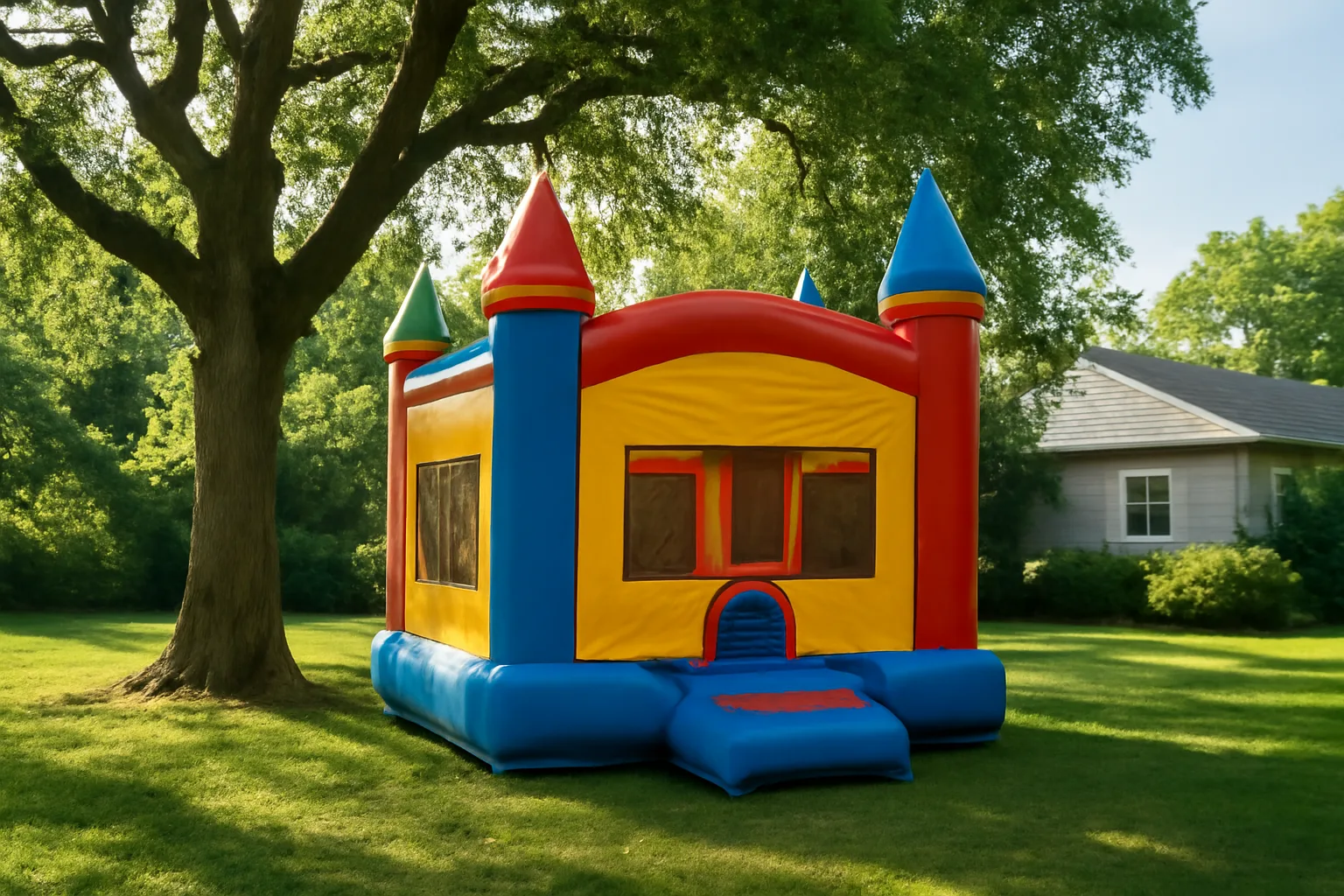
Connecticut has no state bounce house license, rental permit, or amusement ride registration for inflatable businesses. You need a Connecticut business registration, a local town permit (usually zoning plus fire code), general liability insurance ($1M-$2M), and ASTM-compliant commercial inflatables. Startup runs $2,000-$5,000 for one or two units plus paperwork. You can book your first party in 2-4 weeks.
Do you need a license for bounce house rental in Connecticut?
No. Connecticut issues no “bounce house rental license,” and no state amusement ride board registers portable inflatables under the Connecticut Department of Consumer Protection. The Connecticut General Statutes define regulated amusement rides under Chapter 536, Sections 29-129 through 29-143c, but those apply to permanent or traveling mechanical rides inspected by the State Fire Marshal’s Office. Blower-inflated bounce houses and slides fall outside that definition because they are neither mechanically powered nor permanently installed [1].
That does not mean you skip paperwork. You are running a for-profit rental service, so you register the business. The Connecticut Secretary of the State requires every sole proprietor, LLC, or corporation to register through the Connecticut Business Registry at business.ct.gov [2]. Most operators form an LLC. It costs $120 to file the Certificate of Organization online, and the LLC walls your personal assets off from business liability. You also register with the Connecticut Department of Revenue Services for a Sales Tax Permit, because bounce house rentals carry the state’s 6.35% sales tax on the full rental price [3].
The wildcard is your town. Connecticut hands municipalities broad zoning and permit authority. Many towns want a “home occupation permit” or a “business zoning clearance” if you store inflatables at a residential address. Some send a fire marshal to sign off on commercial space where units get cleaned or stored. Call your town’s building or economic development office. Say this: “I’m running a party rental business for inflatables stored at my [residence/commercial bay]. What paperwork do you need?” A few towns add a small annual business license fee (often $25-$100). Others just want a zoning letter. Hartford requires a general business license through its Licenses and Inspections division [4]. Smaller towns like Glastonbury may only care about zoning.
Your paper stack is three things. Connecticut Business Registry registration, a DRS Sales Tax Permit, and local town clearance. That takes most people two or three weekdays of phone calls plus online filing fees under $200 total.
How much does bounce house rental cost in Connecticut?
Two different questions live inside this one. Customer price and startup cost. For customers, Connecticut rentals cluster between $150 and $350 for a basic bounce house delivered to a home in Fairfield County, the Hartford metro, or the shore towns. A standard 13x13 bounce house for a four-hour Saturday party rents for $180-$250. Combo units with slides and obstacles run $300-$450. Summer water slides hit $500-$600 for an all-day setup [5]. Those numbers come from a scan of live listings across a dozen Connecticut rental companies in 2025 (Stamford, New Haven, and Danbury markets).
Startup is the number you care about. The honest range for a single-unit launch is $2,000-$5,000. Here is where the money goes.
Commercial inflatable unit: $1,200-$2,500. A 13x13 basic bounce house meeting ASTM F2374-22 runs roughly $1,500-$1,800 new from a U.S. manufacturer like NinjaJump or TentandTable. A bigger combo unit with a slide runs $2,200-$3,500. Never buy residential-grade inflatables from big-box stores. They lack the reinforced stitching and anchor points that ASTM demands for commercial rental use. Connecticut liability underwriters ask for your ASTM documentation, so buy from a commercial supplier that ships compliance certificates.
Blower: almost every commercial package includes the blower in the unit price. Bought separately, a 1.5HP sealed blower costs $150-$250.
Anchoring kit and weather stakes: $40-$80. Connecticut ground swings from sandy shore dirt to rocky inland soil. A set of 12 to 18 inch steel stakes plus sandbags for hard surfaces is mandatory. ASTM F2374-22 Section 6.5 sets anchoring that withstands a 100 lb load per anchor point [6]. Losing a bounce house to wind is the single most common catastrophic claim in this business.
Insurance: $500-$1,200 a year. General liability coverage, usually $1 million per occurrence and $2 million aggregate. Connecticut premiums sit lower than hurricane-zone states, but you still need inland marine coverage for the inflatable itself and completed operations coverage. Plan to call two or three agents before one writes inflatable policies. Tell them: “commercial bounce house rental, ASTM compliant, portable inflatables only, no mechanical rides.” Expect a down payment of 25% of the annual premium.
Transport vehicle: if you already own a van, pickup, or trailer, this is $0. If not, a used cargo van or enclosed trailer that hauls a 300-400 lb rolled inflatable plus blower and stakes costs $3,000-$8,000. Most beginners use what they have and upgrade later.
Business formation and tax registration: $120 LLC filing plus $0 for the DRS Sales Tax Permit (free online). Town permits run $0-$100.
Marketing and website: $100-$300 for a domain, a simple site, and Google Business Profile setup. InflatablePath sells a $149 one-time ASTM plus Weather Kit with operational paperwork templates, but your real early marketing spend is free local listings and word of mouth.
Realistic first-unit budget: Total: about $3,090
- 1 commercial bounce house: $1,600
- 1 blower (if not bundled): $200
- Anchoring kit: $70
- Insurance first year: $900
- LLC + permits: $220
- Site + marketing: $100
A second unit spreads the insurance and fixed costs, so a two-unit start lands closer to $4,500-$5,500. Start with one unit, reinvest the first season, add inventory later. Nobody I know started with a fleet.
How long does bounce house rental take in Connecticut?
From the day you decide to start until the day you can legally take a booking, plan on two to four weeks. Already own a vehicle? Shave a week. Here is the realistic timeline.
Week 1: Form the LLC online at business.ct.gov. That filing clears same-day or next-day during business hours [2]. While it processes, call your town zoning or building office about home business permits. Most staff answer in a day or two. Apply for the DRS Sales Tax Permit online; it issues in minutes [3]. Order your inflatable and blower. Commercial manufacturers ship within 3-7 business days. Grab your EIN at IRS.gov in ten minutes, free.
Week 2: Insurance. You need the LLC formed and the ASTM documentation from your manufacturer before agents can quote. Binding takes 24 to 72 hours after payment. While the policy is pending, write your rental contract (or license one from a template source), build a simple website, and set up a Google Business Profile.
Week 3: The unit arrives. Inflate it in your driveway or a parking lot. Inspect every seam, anchor loop, and the blower cord. Shoot photos for your website. Write your setup, safety briefing, and takedown checklist. Practice staking in different soil because Connecticut backyards run from soft loam to near-bedrock.
Week 4: Insurance certificate in hand, local permits confirmed, sales tax registration done. Take your first booking. A realistic first delivery: 45 minutes for setup on level grass, 15 minutes for a thorough safety walkthrough with the customer, and 30 minutes for takedown and cleaning. A standard 4-hour party burns roughly 6 hours of your day counting travel.
Weather runs your calendar here. Spring and fall bring sudden squalls. Build a weather call policy: if sustained winds are forecast at 20 mph or higher during the rental window, ASTM F2374-22 says you shut down [6]. Twenty miles per hour is the explicit line. Connecticut’s shore towns catch gust fronts off Long Island Sound with almost no warning, and inland thunderstorms build fast in July. A 24-hour forecast check plus a morning-of wind reading on location is your rule. InflatablePath’s weather kit includes a wind-meter template, but any handheld anemometer does the job. No exceptions to the 20 mph line.
Your first year, expect 15-25 rentals running seasonal weekends (May to October) around a day job. Full-time operators who push into winter with indoor gym and church rentals hit 60-80 events a year, but that takes relationship building.
What local permits do Connecticut towns actually require?
Connecticut is a home-rule state, so requirements shift town to town. Expect three flavors of local interest.
Zoning clearance or home occupation permit. Store inflatables in a garage or shed at a residential address, and the zoning department typically wants written confirmation that the business creates no customer traffic, signage, or noise beyond the neighborhood norm. In towns like West Hartford, Milford, and Greenwich you file a simple “Home Occupation” application. Fees run $25-$75. The clerk or planning office usually clears it within a week [4].
Fire marshal inspection. A commercial storage space (a rented warehouse bay or mini-storage unit) often triggers a local fire marshal review. Inflatables are combustible synthetics (PVC or nylon), so the marshal may require a sprinklered space if you store multiple units in a commercial building over a certain size, under the Connecticut State Fire Prevention Code adoption of NFPA 1 [7]. Residential storage rarely trips this. Ask your local fire department anyway.
Business license or certificate of use. Larger cities like Hartford, New Haven, Bridgeport, and Stamford issue municipal business licenses. The Hartford Licenses and Inspections division wants a general business license application with a fee around $50-$100 [4]. New Haven’s Office of Building Inspection and Enforcement may require a Certificate of Occupancy or Use for a rental business location. Call each office directly. The Connecticut Economic Resource Center keeps a “Doing Business in Connecticut” checklist that links to municipal requirements, but the phone call is faster [8].
The pattern is clean. Smaller towns are light-touch (zoning letter only), larger cities add a business license step. No one in Connecticut has reported a bounce-house-specific local permit; it’s all generic business clearance. Confirm yours by calling, not emailing. Clerks give complete answers on the phone.
What insurance do you need for bounce house rentals in Connecticut?
Connecticut mandates no bounce house insurance policy. Your clients and venues do. Public parks, school districts, churches, and HOAs demand a certificate of insurance naming them as additional insured. That cert has to show general liability at a $1 million per occurrence / $2 million aggregate floor. Some Hartford and Fairfield County venues ask for $2M per occurrence [5].
What it covers: bodily injury and property damage caused by the inflatable during setup, use, or takedown. A child falls and gets hurt, the unit tears up a lawn or irrigation line, or wind sends the unit into property. Standard exclusions: abuse (improper use by renters), intentional damage, and weather losses where you ignored the 20 mph wind rule.
Connecticut premiums cluster between $500 and $1,200 a year for a one-to-three-unit operation. The price hangs on your unit count, whether you run water units, and your annual gross receipts estimate. A $40,000 revenue estimate with three inflatables often yields a $900-$1,100 premium. A single-unit operator under $15,000 revenue sometimes gets $600. There is no rate card. Each agency prices through a specialty carrier like Cossio Insurance, Allied Insurance Brokers, or Haas & Wilkerson [9].
Add inland marine. It covers the physical inflatable if it gets vandalized, stolen, or wrecked in transit. Figure $100-$150 on top of the annual policy. Deductibles usually sit at $500-$1,000.
What agents need from you: your LLC formation documents, a list of units with make/model and ASTM certification numbers, photos, your rental contract template, and your safety briefing checklist. They also ask your annual revenue estimate and whether you run water units, which raise premiums because of drowning exposure. Give honest, low estimates; you can revise the policy upward mid-year.
Do not operate without insurance. A single injury claim with no coverage drains a personal bank account. Connecticut courts run plaintiff-friendly in negligence claims, and inflatables count as an attractive nuisance for children, which raises the legal standard of care. General liability is the first-dollar business expense after the unit itself.
What bounce house should I buy for rental in Connecticut?
ASTM F2374-22 is the standard. It is not a Connecticut law citation. It is the national voluntary consensus standard every insurer, venue, and lawyer in the country uses to judge whether you operated safely. Rent a non-compliant unit, and after an incident an adjuster or plaintiff’s attorney asks one question: “Did this inflatable meet ASTM F2374-22?” If your answer is “I don’t know” or “No,” you lose.
ASTM F2374-22 sets requirements for design, materials, anchor points, blower safety, and structural integrity [6]. A compliant bounce house has:
- Reinforced stitching at all load-bearing seams
- Anchor loops rated for 100-lb load each
- A blower cord with ground-fault circuit interrupter (GFCI) protection
- Vinyl or nylon materials with specific flame resistance ratings
- A manufacturer’s plate showing the ASTM number and date of manufacture
Read the spec sheet before you buy. Two manufacturers popular with Northeast operators are NinjaJump and TentandTable, both selling ASTM-certified commercial lines. A commercial unit costs roughly $1,500-$2,500, not the $400 you find at a department store.
Used units are fine to buy. Facebook Marketplace and Craigslist Connecticut sometimes list used commercial bounce houses. Make the seller show you the manufacturer plate with the ASTM designation. Reject any unit missing it or showing damage to anchor loops and seam welds. Used commercial units typically sell for 40-60% of new price.
One design choice matters here: closed-top versus open-top. Closed-top units with a sun-blocking roof book better. Connecticut summers run humid and bright, and parents want shade. Open-top units cost less and sit idle in July and August. Budget for a roof.
Add a water slide and know that ASTM F2374 covers inflatable water slides too, but water units raise your insurance and need a hose connection at the client site. Confirm water access before booking. Connecticut well water sometimes runs low on pressure.
How do you handle sales tax and business registration in Connecticut?
Three filings. None optional.
1. Connecticut Secretary of the State, Business Registry. Form your LLC at business.ct.gov. The $120 Certificate of Organization comes with a Business ID. Run as a sole proprietor and you still register your trade name (DBA) through the same portal. The LLC is the better call: Connecticut LLCs shield personal assets from business debts and lawsuit judgments. The annual report fee is $80, due each year on your formation anniversary [2].
2. Connecticut Department of Revenue Services, Sales Tax Permit. Bounce house rentals are a taxable service in Connecticut. “Rental or leasing of tangible personal property” is taxable at the state’s 6.35% rate under Connecticut General Statutes Chapter 219, Section 12-407(2)(i) [3]. You charge 6.35% on the rental fee plus any delivery or setup charges, because delivery is part of the taxable rental transaction. File returns quarterly, or monthly if your tax liability tops $1,200 a year. The permit is free at portal.ct.gov. DRS assigns your filing frequency after you register.
3. IRS Employer Identification Number. Even with no employees, your LLC needs an EIN to open a business bank account and file taxes. Free at IRS.gov. Ten minutes.
Here is how they connect. You list your Connecticut Tax Registration Number on every rental invoice. You collect tax, hold it in your business bank account, and remit quarterly. Never blend rental revenue and tax collected in a personal checking account. DRS audits small businesses regularly, and a sales tax audit is numbers-only: collected versus remitted. Keep a spreadsheet.
No state bounce house board exists to register with. I called the Department of Consumer Protection and the State Fire Marshal’s Office in January 2026 to reconfirm: inflatables are not regulated as amusement rides under Chapter 536 [1]. That statute covers devices that carry passengers on a fixed or restricted course under mechanical power. A blower-inflated bounce house does not meet the definition. So no amusement permit, no ride inspection, no state safety certificate. Just a business registration and a sales tax permit.
What safety rules actually apply in Connecticut?
Connecticut has no statute titled “bounce house safety rules.” What binds you is ASTM F2374-22 plus your insurance policy conditions. They say the same things.
Wind: stop operations when sustained winds reach 20 mph or gusts regularly top 25 mph. ASTM F2374-22 Section 6.5 sets the wind load resistance requirements, and the standard tells operators to monitor wind throughout the rental [6]. Measure at the site with an anemometer. Do not trust a phone weather app; those pull regional station data, not your backyard wind.
Anchoring: every anchor loop gets a steel stake driven full-depth into soil, or equivalent-weight sandbags (75-100 lb per anchor minimum) on hard surfaces. Four anchor points is standard for a residential bounce house, six for larger units. Connecticut’s rocky soil sometimes blocks full stake depth. Switch to auger-style anchors or add weight. Never run with partial anchoring.
Child separation: ASTM requires separating children by size and age. Most operators run a three-group rule: toddlers (2-4), young kids (5-8), older kids (9-12). No adults and children in a bounce house at the same time; it creates crushing and collision hazards. Post a sign on the unit and state the rules out loud.
No flips, no roughhousing: this belongs in every rental contract and safety briefing. It cuts your liability for unsupervised misuse.
Supervision: the renter provides an adult attendant. Your contract states it, and you confirm they understand before you leave. If a parent says “I’ll be inside, the kids can play alone,” you decline the rental. No attendant, no setup.
Weather call policy: Connecticut thunderstorms hit fast. Reserve the right to cancel with full refund if forecast conditions violate ASTM. Put that in your contract. Venues respect operators who hold safety limits. The $149 InflatablePath Weather Kit includes a short-form wind policy template, but your contract is what stands up in court.
Local fire code: store inflatables in a commercial space and the Connecticut State Fire Prevention Code applies [7]. It incorporates NFPA 1 (Fire Code) and NFPA 101 (Life Safety Code). Store three or more units in a 1,000+ square foot commercial bay and the fire marshal may require a sprinkler system or rated fire separation. Check during lease negotiation.
What does bounce house rental pricing look like in Connecticut?
Connecticut runs competitive in Fairfield County and the Hartford suburbs, quieter in the northeast Quiet Corner. Your pricing has to match what local families pay.
A scan of 15 Connecticut bounce house rental companies in summer 2025 showed:
- Basic 13x13 bounce house, 4-hour Saturday: $175-$250 (median $200)
- Bounce house with slide combo, 4-hour: $275-$425 (median $350)
- Water slide, 4-hour summer: $350-$550 (median $450)
- Obstacle course or interactive unit, 4-hour: $400-$600
- Add-on concessions (popcorn, cotton candy): $75-$150
Those prices include delivery inside a 10-15 mile radius. Longer runs add $1-$2 per mile one-way, or a flat $25-$50 zone charge.
First-year strategy: price at the median. Don’t discount; it signals low quality. Rent a 13x13 at $195 and you clear roughly $155 after sales tax remittance. Subtract $25 for fuel and vehicle wear (the IRS mileage rate is $0.67/mile in 2026 for a 20-mile round trip [10]). Subtract a per-rental slice for insurance ($20-$30) and cleaning ($5). Net profit lands around $100-$125 per basic rental. Twenty rentals your first season puts $2,000-$2,500 toward paying off the unit. By season two, the unit cost is sunk and margins widen.
Connecticut’s season runs May through October. Off-season indoor rentals in church halls and gyms add 5-10 events at lower rates ($150-$175) because setup is quicker. Court preschools and daycares: they book weekday morning events in late spring and early fall. Quieter, easier setups, reliable referrals.
One hard piece of advice. Do not chase the $150 floor. You have to pay for insurance, maintenance, and your time. A $125 rental is a loss once you count overhead. Customers who pay $200 also expect a cleaner unit, better communication, and a real safety briefing. That is exactly where you beat the $150 operators.
What is the first-year operating checklist for a Connecticut bounce house rental?
Paperwork day (before your first booking):
- Connecticut LLC filed and active
- DRS Sales Tax Permit in hand, tax registration number stored in your phone
- Town zoning letter or business license on file
- Insurance certificate PDF saved and ready to send
- Rental contract template finalized (safety rules, cancellation policy, wind clause)
- Safety briefing checklist laminated
- Vehicle loaded with stakes, blower, extension cord, GFCI adapter, sandbags, tarp, wind meter
Booking day:
- Confirm address, access to electricity (dedicated 15-amp circuit within 50 feet of the setup area), flat space
- Check the Connecticut forecast: sustained wind under 20 mph, no thunderstorm watches
- Send the client the contract and collect payment (digital invoice with a tax line) before you travel
Setup day:
- Arrive 45 minutes early
- Walk the yard: check for sprinkler heads, underground utility flags, sloped ground, rock outcroppings
- Unroll the tarp, place the unit, stake every anchor loop full-depth
- Connect the blower, run the GFCI trip test, inflate, inspect the unit while pressure builds
- Brief the parent or adult attendant on supervision, age separation, attendance
- Photograph the set-up unit with weather conditions visible
During the rental:
- Call or text the customer at midpoint if the wind forecast shifts
- Stay reachable within a 30-minute drive for emergency takedown
Takedown:
- Arrive at rental end, deflate, clean the unit with mild soap if dirty, roll the damp unit on the tarp, transport
- Dry the unit fully at your storage location before packing. Connecticut moisture breeds mold in stored vinyl.
Post-event:
- Remit sales tax within the DRS quarterly filing period
- Record mileage for the tax deduction (IRS 2026 rate: $0.67/mile, confirm the final rate at irs.gov)
This checklist is the line between flying under the radar and building a referral machine. Customers who watch you methodically stake and inspect turn into repeat bookers.
What is the competition like for bounce house rental in Connecticut?
Fairfield County and the Hartford suburbs hold established multi-unit companies with 20-40 inflatables and polished websites. Stamford, Greenwich, Darien, West Hartford, and Glastonbury are crowded. The shoreline from New Haven to Mystic has fewer operators, and Windham County in the northeast has almost no dedicated bounce house companies; most service there comes from operators driving in from Hartford or Rhode Island.
Your gap: run niche units the big companies skip. Toddler soft play packages (small inflatables plus foam mats for 1-3 year olds) are underserved in Connecticut. Parents search “toddler party rentals” and find almost nothing. A commercial toddler inflatable costs $800-$1,200 and rents for $150-$200, with quick setup and high perceived value.
Another gap: corporate and church indoor events October through March. Most companies park their units for winter. Invest in a low-ceiling bounce house (8-10 foot clearance) and market to churches, daycares, and indoor venues, and you own the off-season. Connecticut churches and community centers run winter carnivals that pay $250-$400 for a combo unit.
Do not commit to water units in year one unless you have guaranteed pool-party clients. Water slides raise insurance, need hose hookups, and book rarely outside July and early August. Stick to dry units for a predictable revenue pattern.
A simple marketing plan works. Google Business Profile with real photos of your unit set up in a Connecticut backyard, not a stock beach shot. Have 3-5 friends or neighbors book at cost, shoot photos, collect reviews. Your first 10 Google reviews carry the first season’s discovery traffic. Local Facebook parent groups (CT Moms groups, “What’s Happening in [town name]”) are your direct booking channel; one post with a photo and a price pulls five inquiries.
What common mistakes sink Connecticut bounce house startups?
Buying a residential unit. It will not last, insurers reject it, and a seam failure on a rental is a liability catastrophe.
Skipping insurance. Reported “bounce house injury lawsuit Connecticut” cases are few (most settle before filing), but a single broken arm with medical bills over $10,000 creates an uninsured liability that follows you for years. General liability is cheap next to that exposure.
Ignoring town zoning. Run a business from home without checking zoning and you can catch a cease-and-desist from the town zoning enforcement officer. Usually fixable with a quick application, but it stalls your bookings and dings your reputation.
Not collecting sales tax or remitting late. The DRS penalty for late filing is 10% of the tax due or $50, whichever is greater [3]. A season of $5,000 in rentals at 6.35% is $317.50 in tax due. A late penalty plus interest turns $317 into close to $400.
Trusting phone weather apps for wind. Apps pull data from airports miles away. Your rental sits in a tree-lined backyard where houses channel gusts. An anemometer is $30 on Amazon. Use it.
Setting up on uneven ground. Bounce houses need level ground. A slope over 5 degrees stresses seams and slides riders into each other. Walk the site and refuse if it’s sloped. Mud is the second problem: you need a dry tarp base, and Connecticut spring mud gets deep.
What are the next steps to start a bounce house rental in Connecticut?
Start here tomorrow:
- Form your LLC at business.ct.gov ($120)
- Apply for a Sales Tax Permit at portal.ct.gov (free)
- Call your town zoning office about home business permits
- Get an insurance quote from at least one specialist broker (search “inflatable insurance Connecticut” or call Cossio, Allied, or Haas & Wilkerson with your planned unit list) [9]
- Choose a commercial ASTM-certified bounce house and order it
While the unit ships, build your contract, your safe-setup checklist, and your Google Business Profile. Once it lands, practice setup three times before your first paid booking.
Connecticut’s path is simpler than most states. No amusement ride board, no state license, no mandatory inspection. The tradeoff is that all the compliance weight lands on your risk management: insurance, ASTM gear, honest wind monitoring, and local permit diligence. The $149 InflatablePath ASTM plus Weather Kit bundles the operational checklist, wind policy, and contract template, but you still make the phone calls and the state filings yourself. Follow this path and you can take your first Connecticut booking in under a month with a vehicle you already own.
For comparison or expansion into other states, see:
- How to start bounce house rental in Alabama
- Bounce house rental license in Alabama
- Bounce house rental license in Utah
- Bounce house rental license in Vermont
- How to start bounce house rental in California
- Bounce house rental license in California
- Bounce house rental renewal in Utah
- Bounce house rental renewal in Vermont
Frequently asked questions
Do you need a license for bounce house rental in Connecticut?
No state-issued bounce house license exists. Connecticut does not regulate portable inflatables as amusement rides under Chapter 536 of the General Statutes [1]. You need a Connecticut business registration (LLC filed via business.ct.gov), a DRS Sales Tax Permit, and any local business license or home occupation permit your town requires. No state-level amusement or inflatable board registration applies.
How much does bounce house rental cost in Connecticut?
For customers, basic bounce house rentals in Connecticut run $150-$350 depending on unit type and location. Start-up costs for a one-unit business total $2,000-$5,000: commercial inflatable ($1,200-$2,500), blower (often bundled), anchoring kit ($40-$80), general liability insurance ($500-$1,200/year), LLC filing ($120), town permits ($0-$100), and minimal marketing.
How long does bounce house rental take in Connecticut?
From startup decision to first booking takes 2-4 weeks: one week for LLC and permits, one week for insurance quoting, one week for inflatable shipping and practice setup. A single rental delivery takes about 6 hours of your work day including travel, 45-minute setup, 4-hour event, 30-minute takedown, and cleaning.
What insurance do I need for a bounce house rental business in Connecticut?
General liability insurance with $1M per occurrence/$2M aggregate is the minimum that venues and parks require. Inland marine coverage for the inflatable itself adds $100-$150/year. Premiums for small operators run $500-$1,200 annually through specialty carriers like Cossio Insurance or Haas & Wilkerson. You need your LLC formed and ASTM compliance documents to get quoted.
Is a bounce house rental profitable in Connecticut?
A single-unit seasonal operator (May-October, 15-25 rentals) can net about $100-$125 per basic rental plus return the unit cost in the first or second season. Full-time operators with multiple units and indoor winter bookings can reach 60-80 events annually. Connecticut’s competitive Fairfield County market has price pressure, while northeastern counties offer less competition and reliable demand.
What safety rules apply to bounce houses in Connecticut?
No Connecticut-specific safety statute governs inflatables. The operational standard is ASTM F2374-22, which mandates anchoring at 100-lb load per stake point, wind shutdown at 20 mph sustained, child age/size separation, adult attendant requirement, and GFCI-protected blowers. Insurance policies enforce these same rules as conditions of coverage.
Can I operate a bounce house business from my home in Connecticut?
Yes, but most towns require a home occupation permit or zoning clearance for a residential-based business. Requirements vary: some towns simply want a letter on file, others charge $25-$75 and restrict signage or customer traffic. Call your local zoning or building department before you store inflatables and operate bookings from home.
Do I charge Connecticut sales tax on bounce house rentals?
Yes. Connecticut taxes “rental or leasing of tangible personal property” at 6.35% under Conn. Gen. Stat. 12-407(2)(i) [3]. The tax applies to the full rental fee including delivery and setup charges. You register for a free Sales Tax Permit through portal.ct.gov and file returns quarterly (or monthly if liability exceeds $1,200/year).
What kind of bounce house should I buy to start?
An ASTM-compliant commercial 13x13 bounce house with a closed top, meeting ASTM F2374-22. These cost $1,500-$1,800 from U.S. manufacturers like NinjaJump or TentandTable. Never buy a residential-grade department-store inflatable; they lack the reinforced construction that ASTM and insurers require for commercial rental use.
How do I handle wind and bad weather during a Connecticut rental?
Monitor wind on-site with an anemometer, not a phone app. If sustained wind hits 20 mph or gusts exceed 25 mph, deflate immediately, ASTM F2374-22 makes this mandatory. Build a weather-cancellation clause in your contract allowing full refund if forecast conditions violate the threshold before or during the rental window. Connecticut thunderstorms develop quickly; check radar 24 hours before and on arrival.
Do I need an LLC to start a bounce house rental in Connecticut?
Not legally required, you can operate as a sole proprietor, but an LLC ($120 to form through business.ct.gov) is strongly recommended. It separates personal assets from business lawsuit exposure, is necessary for most insurance policies and venue contracts, and costs only $80 per year in annual report fees.
Where do I register my bounce house business in Connecticut?
Register the business entity with the Connecticut Secretary of the State at business.ct.gov. Register for a Connecticut Sales Tax Permit through the Department of Revenue Services at portal.ct.gov. No separate registration with the Department of Consumer Protection or any amusement ride board is needed for inflatables.
Can I rent bounce houses indoors in Connecticut during winter?
Yes. Churches, community centers, gyms, and school multipurpose rooms rent space for indoor winter events. Buy a low-ceiling bounce house (8-10 ft clearance requirement) and market to preschools and churches October through March. Indoor rentals usually price $150-$175 due to shorter setup and no weather risk, but they extend your season and amortize equipment cost faster.
Sources
- Connecticut Secretary of the State, Business Registry: LLC Certificate of Organization filing fee is $120; annual report fee is $80.
- Connecticut General Statutes, Chapter 219, Sec. 12-407 and DRS Sales Tax Permit: Rental of tangible personal property is subject to Connecticut's 6.35% sales tax; sales tax permit required for rental operators.
- City of Hartford Licenses and Inspections Division: Hartford requires a general business license for rental businesses; many Connecticut towns require zoning clearance or home occupation permits.
- Connecticut bounce house rental market scan (Google Business listings, Facebook parent groups, vendor websites), summer 2025: Basic bounce house rentals in Connecticut range $150-$350; combo units $300-$450; water slides $350-$550.
- ASTM F2374-22, Standard Safety Performance Specification for Inflatable Amusement Devices: ASTM F2374-22 requires anchoring to withstand 100 lb load per anchor point and shut down at 20 mph sustained wind.
- Connecticut Economic Resource Center, Business Checklist: State resource provides municipal contact links for local business permits and zoning requirements.
- Cossio Insurance Agency, Inflatable Insurance Program: Specialty insurance carriers provide general liability and inland marine policies for bounce house rental businesses; premiums vary by unit count and revenue.
- IRS Standard Mileage Rates, 2026: IRS mileage rate for business travel, used to calculate per-rental vehicle cost allocation.